


Fantasy football is not a game of pure luck. If it were, rookie players walking into a draft room blind wouldn’t consistently get chewed up by seasoned veterans who harvest championships year after year. Winning a fantasy football league requires a blend of probability, asset management, psychological warfare, and ruthless discipline.
Too many managers draft a team in August, check out by October, and wonder why they are paying for their league’s last-place trophy by December. Dominating your league means treating your roster like an active portfolio—optimizing value on the waiver wire, leveraging trade psychology, and building for the single-elimination playoff bracket from day one.
This masterclass walks you through every phase of the fantasy football calendar, engineered to give you an unyielding competitive edge.
1. Decoding the Rules & League Economy (Pre-Draft Fundamentals)
Before you even look at a player ranking sheet, you must master the governing laws of your specific league. Ignoring league settings is the fastest way to blow a draft.
Mapping the Scoring Matrix
- Standard vs. Half-PPR vs. Full PPR: Scoring changes everything. In a standard league, early-down workhorse running backs who punch in touchdowns are king. In full PPR (Points Per Reception), high-volume pass-catching slot receivers and pass-catching backs skyrocket in value because a 5-yard catch is worth half as much as a 10-yard run.
- Custom League Settings & Roster Construction: Pay close attention to unique modifiers like TE-Premium, Superflex, or 2-QB leagues, and starting slot requirements. Before building your draft board, make sure you understand how many of each position for fantasy football your specific league rules mandate so you never get caught scrambling for backups.
Understanding the League Economy (FAAB vs. Waiver Priority)
How your league handles player acquisitions dictates your entire strategy:
- FAAB (Free Agent Acquisition Budget): A blind-bidding budget system where every manager gets a fixed dollar amount (e.g., $100) for the season. This is the gold standard of competitive fairness. Saving your FAAB for mid-season injuries to acquire league-winning waiver wire goldmines separates amateurs from champions.
- Waiver Priority Order: A rolling list based on standings (worst record gets first priority) or inverse standings reset weekly. In these formats, burning your waiver claim too early on a flash-in-the-pan player can leave you empty-handed when a true season-altering injury replacement emerges.
2. Modern Draft Philosophies—Choosing Your Weapon
Draft day sets your baseline floor and ceiling. Adopting a cohesive draft strategy prevents you from reaching for players out of panic. To help formulate your baseline targets before draft day, bookmark a reliable the ultimate fantasy football cheat sheet to keep your tiers organized.
- Robust RB (The Traditional Bully): You lock down heavy-workload, bell-cow running backs in the first three rounds. The goal is to corner the market on scarce high-touch positions while your opponents scramble for depth later.
- Hero RB / Anchor RB: You draft one elite, locked-in running back early (your “anchor”) and then pivot aggressively to elite wide receiver depth and high-upside value in the middle rounds. This balances safety with high-ceiling pass-catchers.
- Zero RB / Modified Zero RB: You completely fade running backs in the early rounds, loading up on elite wide receiver tiers and elite tight ends. You bank on early-season running back injuries creating high-value backup breakouts on the waiver wire, protecting your roster from early-round bust risk.
- Late-Round QB & Elite TE Strategy: Opportunity-cost analysis dictates that unless you are securing a genuine positional advantage (like an elite tight end who outscores the replacement tier by massive margins), waiting on quarterbacks and streaming or finding value late maximizes your overall team capital.
3. Round-by-Round Blueprint & Positional Scarcity
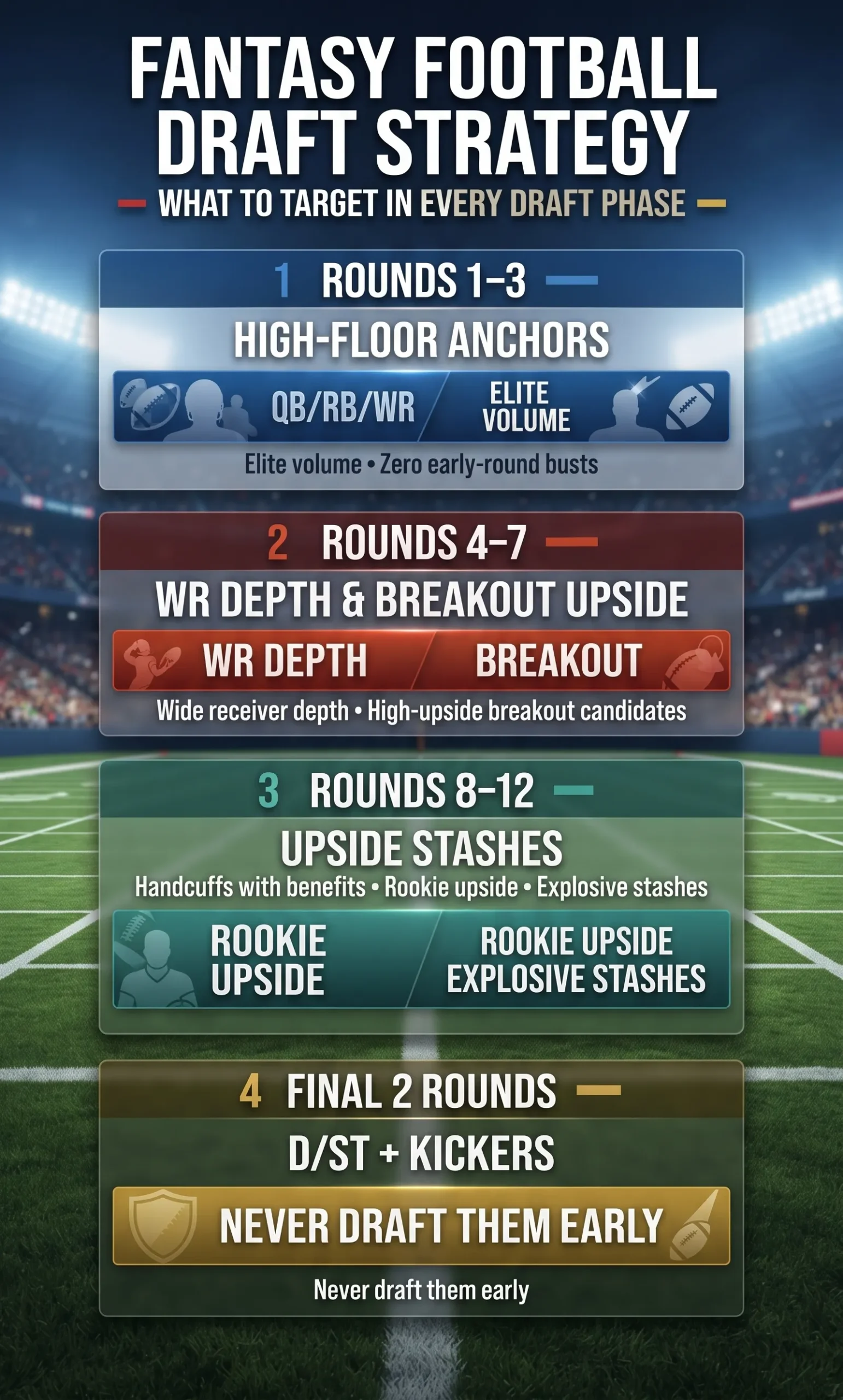
Rounds 1-3 (The Foundation)
Draft for floor, not ceiling. Your early picks shouldn’t win you the league, but they can lose it if they bust or get hurt. Avoid reaching for players coming off major injuries or ambiguous offensive schemes unless the draft discount is undeniable. When evaluating the top tier of talent, monitor the real-world top 10 running backs in the NFL to gauge true offensive volume and talent transitions.
Rounds 4-7 (The Value Mid-Tier)
This phase is where drafts are won or lost. Navigating the wide receiver tiers here requires looking at target share data, coaching changes, and offensive pace. Target pass-catchers on teams projected for negative game scripts (teams that will be trailing and throwing often).
Rounds 8-12 (The Upside Zone)
Stop drafting safety here. Look for explosive athletic upside: rookie wide receivers with late-season breakout profiles, backup running backs tied to fragile starters (explore high-upside targets via fantasy football running backs), and explosive playmakers. Keep an eye out for underrated NFL players whose ADP (Average Draft Position) fails to reflect their true expected snap counts.
The Final Rounds
Strict rule: Never draft a Kicker or Defense (D/ST) before the final two rounds. Their weekly scoring variance is too flat compared to the lottery-ticket running backs and wide receivers you could be stashing on your bench.
4. In-Season Management & The Waiver Wire Warfare
The draft is only 30% of the battle. The remaining 70% is executed between September and December on the waiver wire.
- Mastering Waiver Wire Tuesday: Do not wait for Wednesday morning summaries. Study snap counts, target shares, and red-zone usage as soon as Sunday games conclude. Predictive bidding on ascending players before the mainstream fantasy media highlights them is how you find league winners. For continuous monitoring, consult curated guides covering the best fantasy football advice websites to cross-reference expert metrics.
- Roster Hygiene & Bench Optimization: Stop hoarding unplayable clutter. If a bench player has zero path to starting consideration and isn’t a high-upside injury handcuff, churn them. Keep your final roster spots fluid to cycle through high-upside lottery tickets.
- Streaming Defenses and Kickers: Spend zero draft capital on D/ST or Kickers. Instead, stream them weekly by targeting weak offensive lines, rookie quarterbacks making their first road starts, and dome games with high implied totals.
5. The Masterclass in Trading (How to Rob Your Friends Legally)
Trading is psychological warfare wrapped in football analytics. Most managers fail at trading because they try to “win” every deal by swindling their league mates. Successful traders focus on mutual roster construction improvement.
As you approach the pivotal fantasy football trade deadline, your strategy must pivot from depth accumulation to starting-lineup maximization.
Advanced Trade Frameworks
- The 2-for-1 Consolidation Play: Take two solid starting players from your bench and package them for a single, elite, top-tier stud. In fantasy football, starting lineups win matchups, not bench depth. Consolidating assets upgrades your weekly ceiling.
- The Buy-Low Window: Capitalize on early-season schedule anomalies, slow starts, or owner panic. If an elite player has underperformed for three consecutive weeks due to a brutal defensive stretch or uncharacteristic touchdown regression, buy them before their schedule softens.
- The Handcuff Leverage Play: If your league mate owns an elite, injury-prone running back, acquire his direct backup (handcuff) and leverage that insurance piece in a larger trade to extract maximum value.
6. Navigating the Injury Minefield & Bye-Week Collisions
Attrition defines fantasy football. How your roster handles adversity determines whether you survive November.
- Managing Structural Losses: When a first-round player goes down for the season, do not panic-trade your remaining assets at 50 cents on the dollar. Shift your team identity into a committee approach, relying on high-volume waiver targets and efficient floor plays.
- The Bye-Week Matrix: Pre-plan your roster architecture during the draft or early September so you don’t take forced zeros during heavy bye weeks (typically Weeks 6 through 14). Sacrifice minor bench depth early if it means securing a clean replacement starter for a critical week.
7. The Playoff Push and Championship Execution
Regular-season dominance means nothing if you choke in the single-elimination fantasy playoffs.
- The Stash Horizon (Weeks 10-11): Begin dropping low-tier developmental bench depth to hoard defenses and running backs with elite, favorable matchups during Weeks 15 through 17.
- Shifting Strategy from Consistency to Ceiling: In September and October, you want high-floor consistency. In December playoff games, floor doesn’t matter—you need explosive, home-run boom/bust upside to outscore opponent explosions in single-elimination formats. For a concise breakdown of winning habits, review these core tips to build a championship fantasy football team.
Conclusion
Perennial fantasy champions share three core traits: relentless research, emotional detachment, and disciplined adaptability. Trust your draft process, stay aggressive on the waiver wire, and never stop working the trade market.
What is your biggest draft strategy debate this year, or what pick position are you dreading the most? Drop a comment below and let’s discuss your path to the championship.