


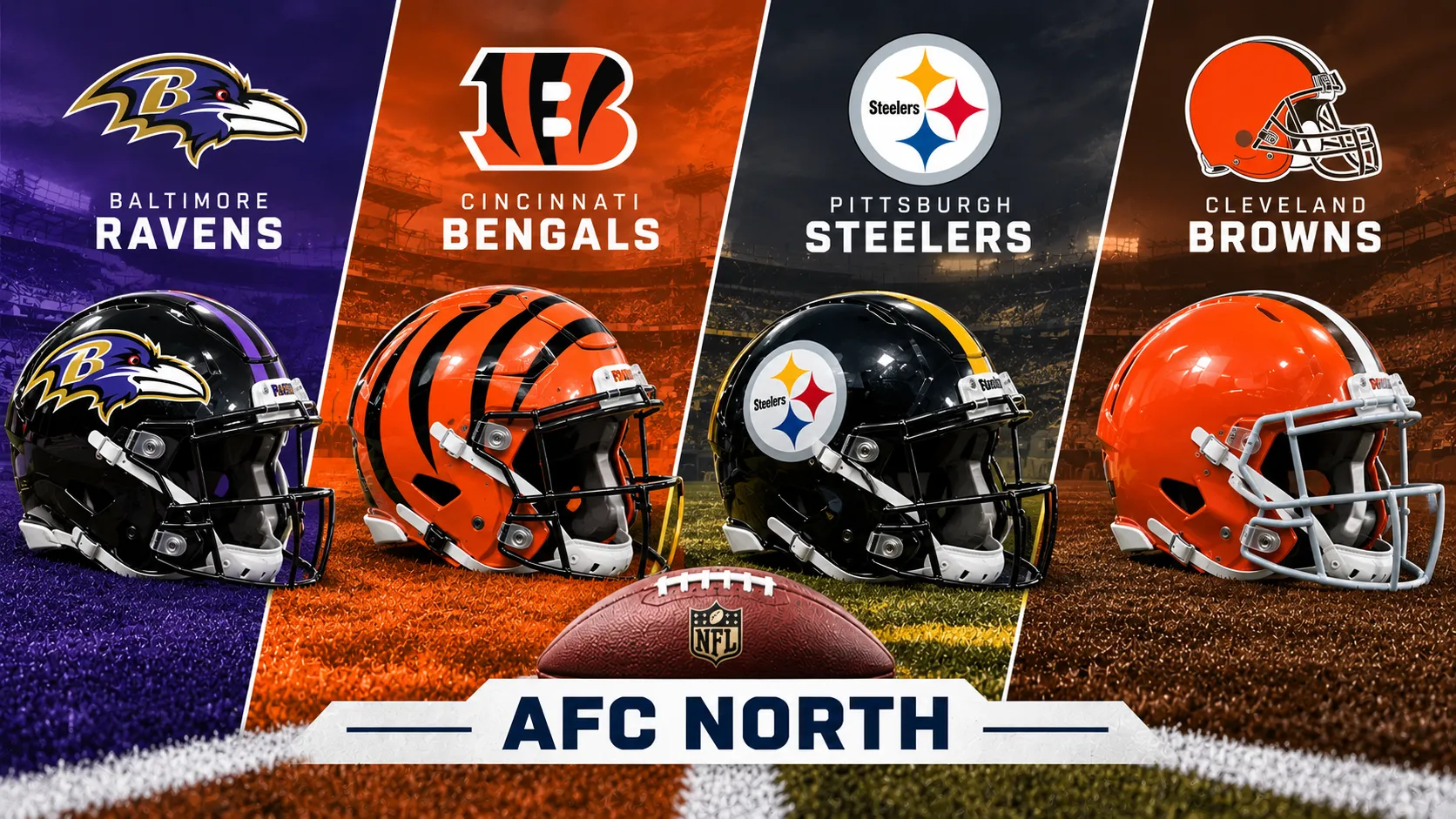
NFL parity is engineered through strict scheduling and a hard salary cap. However, the NFL AFC North remains an uncompromising arena of physical attrition and trench warfare. Established during the 2002 league realignment from the historic AFC Central, the division remains a weather-hardened outlier. For example, every member franchise battles in open-air stadiums across contiguous state borders. Freezing late-season temperatures consistently neutralize perimeter speed and finesse passing concepts. Consequently, line-of-scrimmage leverage and defensive execution dictate movement across the broader AFC standings.
You can map every franchise across the wider league footprint through our NFL teams alphabetical list. Nevertheless, the North demands its own distinct football framework. When evaluating the AFC North teams, the roster reveals four historically entrenched organizational cultures. Specifically, the division features the Baltimore Ravens, Cincinnati Bengals, Cleveland Browns, and Pittsburgh Steelers. Over three decades of modern cap mechanics, each front office has deployed contrasting roster architectures. Yet beneath those divergent balance sheets, every team submits to the same unyielding reality. In this corridor, finesse football is an immediate liability.
The Four AFC North Franchises: Roster Mechanics and Team DNA
Mastering the division requires examining how front offices construct depth charts and manage cash spending against cap constraints. In particular, schemes must withstand brutal winter conditions where perimeter finesse inevitably stalls.
Baltimore Ravens: Analytics, Draft Capital, and Power Run Heavyweight
- Established: 1996
- Home Venue: M&T Bank Stadium (Baltimore, MD)
- Championship Record: 2 Super Bowl Championships (XXXV, XLVII)
- Head Coach: Jesse Minter
- Signature Identity: Ball-control rushing efficiency, defensive disguises, compensatory pick maximization
The Ravens operate with exceptional institutional discipline among all AFC teams. First, Hall of Fame general manager Ozzie Newsome constructed this sustainable model. Later, general manager Eric DeCosta maintained that identical operational standard. In addition, Baltimore treats the compensatory draft pick formula as an essential roster-building engine. Rather than overspending on mid-tier free agents, the front office routinely lets departing veterans walk. Consequently, they accumulate valuable mid-round draft capital. They then deploy these assets to replenish defensive depth and reinforce offensive line trenches.
From a tactical perspective, Baltimore pairs advanced analytics with power rushing dominance. For example, the offensive scheme weaponizes dynamic quarterback leverage alongside heavy multi-tight-end packages. At the same time, Baltimore commits premier cap resources to its interior front. Even after signing major franchise quarterback commitments, the front office preserves its inside-out roster structure. Under head coach Jesse Minter, Baltimore continues to rotate complex pre-snap defensive disguises. As a result, the Ravens consistently control the upper tier of the AFC North standings.
Cincinnati Bengals: Vertical Explosiveness and Offensive Precision
- Established: 1968
- Home Venue: Paycor Stadium (Cincinnati, OH)
- Championship Record: 3 AFC Championships (1981, 1988, 2021); 0 Super Bowl Titles
- Head Coach: Zac Taylor
- Signature Identity: Boundary route precision, high-efficiency passing attacks, front-loaded contract cash flow
In contrast, Cincinnati serves as the division’s offensive counterweight. Team president Mike Brown and director of player personnel Duke Tobin run a focused, family-directed front office. Therefore, the Bengals lean heavily on premium draft capital to secure generational playmakers. Under head coach Zac Taylor, Cincinnati reached Super Bowl LVI. Across franchise history, Cincinnati has captured three conference crowns. However, securing that elusive first Lombardi Trophy remains the organization’s defining championship hurdle.
Historically, the Bengals anchor their offensive identity around elite pocket passers and vertical boundary receivers. In contract construction, many NFL front offices lean on rolling restructures and void years to delay financial impacts. Conversely, Cincinnati prioritizes heavy upfront cash commitments and strict escrow discipline. However, this payroll strategy forces difficult decisions regarding secondary depth and defensive retention. As a result, their passing efficiency directly dictates their position in the AFC North division standings.
Cleveland Browns: Trench Dominance, Cap Aggression, and the Rebuild Paradigm
- Established: 1946 (AAFC; NFL admission 1950; reactivated 1999)
- Home Venue: Huntington Bank Field (Cleveland, OH)
- Championship Record: 4 NFL Championships (1950, 1954, 1955, 1964); 4 AAFC Championships (1946-1949); 0 Super Bowl appearances
- Head Coach: Todd Monken
- Signature Identity: Elite edge-rush pressure, power-gap blocking schemes, aggressive cap engineering
The Browns boast one of the most storied pre-merger traditions in football history. However, their modern era has been defined by a relentless search for institutional stability. Cleveland remains one of four NFL franchises that have never reached a Super Bowl. In fact, the franchise’s last league championship predates the Super Bowl era, coming in 1964 behind Jim Brown.
From a salary-cap perspective, general manager Andrew Berry manages payroll with aggressive cash conversions. Specifically, he routinely restructures base salaries into prorated signing bonuses using void years. Consequently, the organization creates aggressive, short-term competitive windows. Under head coach Todd Monken, the offense emphasizes trench power and downhill play-action passing. Defensively, the entire scheme revolves around Myles Garrett. Garrett consistently posts league-leading pass-rush win rates and commands constant double teams. When the Browns control the defensive trenches, they radically alter the AFC North playoff picture.
Pittsburgh Steelers: Five Decades of Iron-Clad Coaching Continuity
- Established: 1933
- Home Venue: Acrisure Stadium (Pittsburgh, PA)
- Championship Record: 6 Super Bowl Championships (IX, X, XIII, XIV, XL, XLIII)
- Head Coach: Mike McCarthy
- Signature Identity: Defensive front disruption, heavy backfield balance, zero tolerance for losing campaigns
Pittsburgh’s six Super Bowl titles tie New England for the greatest championship haul in NFL history. Owned by the Rooney family, the franchise’s defining characteristic is legendary organizational patience. Remarkably, the Steelers have employed just four head coaches since 1969: Chuck Noll, Bill Cowher, Mike Tomlin, and Mike McCarthy. Furthermore, this cultural stability led to nearly two straight decades of non-losing football.
Financially, the front office directs its heaviest payroll capital toward front-seven game-wreckers. For instance, perennial All-Pro edge T.J. Watt and interior anchor Cameron Heyward set the defensive tone. Moreover, Pittsburgh consistently steers clear of multi-year tanking strategies. Instead, they rely on veteran bridge leadership and suffocating defensive execution. As a result, the Steelers continue to be competitive in the AFC North standings year after year.
Division Tale of the Tape: Franchise Matrix
When comparing all NFL teams across the league’s eight divisions, the AFC North features unmatched physical balance:
| Franchise | Founded | Home Venue | Super Bowl Record | Division Titles* | Head Coach |
|---|---|---|---|---|---|
| Baltimore Ravens | 1996 | M&T Bank Stadium | 2-0 | 8 | Jesse Minter |
| Cincinnati Bengals | 1968 | Paycor Stadium | 0-3 | 6 | Zac Taylor |
| Cleveland Browns | 1946 | Huntington Bank Field | 0-0 | 0 | Todd Monken |
| Pittsburgh Steelers | 1933 | Acrisure Stadium | 6-2 | 9 | Mike McCarthy |
| *Division titles recorded since the 2002 NFL divisional realignment. | |||||
Historical Rivalries: Bad Blood and Structural Grudges
Intra-division scheduling forces these four opponents to square off twice every autumn. However, the visceral hostility inside this division extends far beyond standard divisional play.
Steelers vs. Ravens: The Benchmark of Modern Football Violence
The rivalry between Baltimore and Pittsburgh emerged in the late 1990s as a clash of defensive juggernauts. Enforcers like Ray Lewis, Ed Reed, Troy Polamalu, and James Harrison set an unforgiving standard of physical contact. Most matchups between these franchises come down to single-score margins and decisive fourth-quarter goal-line stands. Ultimately, this series represents football at its most elemental and unforgiving level.
The Battle of Ohio: Bengals vs. Browns
This intra-state rivalry shares deep institutional DNA. Specifically, football innovator Paul Brown founded the Browns in 1946. Later, after owner Art Modell laid him off in 1963, Brown responded by founding the Cincinnati Bengals in 1968. Beyond regional bragging rights along Interstate 71, this contest represents an enduring fight for Ohio football supremacy.
Browns vs. Ravens: The Ghost of the 1996 Relocation
Art Modell relocated the original Browns roster and coaching staff to Maryland after the 1995 campaign. Naturally, this sudden departure devastated the city of Cleveland. Although Cleveland retained its name, team colors, and official franchise archives, immense resentment lingered. Moreover, Baltimore quickly built a perennial contender, capturing two Super Bowl titles under Newsome’s direction. Consequently, this historical grudge reignites every time these two franchises collide.
Steelers vs. Bengals: Perimeter Volatility
This rivalry features raw emotion, intense personal duels, and critical post-whistle penalties. Over the past two decades, Pittsburgh and Cincinnati have produced some of the league’s most volatile playoff meetings. In particular, Cincinnati’s vertical aerial concepts clash violently with Pittsburgh’s physical zone blitzes. As a result, this matchup remains one of the most combative dates on the NFL calendar.
Division Standings and Realignment Context
Postseason qualification in the North requires surviving a brutal battle. Currently, fourteen teams reach the playoffs, with seven qualifying from each conference. However, AFC North contenders must navigate six punishing divisional collisions each year. Therefore, late-season wild-card seeding often hinges on razor-thin divisional tiebreakers and strength-of-victory calculations.
When analyzing division depth, the AFC North frequently sends three separate franchises into the postseason tournament. This sustained success highlights the collective talent across all four rosters. In December, a winning divisional record serves as a true indicator of postseason durability. A roster that emerges intact from this gauntlet can withstand winter elements and elite defensive lines anywhere.
Winning an AFC North championship provides a vital strategic advantage. First, the division winner secures a guaranteed home postseason game. Second, the champion bypasses the perils of wild-card road travel. Since the 2002 realignment, Pittsburgh has claimed nine division titles. Meanwhile, Baltimore has earned eight crowns, and Cincinnati has captured six. In contrast, Cleveland is still seeking its first modern AFC North banner.
Frequently Asked Questions
Which franchise has dominated the AFC North since realignment?
The Pittsburgh Steelers lead the division with nine titles since 2002. Meanwhile, the Baltimore Ravens have captured eight division crowns, and the Cincinnati Bengals have won six.
Why do the AFC North games feel more defensive than other divisions?
First, the region features harsh winter weather and open-air grass surfaces. In addition, all four organizations invest heavily in defensive linemen and edge rushers. Consequently, these games produce lower scores and higher physical contact than dome matchups.
How does the wild-card format impact the AFC North?
Three wild-card spots are available alongside the four division winners in each conference. Therefore, the AFC North routinely sends multiple teams into the postseason. However, divisional games take a physical toll that tests overall roster depth. Ultimately, late-season health and salary-cap depth determine which team survives to reach the conference championship.