


A two-point conversion in football is an offensive scoring attempt directly following a touchdown. The offense attempts to advance the ball across the goal line from scrimmage instead of kicking an extra point. A successful run or pass into the end zone earns two points. This play raises the total drive score from 6 to 8 points.
The attempt occurs on an untimed scrimmage down known in the official rulebook as a try. Because it doubles the reward of a kick, the conversion represents a critical late-game coaching choice. To explore how this play fits into broader game fundamentals, review our guide to American football rules explained.
What Is a PAT in Football?
Every touchdown in American football creates an immediate scoring opportunity called a try. Fans and commentators often call this the point after touchdown (PAT). After scoring a touchdown, the team selects one of two scoring methods:
- The Extra-Point Kick (1 Point): The special teams unit places the kicks the ball through the uprights. While the rulebook records this as a 1-point try, fans call it the extra point.
- The Two-Point Conversion (2 Points): The offense runs a standard play from scrimmage. Running or passing the ball across the goal line awards two points.
To see how this play fits into game-long scoring patterns, explore how does NFL scoring work.
NFL Two-Point Conversion Rules
Specific NFL rules control ball placement, timing, defensive scoring, and penalty enforcement during a Try.
Line of Scrimmage vs. Kick Distance
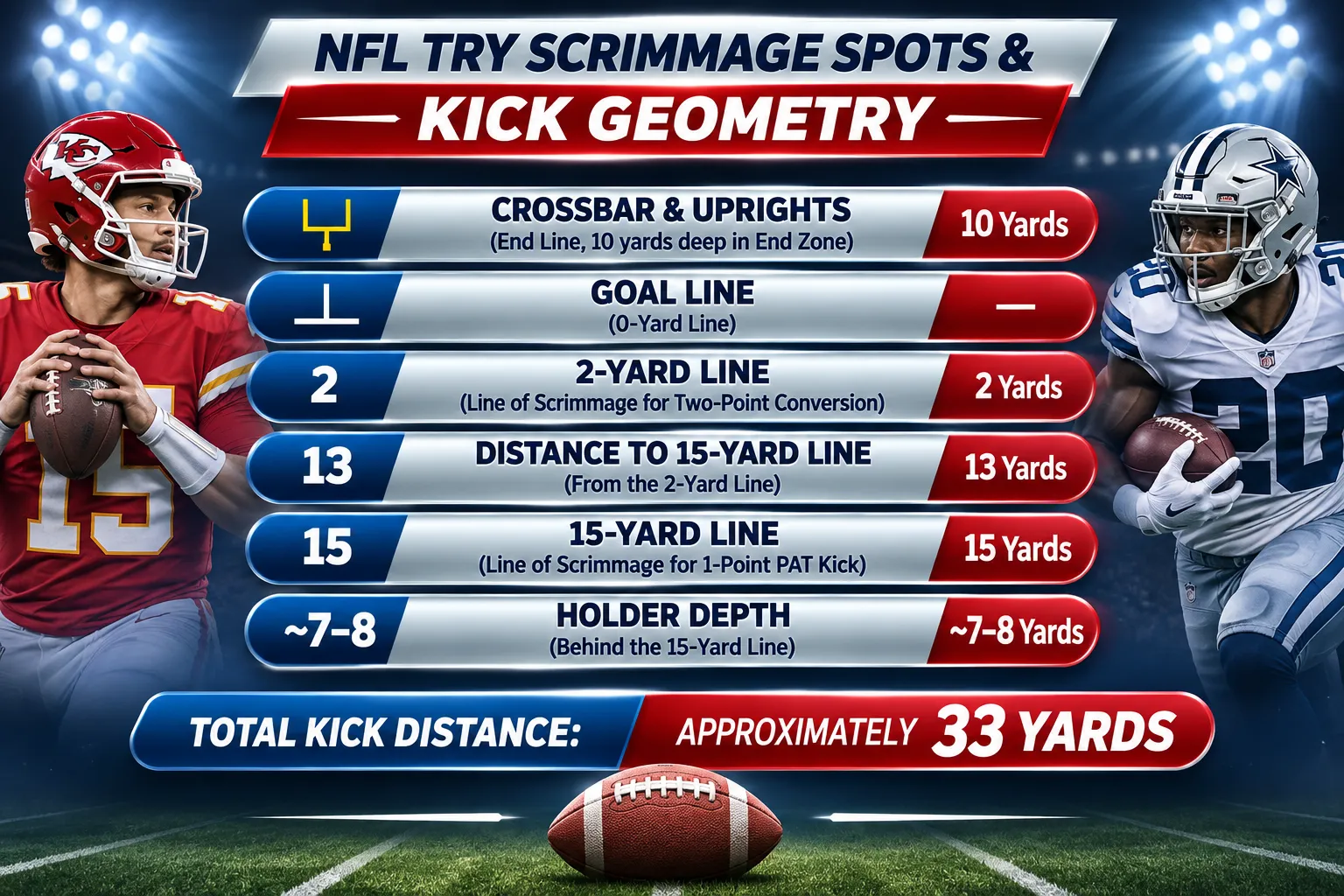
Officials spot the ball at the 2-yard line for an NFL two-point conversion. They center the ball between the hash marks unless the offense chooses a specific hash before the snap.
In contrast, officials place the ball at the 15-yard line for a 1-point PAT kick. The holder typically sets up 7 to 8 yards behind the line of scrimmage. Adding the 10-yard end zone depth creates a total kick distance of roughly 33 yards.
Clock Rules and Timing
A two-point conversion runs on an untimed down. The game clock never ticks during the snap. If a team scores as regulation time expires, officials still administer the Try if the points impact the final outcome. The offense must snap the ball before the standard play clock expires.
Penalty Enforcements on the Try
Penalties during a try adjust the line of scrimmage according to established NFL principles:
- Defensive Pass Interference (DPI): Special rules govern defensive pass interference during a Try. If the defense commits interference in the end zone from outside the 2-yard line, officials spot the ball at the 1-yard line. The offense then receives a retry under official Try guidelines.
- Offensive Penalties (e.g., False Start): A 5-yard false start pushes the line of scrimmage back to the 7-yard line. Under NFL Rule 11, teams do not lose their strategic options after a penalty or timeout. The offense can still run a conversion play from the 7-yard line or attempt a 20-yard placekick.
Can the Defense Score on a Two-Point Conversion?
The defense can score points during a Try in two specific scenarios:
- Defensive Two-Point Return: The defense earns two points by returning a turnover across the opponent’s goal line. This includes intercepted passes, recovered fumbles, and blocked kicks returned to the opposite end zone.
- The One-Point Safety: A safety on a try awards one point to the opposing team. This contrasts with a standard scrimmage safety, which provides two points. For example, if a defender gains possession outside the end zone, retreats inside, and goes down, the offense earns one point.
For full rules covering standard two-point defensive plays outside of a try, visit what is a safety in American football.
How Does a Two-Point Conversion Work?
An offense must cross the goal line using standard offensive mechanics to secure two points.
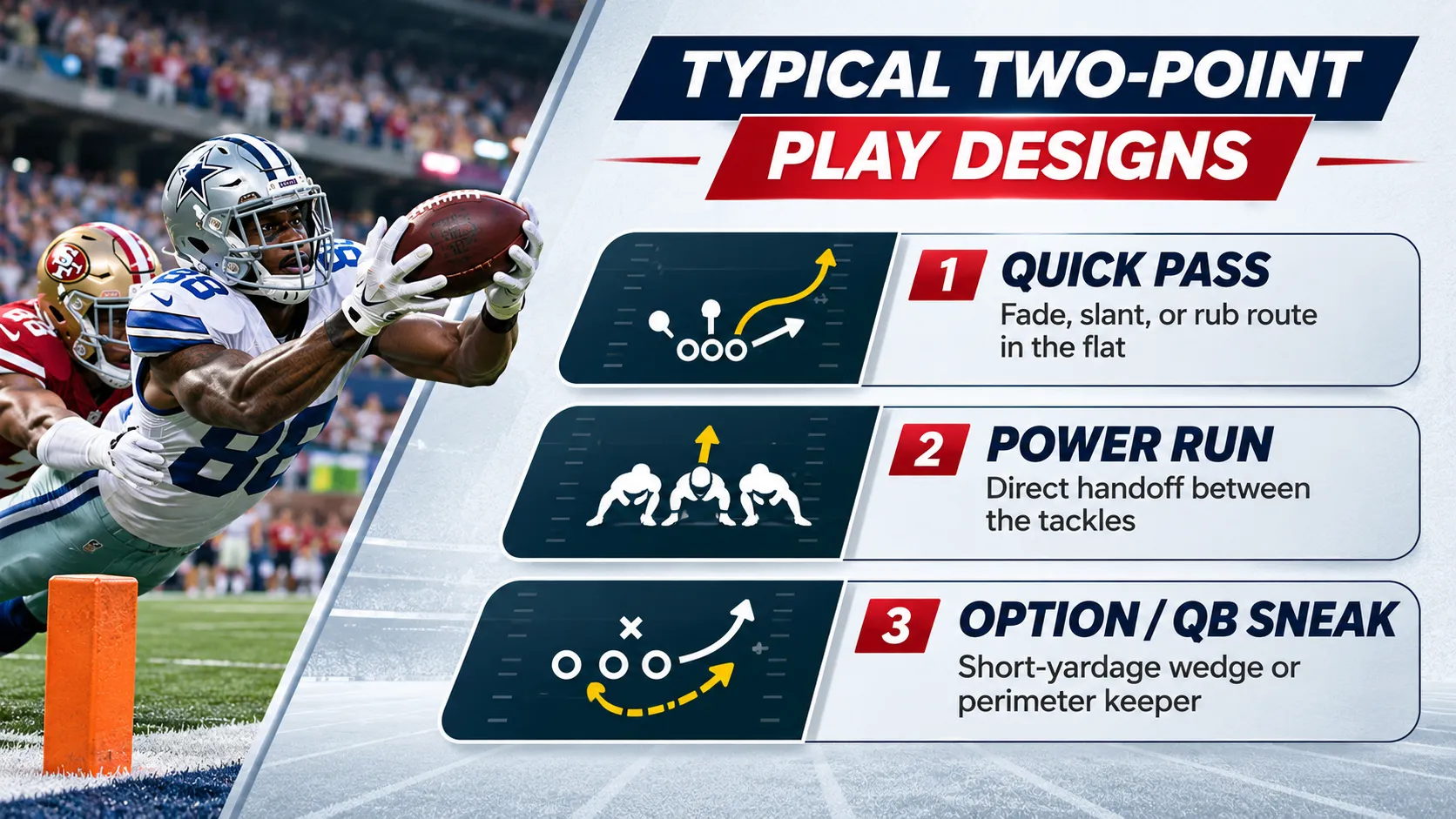
- Rushing Plays: The ball carrier must maintain possession and break the plane of the goal line before touching out of bounds or being down by rule.
- Passing Plays: A receiver must catch the ball in the end zone and meet all NFL catch requirements. The receiver must establish two feet in bounds and complete the catch through a football act or ground contact.
The try ends the moment officials rule the runner short, an incomplete pass hits the turf, or a turnover concludes. To study how teams sequence downs leading up to these calls, read what is a down in football.
Two-Point Conversion Success Rate
Historical NFL regular-season data from 1999 through 2025 shows a league-wide conversion rate of roughly 47.4%.
Data Note: This historical baseline includes 1,119 successful conversions out of 2,363 regular-season attempts. Conversion rates vary across individual seasons and matchups. Treat these figures as a historical reference rather than a predictive certainty.
- Short-Yardage Running Plays: In the 1999–2025 dataset, rushing plays converted at an observed rate of 55.4%. While runs historically outperformed passes, personnel matchups and defensive alignments strongly influence specific results.
- Passing Plays: Teams threw passes on roughly 72% of attempts in this dataset, converting at a 44.2% clip. Coordinators often favor passing plays to create multiple route options against heavy defensive fronts.
Two-Point Conversion vs. Extra Point: Analytics & Expected Value
Evaluating whether to kick or run a play begins with comparing expected points and situational win probability.
The Expected Value Formula
The mathematical break-even mark for attempting two points depends on a team’s extra-point kicking accuracy:
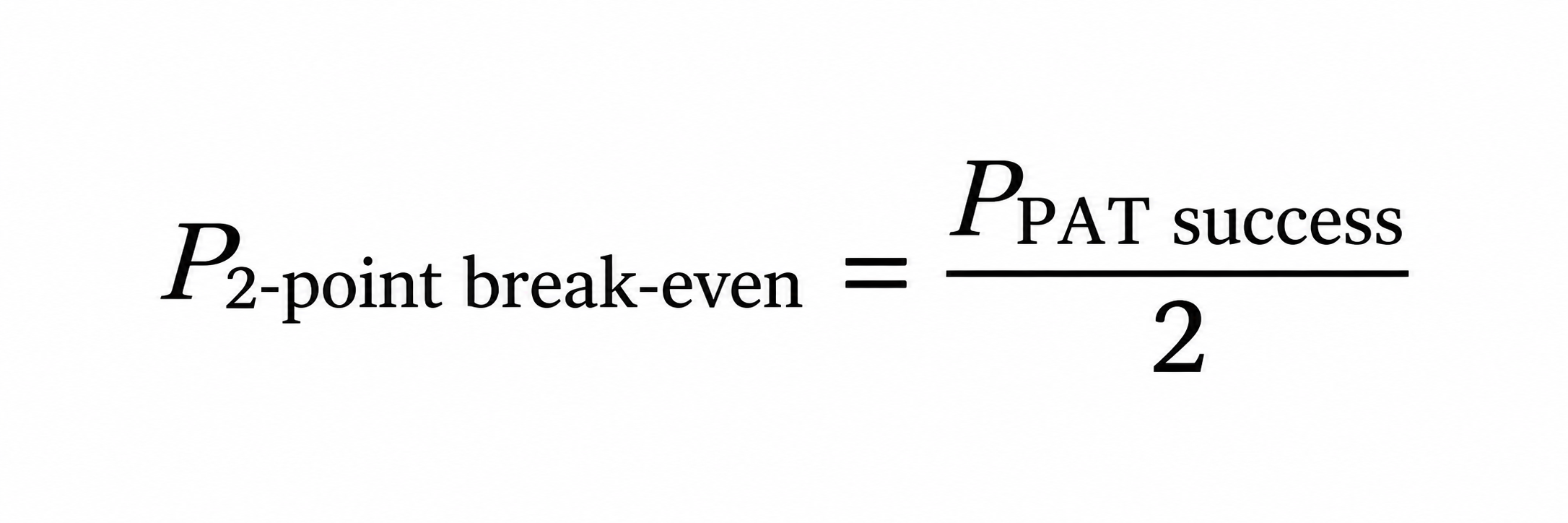
Evaluating this dynamic across standard NFL kicking percentages shows how the target shifts:
| Extra-Point Kick Success Rate | Corresponding Two-Point Break-Even Rate |
|---|---|
| 94.0% | 47.0% |
| 95.0% | 47.5% |
| 96.0% | 48.0% |
An offense projecting higher conversion odds gains long-term value by running offensive plays instead of kicking.
Expected Points vs. Win Probability
Expected value measures point totals over large sample sizes, but Win Probability (WP) dictates fourth-quarter choices. A coach might accept a lower expected-point option if that choice maximizes the immediate odds of winning.
When Should an NFL Team Go for Two?
These situations illustrate common late-game margins rather than automated rules. Coaches must always assess remaining clock time, opponent scoring strength, and offensive conversion confidence.
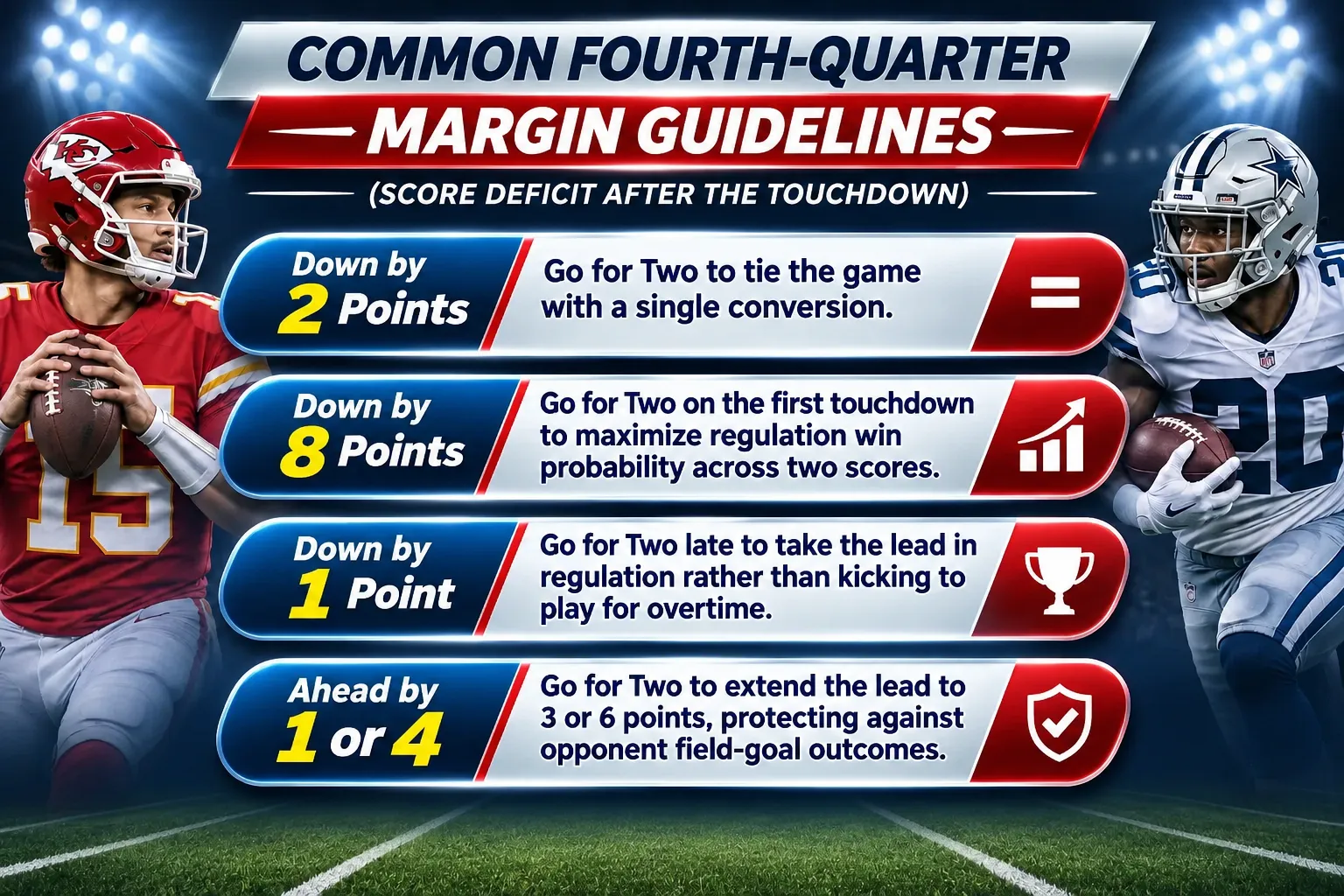
The “Down 8” Strategy Explained
Analytical models urge teams trailing by 14 points to attempt a conversion immediately after scoring their first touchdown. With the margin cut to 8 points, going for two maximizes the chances of winning in regulation.
- Scenario A (Convert on Try 1): The offense converts the first attempt, trimming the deficit to 6 points. Scoring a second touchdown allows a standard kick to win the game in regulation.
- Scenario B (Fail on Try 1, Convert on Try 2): The offense fails on the first attempt, leaving an 8-point deficit. Scoring a second touchdown allows a second conversion attempt to tie the score.
- Scenario C (Fail on Both Tries): If both attempts fail and the clock expires after the second touchdown, the team loses by two points. Remaining game time determines whether the team can mount another drive.
Assuming an illustrative 48% conversion rate on independent attempts, the offense holds an estimated 73% probability of converting at least one try ($0.48 + [0.52 \times 0.48] = 0.7296$).
Analytical Note: This model assumes the team successfully scores a second touchdown. It measures conversion probability across two tries, not the probability of generating another scoring drive or stopping the opponent.
Kicking extra points after both touchdowns merely targets overtime. The outcome in overtime depends on possession, field position, and late-game execution.
NFL vs. NCAA Two-Point Conversion Rules
While both levels share core scoring goals, pro and college football differ in field placement and overtime rules:
- Line of Scrimmage Placement:
- NFL: Teams snap the ball from the 2-yard line.
- NCAA: College rules place the ball at the 3-yard line, requiring an additional yard of offense.
- Overtime Procedures:
- NFL Overtime: Regular-season overtime lasts 10 minutes. Both teams receive an opportunity to possess the ball; if the score remains tied after 10 minutes, the game finishes as a tie. Playoff overtimes last 15 minutes and continue until someone wins.
- NCAA Overtime: College teams must attempt a two-point conversion after touchdowns starting in the second overtime (2OT). In the third overtime (3OT), teams run alternating two-point conversion plays until a winner emerges.
Frequently Asked Questions
How many points is a two-point conversion worth in football?
A successful two-point conversion awards two points. A team earns these points by running or passing the ball into the end zone after a touchdown. Teams can also choose a one-point placekick instead.
Where is the line of scrimmage for an NFL two-point conversion?
NFL officials place the ball at the 2-yard line. They center the ball between the hash marks unless the offense requests a specific hash mark before the play begins.
When did the NFL introduce the two-point conversion?
The NFL adopted the two-point conversion for the 1994 regular season. The AFL used the rule during the 1960s and college football adopted it in 1958, but the NFL waited until 1994 to add excitement and tactical variety.
Does an individual player receive fantasy points for a two-point conversion?
Yes, depending on individual league rules. Fantasy formats typically award two points to the runner or receiver. Quarterbacks who throw a conversion pass usually earn two points instead of yardage or passing touchdown credit.
Can a football game end on a two-point conversion?
Yes. A conversion can decide the game when a team needs points to tie or take the lead as time expires. For example, a team trailing by seven points cuts the deficit to one with a late touchdown. The coach can attempt a conversion to win in regulation rather than kicking to force overtime.