


Drafting running backs in fantasy football has fundamentally shifted. For years, fantasy managers debated whether early-round backs were too fragile to trust or too scarce to pass up. Today, winning your league is not about rigidly adhering to old dogmas. It comes down to roster architecture, understanding leverage, and evaluating how your starting lineup requirements intersect with the true math of weekly scoring.
Positional execution only works when tied to a macro plan. Before mapping out individual picks, master our comprehensive fantasy football draft strategy guide to establish your overarching game plan. Once your broader roster framework is locked in, the question that will define your draft day is simple: how are you going to attack the running back position?
The Modern NFL Landscape: Why Running Backs Dictate Fantasy Ceilings
In recent seasons, NFL defensive coordinators have leaned into two-high safety shells and split-field coverage disguises designed to eliminate explosive passing plays downfield. This tactical adjustment has reshaped offensive production across the league, leading to the following trends:
- Passing Volume Has Leveled Off: League-wide passing yards per game have settled near historical lows, trimming the sheer quantity of wide receivers posting massive weekly lines.
- Target Concentration Has Diluted: Modern passing offenses distribute targets across multiple pass-catchers, making truly dominant wide receivers with 28%+ target shares rarer than ever.
- Rushing Production Has Consolidated: While backfield committees are standard, genuine dual-threat running backs who monopolize goal-line work and passing downs generate an irreplaceable point-differential in weekly matchups.
While wide receivers often provide the explosive scoring necessary to survive weekly variance in points-per-reception (PPR) setups, elite running backs create an unmatched mathematical edge. When your lineup features a bellcow capable of posting 20+ points every week, your opponent is forced to play catch-up from kickoff.
The Big 4 Running Back Draft Philosophies
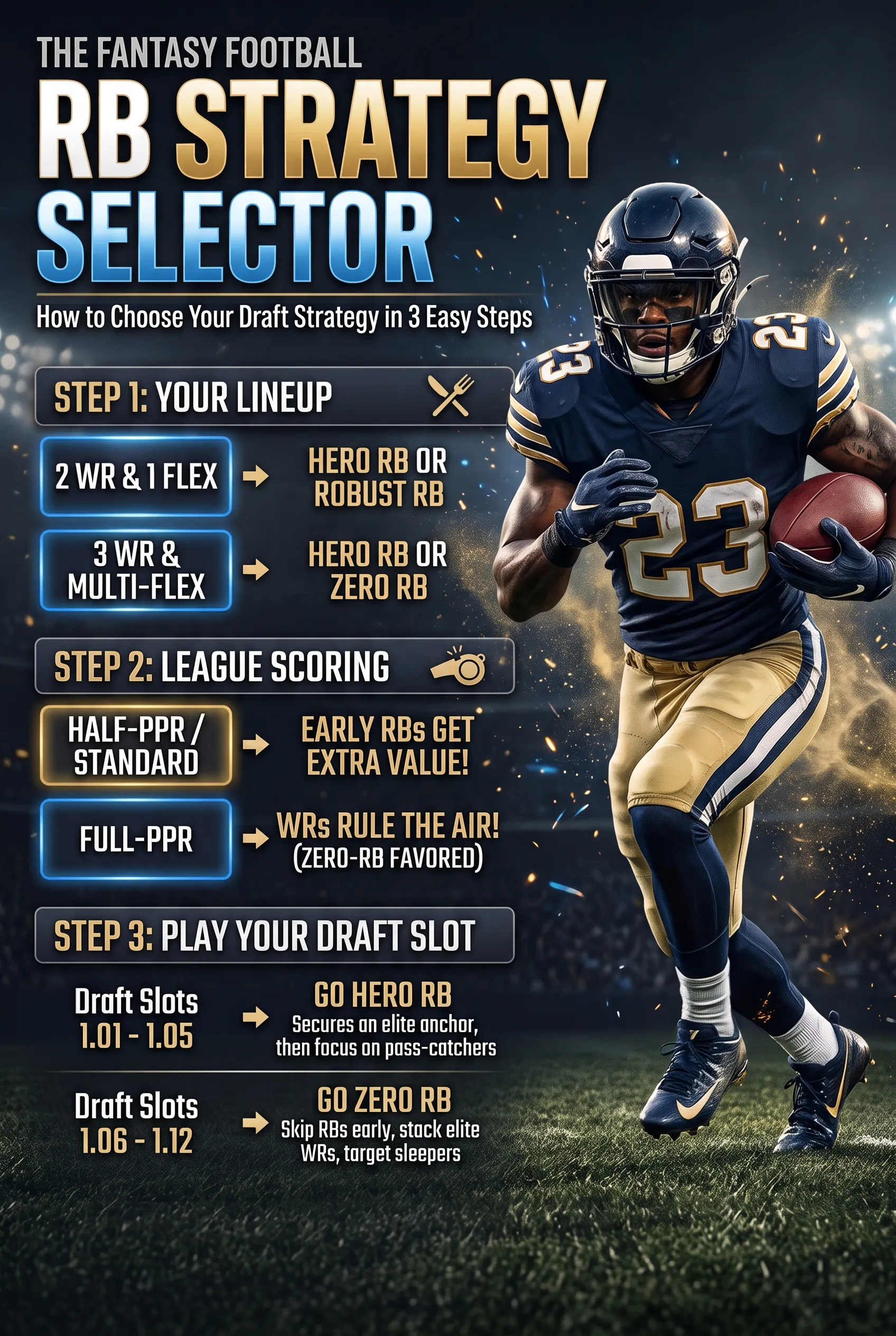
There is no universal “best” running back strategy. The right path depends on your draft slot, scoring rules, and how your league values players on draft day. Keep our ultimate fantasy football cheat sheet open to track value drops while executing one of these four core draft builds:
1. Hero RB (The Anchor Build)
Definition: Draft an elite, workhorse running back in Round 1 (or early Round 2), then pause on the position entirely until Rounds 7-9. Use your middle-round capital to build an overwhelming wide receiver corps, grab an elite quarterback, or secure a top-tier tight end.
Why It Wins
Hero RB bridges the gap between positional scarcity and injury risk. By securing a legitimate tier-one rusher, you lock down an elite 18-22 point weekly floor at your RB1 slot. Pausing on running backs in the middle rounds spares you from high-bust volume bets, allowing you to load up on difference-makers at wide receiver, quarterback, and tight end. You then assemble your RB2 slot through late-round upside stashes and calculated waiver moves.
Ideal Roster Construction (12-Team PPR)
- Round 1: Tier 1 Anchor RB
- Rounds 2-6: WR / WR / Elite QB or TE / WR / WR
- Rounds 7-10: High-upside ambiguous backfield targets, pass-catching specialists
- Rounds 11+: Contingent upside stashes, pure handcuffs
The Non-Negotiable Hero RB Profile
To qualify as your draft anchor, a back must hit three benchmarks:
- 70%+ Offensive Snap Share: Game-script immunity (plays when leading or trailing).
- Goal-Line Monopoly: Secures virtually all carries inside the 5-yard line.
- Route Participation: Runs routes on at least 50% of team dropbacks (minimum 12-15% target share).
2. Zero RB (The Antifragile Build)
Definition: Completely bypass running backs throughout the first 5 to 6 rounds. Draft wide receivers, an elite quarterback, and a top tight end before stocking your backfield with late-round flyers, passing-down backs, and active waiver pickups.
Why It Wins
Shawn Siegele popularized Zero RB, which is built on antifragility—the concept that your roster benefits from league chaos. Running backs experience the highest in-season attrition in football. When an early-round running back suffers an injury, that manager loses irreplaceable draft equity.
With Zero RB:
- Your early draft capital is locked into wide receivers and elite quarterbacks, who carry lower injury variance and more stable weekly projection.
- You hold multiple late-round backup running backs. When injuries inevitably create open backfield roles, your bench rushers step into starting workloads for free.
When to Avoid Zero RB
Never force Zero RB in standard non-PPR leagues or shallow formats that start only 2 WRs and 1 Flex. Without reception points and deep lineup requirements, wide receivers cannot overcome the raw touchdown and rushing leverage of elite running backs.
3. Robust RB (The Bully Build)
Definition: Spend 3 of your first 4 draft picks on starting running backs to corner positional scarcity.
Why It Wins
Robust RB creates a virtual monopoly on weekly rushing production. In leagues where your opponents prioritize wide receivers early, you walk away with an overwhelming, high-floor backfield that starves your competitors of reliable touch volume.
The Strategic Cost
Robust RB leaves your wide receiver room vulnerable. If two of your early running backs miss time with multi-week injuries, your season can quickly derail because your late-round receivers lack the high ceiling required to keep up. Reserve this build for standard non-PPR leagues and shallow 10-team setups.
4. Opportunistic (Value-Based Drafting)
Definition: Entering your draft without a rigid positional quota, letting unexpected draft runs and value drops dictate your selections.
If your league panics and starts an aggressive wide receiver run in Round 1, an opportunistic manager scoops up falling, top-tier running backs at a steep discount. Conversely, if your league mates draft running backs early and often, you pivot into a Zero RB build and hoover up elite pass-catchers. Flexibility beats dogmatic drafting every time.
Strategy Comparison Matrix
| Strategy | First RB Picked | Best League Format | Risk Profile | In-Season Management Required |
|---|---|---|---|---|
| Hero RB | Round 1 (or early Round 2) | Half-PPR; 2 WR / 1 Flex; 3 WR | Moderate | Moderate (manage RB2 slot) |
| Zero RB | Round 6 or later | Full-PPR; 3 WR + 2 Flex | High early variance; massive late ceiling | Very High (aggressive FAAB/waivers) |
| Robust RB | Rounds 1, 2, and 3/4 | Standard (Non-PPR); shallow rosters | High injury fragility | Low early; difficult WR maintenance |
| Opportunistic | Dynamic / Board-dependent | Any format | Balanced | Moderate |
How Scoring Formats and Lineups Dictate RB Strategy
Your draft plan must reflect your league settings. Ignoring scoring rules and starting requirements is the fastest way to derail a draft before the season even kicks off. For broader strategic fundamentals, check out our guide on how to build a championship fantasy football team.
1. Scoring Rules: PPR vs. Half-PPR vs. Standard
The value of an individual touch varies dramatically by scoring format:
- Full-PPR: A target is worth roughly 2.5× to 2.8× more than an interior rushing attempt. Pure third-down pass-catchers become reliable weekly starters, while two-down rushers lose substantial value.
- Standard (Non-PPR): Rushing yardage and touchdowns drive the entire scoreboard. Historically, running backs claim almost all top-three overall flex-eligible finishes in standard formats. Drafting running backs early is practically mandatory.
- Half-PPR: The balanced middle ground. Elite rushers retain immense leverage, but high-volume wide receivers remain competitive.
2. Lineup Demands: 2 WR vs. 3 WR + Multi-Flex
- 2-WR / 1-Flex Setups: You only need two starting wide receivers. Positional leverage is driven by running backs and elite single-starter positions (QB/TE). Hero RB and Robust RB dominate here.
- 3-WR / Multi-Flex Setups: You must start 3 to 5 pass-catchers every week. The baseline demand for wide receiver scoring jumps significantly. Skipping wide receivers early creates an insurmountable weekly deficit at WR2, WR3, and your Flex spots. Hero RB and Zero RB are essential.
Escaping the “RB Dead Zone”
The RB Dead Zone sits between Rounds 3 and 6. Historically, running backs drafted in this range produce the lowest return on investment (ROI) and the highest bust rates in fantasy sports.
Why the Dead Zone Exists
Drafters usually pick Dead Zone running backs out of panic rather than conviction. Managers who bypassed running backs early often reach for aging veterans simply because they carry an official “starter” tag on a depth chart.
These backs often have serious structural issues:
- They are two-down grinders with minimal passing-game involvement.
- They play in low-scoring, inefficient offenses.
- They hold precarious depth chart leads and frequently lose touches to younger, more explosive backups.
How to Navigate the Dead Zone
- Prioritize Wide Receivers: Rounds 3 through 6 are packed with high-end WR2s who have legitimate paths to top-12 seasonal finishes.
- Target Elite QBs and TEs: Grabbing an elite dual-threat quarterback or a dominant tight end in this window yields far more weekly leverage than a volume-dependent, low-efficiency running back.
- Only Target Dead Zone RBs with Passing Equity: If you take an RB in Rounds 3-6, verify that they are young, explosive, catch passes out of the backfield, and play in an above-average offense.
To evaluate which players fit these high-end talent profiles, read our scouting breakdown of the top 10 running backs in the NFL alongside our updated tiers of fantasy football running backs.
Predictive Metrics That Actually Win Leagues
Basic box-score numbers like rushing yards and career yards per carry (YPC) are noisy and misleading. Build your draft board around predictive opportunity and efficiency metrics:
- High-Value Touches (HVT): The sum of a running back’s receptions plus carries inside the opponent’s 10-yard line (the green zone). High-value touches generate nearly 80% of all running back fantasy scoring.
- Route Participation: The percentage of team passing plays where the running back runs a route rather than staying in to pass-block or sitting on the sideline. Aim for 50%+ route participation.
- Yards After Contact per Attempt (YCO/A) & Missed Tackles Forced (MTF): These metrics isolate a runner’s individual athletic ability from the quality of their offensive line blocking.
- Offensive Run-Block Win Rate (RBWR): Team context matters. Runners operating behind top-tier run-blocking offensive lines score touchdowns and create explosive plays at a significantly higher rate than those stuck behind bottom-tier units.
To spot undervalued players who check these analytical boxes without demanding high draft capital, review our list of underrated NFL players before your draft.
Handcuffs: Smart Insurance or Roster Clog?
The debate over whether to draft your starter’s direct backup comes down to upside and expected outcomes.
The Pitfall of Drafting Your Own Handcuff
Drafting your backup creates a defensive, low-ceiling roster:
- Best-case scenario: Your starter stays healthy, and your handcuff sits unused on your bench for four months.
- Worst-case scenario: Your starter gets hurt, and your backup steps in to deliver 75-80% of the original player’s production. You took on an injury hit and gained zero net upside.
The Winning Play: Target Other Managers’ Handcuffs
Instead of drafting your backup, stash the high-upside backups of other teams’ starting running backs:
- If your starter stays healthy and an opponent’s starter misses time, your late-round bench flyer suddenly becomes an every-week RB1/RB2 starter.
- You create a brand-new elite asset on your roster without losing your original draft investment.
In-Season Running Back Asset Management
Draft day is only the starting point. Winning leagues requires aggressive, proactive in-season management:
- Be Decisive with Early FAAB: The most impactful waiver wire running backs emerge in Weeks 1 through 3, when real coaching schemes and touch distributions are unveiled. Do not hoard your Free Agent Acquisition Budget (FAAB) for November. If an undrafted backup unexpectedly commands a 65%+ snap share early, bid 30-50% of your budget to secure that workload immediately.
- Leverage Touchdown Regression: Track expected fantasy points (xFP). If a running back averages 18 touches per game with heavy red-zone work but has only scored once through four games, trade for them before positive touchdown regression balances their scoring.
- Sell Unsustainable Volume Ahead of Deadlines: If a committee back is putting up top-12 numbers driven entirely by an unsustainable touchdown streak on low route participation, sell high for a stable wide receiver before your league’s fantasy football trade deadline.
- Utilize Expert Resources: Stay ahead of weekly depth chart changes and touch trends by cross-referencing reliable analysis from the best fantasy football advice websites.
Frequently Asked Questions
Is the Zero RB strategy still viable?
Yes, particularly in Full-PPR leagues starting 3 wide receivers and multiple flex positions. It underperforms in standard non-PPR scoring and shallow 10-team leagues, but in deep, reception-heavy formats, it delivers elite late-season ceilings.
How many running backs should I draft on my bench?
In typical 15- to 16-round fantasy drafts, carry 4 to 6 total running backs. Your bench should consist almost entirely of high-upside contingent backups and standalone third-down pass-catchers rather than replacement-level veterans with low ceilings.
Should I draft two running backs in the first two rounds?
Yes, if you hold an early draft slot in Standard (non-PPR) or Half-PPR leagues, or if an aggressive wide receiver run pushes a consensus top-tier running back down the board into pure value territory. In Full-PPR formats requiring 3 wide receivers, picking two early backs introduces structural roster fragility that can leave your weekly receiver scoring thin.