


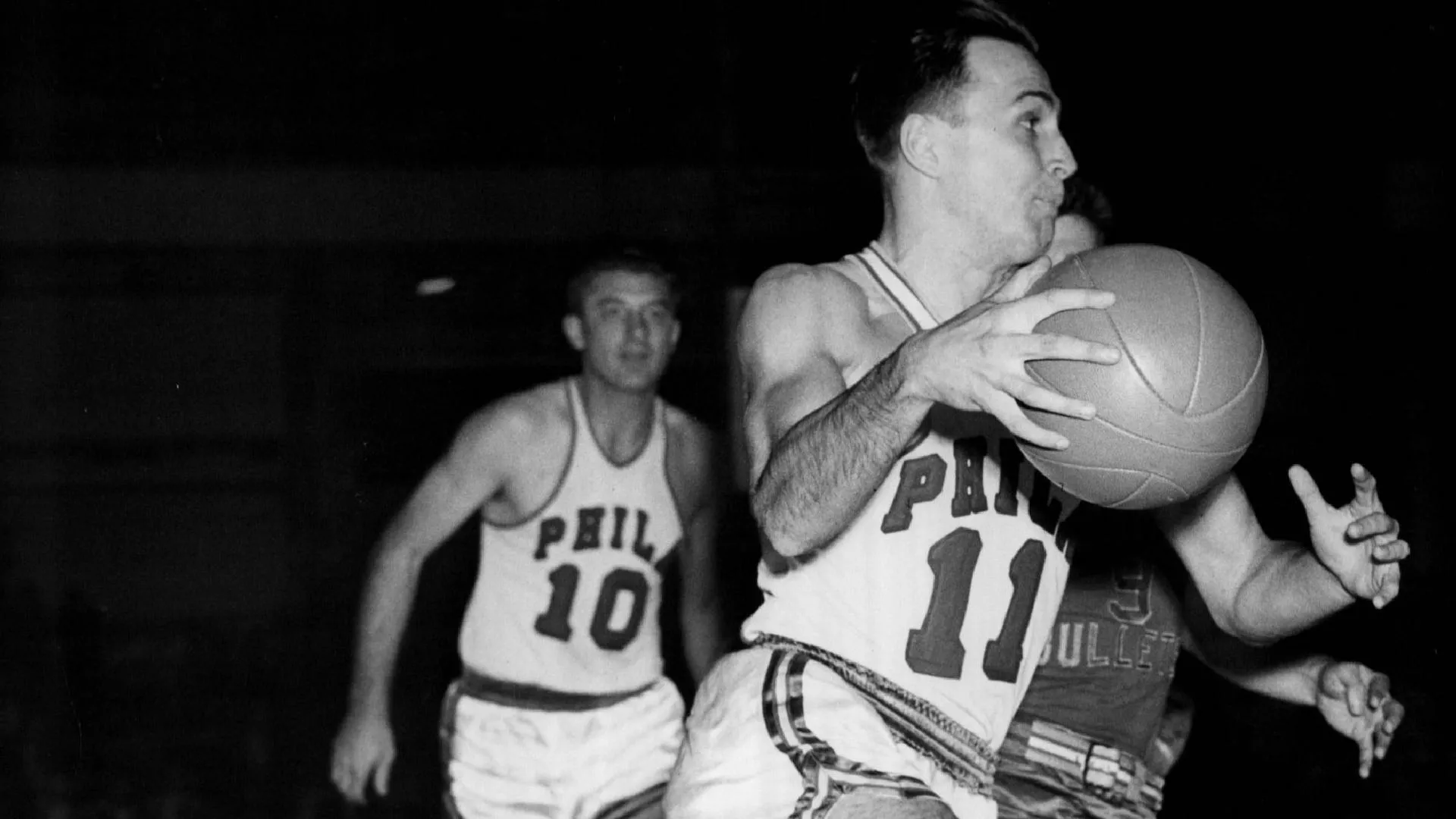
A chemistry major who couldn’t make his own high school team went on to retire as the third-leading scorer in NBA history. Paul Arizin’s net worth, reflecting the value of his estate, stands at an estimated $2 million, a financial story rooted almost entirely in a 23-year corporate career at IBM rather than professional basketball. He pioneered the modern jump shot at a time when most scorers still fired from a flat-footed set position, and he capped his career with the 1956 championship alongside the Philadelphia Warriors.
His scoring dominance secured his permanent spot among the NBA’s most accomplished all-time names, and it’s easy to see why. He retired with 16,266 career points, good for third on the NBA all-time scoring list at the time, despite losing two full prime seasons to military service. Operating decades before free agency or luxury tax brackets existed, he built his life around family stability in Pennsylvania rather than chasing bigger paydays elsewhere.
Paul Arizin Contracts and Career Earnings Breakdown
Philadelphia used a territorial pick to secure him out of Villanova ahead of the 1950 NBA Draft, a now-defunct rule that let teams claim local college stars without competing in the regular draft order. He signed his rookie contract for $9,000, a figure that looks almost unbelievable next to what small forwards earn now, and he immediately validated it by winning Rookie of the Year while averaging 17.2 points per game.
He led the league in scoring during his second season, earning a modest raise before his career was interrupted. Paul enlisted in the United States Marine Corps in the summer of 1952, missing the entire 1952-53 and 1953-54 seasons while serving during the Korean War and rising to the rank of sergeant. The NBA lacked free agency at the time regardless, binding his entire playing career to a single franchise whether he served or not.
He returned to the Warriors for the 1954-55 season, teaming with center Neil Johnston to form one of the league’s most dangerous scoring duos and anchoring the 1956 title run alongside Tom Gola. His salary climbed gradually across his final eight seasons, peaking at roughly $15,000 annually, top-tier pay for a wing player in that era even though it wouldn’t cover a modern rookie’s meal money. When the Warriors announced their move to San Francisco after the 1961-62 season, he chose to retire at 34 rather than uproot his family, walking away despite averaging 21.9 points per game that final year.
Career NBA Salary Table
Complete official salary records don’t exist for most 1950s players the way they do for the modern era, so the estimate below is built from his documented $9,000 rookie contract and his reported $15,000 peak salary, spread across the ten seasons he actually played.
| Season / Era | Team | Total Earnings (Estimated) |
|---|---|---|
| 1950 – 1952 | Philadelphia Warriors (Rookie Contract & Scoring Title) | $21,000 |
| 1952 – 1954 | United States Marine Corps (No NBA Salary) | $0 |
| 1954 – 1962 | Philadelphia Warriors (Championship Peak & Retirement) | $112,000 |
| 10 NBA Seasons | Philadelphia Warriors (Sole Franchise) | $133,000 |
Endorsement Deals and Corporate Career
Commercial opportunities in the 1950s consisted of localized print advertisements rather than global sneaker campaigns, and he built his off-court income around Philadelphia sporting goods stores and local athletic clubs instead. His real financial security came from a career pivot most modern stars would find unrecognizable.
- IBM: Accepted a marketing and sales position with the technology giant, working there for 23 years and retiring with a full corporate pension.
- Camden Bullets: Played weekend games in the Eastern Professional Basketball League while employed full-time, winning league MVP in his first season and a championship in his third.
- Local Sporting Goods Stores: Appeared in regional Philadelphia print advertisements during his playing career.
- Athletic Clubs: Made paid appearances at local basketball clinics and community athletic events.
Real Estate, Family, and Community Leadership
Unlike modern superstars purchasing sprawling mega-mansions, his property investments stayed practical and deeply rooted in Pennsylvania. He built his life in Springfield Township, maintaining lifelong ties to the Philadelphia area rather than chasing the glamour of a West Coast NBA relocation. Verified purchase prices for his personal homes aren’t part of the public record the way they are for today’s highest paid nba player, so rather than guess, it’s worth being direct about it: his wealth story runs through a corporate pension and community roots, not real estate.
He lived a quiet, humble life largely insulated from the celebrity culture that surrounds today’s basketball stars. His charitable efforts prioritized direct neighborhood impact and local Catholic charities over any kind of public recognition. That dedication to his roots defined his legacy far more than any property he ever owned.
Personal Life
Paul married Maureen McAdams on October 18, 1952, just before shipping out for Marine Corps basic training, and the couple went on to raise five children together. That timing meant he spent the first two years of his marriage stationed at Quantico, Virginia, playing service basketball for the Marines while his new wife managed a household back in Pennsylvania. He stayed close to Philadelphia for the rest of his life, passing away in December 2006.
Early Life, Villanova, and the 1950 NBA Draft
Paul Joseph Arizin was born in Philadelphia on April 9, 1928, to French immigrant parents. He failed to make his high school team during his only tryout as a senior and spent his formative years playing in independent Catholic leagues instead, where Villanova head coach Al Severance eventually spotted his unusual jump-shooting form.
He enrolled at Villanova as a chemistry major and didn’t join the varsity team until his sophomore year. Paul averaged 25.3 points per game as a senior in 1950 and earned consensus All-American honors, numbers that made him the nation’s leading scorer that season. Philadelphia used its territorial pick to lock him up before the official 1950 NBA Draft even began.
Evolution of Small Forward Salaries
Wing compensation across the decades shows just how far the league’s financial structure has traveled. Today’s highest-paid NBA player at small forward commands a supermax contract worth well over $50 million a season, a number that would have sounded like science fiction to a player earning $15,000 at his absolute peak.
He still ranks among the best NBA players of all time because his pioneering jump shot laid the technical foundation for the perimeter scoring that defines the modern game. Julius Erving and Elgin Baylor represent the bridge generation between Arizin’s flat-money era and today’s supermax paydays, and the table below lines up four generations of small forward salaries side by side.
| Player | Primary Era | Peak Annual Salary |
|---|---|---|
| Paul Arizin | 1950s | $15,000 |
| Larry Bird | 1980s | $7,000,000 |
| LeBron James | 2010s – 2020s | $52,600,000 |
| Kevin Durant | 2010s – 2020s | $53,300,000 |
Legendary Forwards’ Career & Earnings Comparison
| Legendary Forward | Position | Primary Era | Peak NBA Salary | Estimated Net Worth |
|---|---|---|---|---|
| Paul Arizin | Small Forward | 1950 – 1962 | $15,000 | $2 million (Estate) |
| Elgin Baylor | Small Forward | 1958 – 1971 | $100,000 | $50 million |
| Julius Erving | Small Forward | 1971 – 1987 | $1.4 million | $50 million |
| LeBron James | Small Forward | 2003 – Active | $52.6 million | $1.2 billion |
| Kevin Durant | Small Forward | 2007 – Active | $53.3 million | $300 million |
Frequently Asked Questions
What is Paul Arizin’s net worth today?
Paul Arizin holds an estimated net worth of $2 million, reflecting the value of his estate. His wealth stems from modest 1950s NBA playing wages, a 23-year corporate career at IBM, and long-term pension benefits rather than modern-style endorsement income.
Why did Paul Arizin retire from the NBA so early?
Paul Arizin retired in 1962 at age 34 because the Philadelphia Warriors relocated to San Francisco. He chose not to uproot his wife and five children from Pennsylvania and instead accepted a more financially secure corporate job with IBM.
Did Paul Arizin invent the jump shot?
Basketball historians credit Paul Arizin as one of the first players to popularize and perfect the modern jump shot. He developed the technique on slippery dance-hall floors in Philadelphia years before he ever set foot on an NBA court.
Paul Arizin’s $2 million estate traces back to a $9,000 rookie contract, two prime seasons sacrificed to military service, and a 23-year corporate career that gave his family more security than professional basketball could offer in the 1950s. That combination is why his name still surfaces whenever the conversation turns to the pioneers who shaped the greatest nba players of all time.