


NFL stadium design has shifted dramatically from open-air steel bowls to multi-billion-dollar architectural marvels featuring retractable roofs, translucent ETFE canopy domes, and real-time climate regulation. Whether fans are cross-referencing team home grounds using our comprehensive alphabetical list of NFL teams or evaluating venue capacities, the league’s competitive fields remain anchored by a century of structural evolution. From historic venues built prior to the AFL-NFL merger to modern facilities in Los Angeles and Las Vegas, ranking stadiums by age offers an in-depth look at how team ownership groups manage physical assets and fan amenities.
Below, we rank every active home field across the league in chronological order based on its original opening date.
The Chronological List of All 30 Active NFL Stadiums
| Rank | Stadium Name | Primary Tenant(s) | Details | |
|---|---|---|---|---|
| Opened | Capacity | |||
| 1 | Soldier Field | Chicago Bears | 1924 | 61,500 |
| 2 | Lambeau Field | Green Bay Packers | 1957 | 81,441 |
| 3 | Arrowhead Stadium | Kansas City Chiefs | 1972 | 76,416 |
| 4 | Highmark Stadium | Buffalo Bills | 1973 | 71,608 |
| 5 | Caesars Superdome | New Orleans Saints | 1975 | 73,208 |
| 6 | Hard Rock Stadium | Miami Dolphins | 1987 | 65,326 |
| 7 | EverBank Stadium | Jacksonville Jaguars | 1995 | 69,132 |
| 8 | Bank of America Stadium | Carolina Panthers | 1996 | 74,867 |
| 9 | Northwest Stadium | Washington Commanders | 1997 | 67,617 |
| 10 | M&T Bank Stadium | Baltimore Ravens | 1998 | 71,008 |
| 11 | Raymond James Stadium | Tampa Bay Buccaneers | 1998 | 65,890 |
| 12 | Huntington Bank Field | Cleveland Browns | 1999 | 67,895 |
| 13 | Nissan Stadium | Tennessee Titans | 1999 | 69,143 |
| 14 | Paycor Stadium | Cincinnati Bengals | 2000 | 65,515 |
| 15 | Acrisure Stadium | Pittsburgh Steelers | 2001 | 68,400 |
| 16 | Empower Field at Mile High | Denver Broncos | 2001 | 76,125 |
| 17 | Ford Field | Detroit Lions | 2002 | 65,000 |
| 18 | Gillette Stadium | New England Patriots | 2002 | 64,628 |
| 19 | Lumen Field | Seattle Seahawks | 2002 | 69,000 |
| 20 | NRG Stadium | Houston Texans | 2002 | 72,220 |
| 21 | Lincoln Financial Field | Philadelphia Eagles | 2003 | 69,596 |
| 22 | State Farm Stadium | Arizona Cardinals | 2006 | 63,400 |
| 23 | Lucas Oil Stadium | Indianapolis Colts | 2008 | 67,000 |
| 24 | AT&T Stadium | Dallas Cowboys | 2009 | 80,000 |
| 25 | MetLife Stadium | New York Giants / New York Jets | 2010 | 82,500 |
| 26 | Levi’s Stadium | San Francisco 49ers | 2014 | 68,500 |
| 27 | U.S. Bank Stadium | Minnesota Vikings | 2016 | 66,860 |
| 28 | Mercedes-Benz Stadium | Atlanta Falcons | 2017 | 71,000 |
| 29 | Allegiant Stadium | Las Vegas Raiders | 2020 | 65,000 |
| 30 | SoFi Stadium | Los Angeles Rams / Los Angeles Chargers | 2020 | 70,000 |
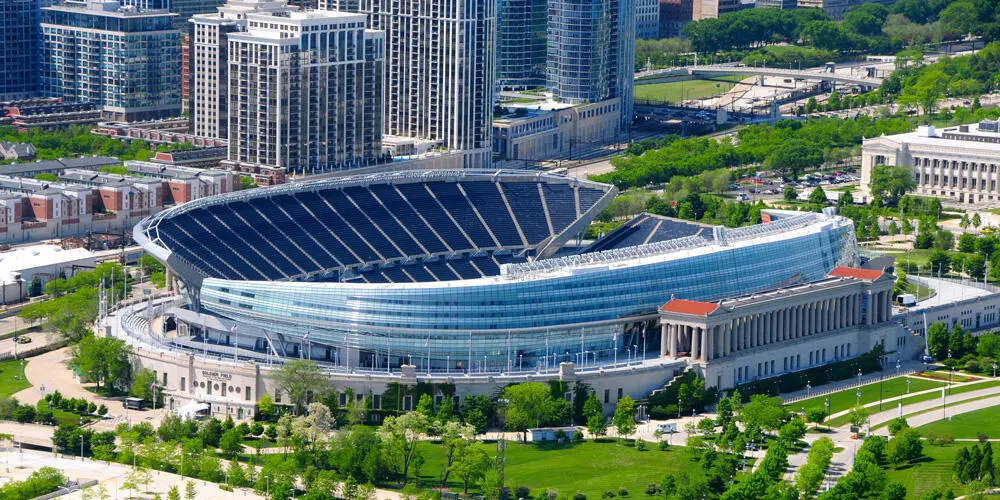
1. Soldier Field (Chicago Bears) – Opened: 1924
Located on Chicago’s lakefront, Soldier Field opened on October 9, 1924, passing its centennial mark in 2024. The Chicago Bears moved in full-time in 1971 after leaving Wrigley Field. A complete interior rebuild in 2002 altered the historic seating bowl, reducing capacity to 61,500 and making it the smallest stadium in the NFL by base capacity. For a complete analysis of how Chicago’s landmark compares to other legacy venues, explore our detailed review of the oldest NFL stadium still in use.
2. Lambeau Field (Green Bay Packers) – Opened: 1957
Green Bay constructed City Stadium in 1957 before renaming the facility in honor of Curly Lambeau. Operating for over 65 continuous seasons, Lambeau Field holds the NFL record for the longest continuous residency by a single franchise. Systematic stadium expansions over decades brought capacity past 81,000 without sacrificing the famous bowl architecture.
3. Arrowhead Stadium (Kansas City Chiefs) – Opened: 1972
Arrowhead Stadium opened in 1972 as part of the Truman Sports Complex. Designed with steep, terraced seating tiers, the venue captures and amplifies crowd noise directly onto the playing surface. Major capital renovations updated concourses and suite levels while maintaining the iconic structural footprint.
4. Highmark Stadium (Buffalo Bills) – Opened: 1973
Opening in Orchard Park in August 1973 as Rich Stadium, Highmark Stadium is widely recognized for its open-air design and extreme lake-effect winter winds. With construction well underway on a new state-of-the-art venue across the street, the facility is entering its final seasons of active NFL play.
5. Caesars Superdome (New Orleans Saints) – Opened: 1975
The Superdome introduced large-scale enclosed stadium architecture to professional sports upon opening in August 1975. Beyond hosting regular-season Saints games, the iconic venue has hosted multiple Super Bowls and major college football championships. Modern structural overhauls continuously update fan gateways and interior concourses.
6. Hard Rock Stadium (Miami Dolphins) – Opened: 1987
Opening as Joe Robbie Stadium in 1987, Hard Rock Stadium underwent a massive private renovation that added an open-air shade canopy over 90% of spectator seats. The multi-purpose venue accommodates NFL football, international tennis tournaments, formula racing, and major concerts.
7. EverBank Stadium (Jacksonville Jaguars) – Opened: 1995
Constructed on the historic site of the old Gator Bowl, EverBank Stadium opened in time for Jacksonville’s inaugural 1995 season. Known for its massive end-zone video boards and poolside cabana decks, the city and team recently approved a comprehensive modernization design for future seasons.
8. Bank of America Stadium (Carolina Panthers) – Opened: 1996
Situated in uptown Charlotte, Bank of America Stadium opened in 1996, featuring a black-and-blue exterior facade flanked by signature arched entryways. The open-air stadium serves as the primary home field for both the Panthers and Charlotte FC.
9. Northwest Stadium (Washington Commanders) – Opened: 1997
Originally opening as Jack Kent Cooke Stadium in Landover, Maryland, this venue replaced historic RFK Stadium in 1997. Serving the Washington franchise for over a quarter-century, ownership continues evaluating long-term relocation and redevelopment options across the region.
10. M&T Bank Stadium (Baltimore Ravens) – Opened: 1998
M&T Bank Stadium opened in 1998, anchoring Baltimore’s downtown sports complex adjacent to Oriole Park at Camden Yards. The stadium features high-definition video displays and upper-deck sightlines tailored for Baltimore’s home crowd, alongside recently upgraded field-level club facilities.
11. Raymond James Stadium (Tampa Bay Buccaneers) – Opened: 1998
Famous for its 43-foot replica pirate ship behind the north end zone, Raymond James Stadium opened in September 1998. The venue features wide concourses, expansive end-zone plazas, and has hosted multiple Super Bowl matchups.
12. Huntington Bank Field (Cleveland Browns) – Opened: 1999
Built on the former footprint of Cleveland Municipal Stadium along Lake Erie, this venue opened in 1999. The open-air facility exposes teams to harsh late-season weather conditions, prompting ongoing discussions regarding future enclosed stadium developments in the region.
13. Nissan Stadium (Tennessee Titans) – Opened: 1999
Located along the east bank of the Cumberland River directly across from downtown Nashville, Nissan Stadium opened in 1999 as Adelphia Coliseum. After a quarter-century of action, the Titans have begun construction on an adjacent, enclosed stadium that will replace the venue.
14. Paycor Stadium (Cincinnati Bengals) – Opened: 2000
Paycor Stadium—originally Paul Brown Stadium—opened along the Ohio River in August 2000. Featuring a glass-and-steel architectural style, the open-air facility replaced the multi-purpose Riverfront Stadium.
15. Acrisure Stadium (Pittsburgh Steelers) – Opened: 2001
Acrisure Stadium (formerly Heinz Field) opened in August 2001 on Pittsburgh’s North Shore. The horseshoe-shaped bowl frames clear views of downtown Pittsburgh and houses the Great Hall, displaying franchise championship history.
16. Empower Field at Mile High (Denver Broncos) – Opened: 2001
Constructed adjacent to the original Mile High Stadium site, Empower Field sits 5,280 feet above sea level. The venue’s steel seating tiers accentuate fan noise during key defensive stands, continuing a long-standing mile-high tradition.
17. Ford Field (Detroit Lions) – Opened: 2002
Ford Field uniquely incorporated the historic Hudson’s warehouse facility into its southern stadium structure, creating an original blend of historic preservation and modern architecture. Located in downtown Detroit, the domed building shields spectators from harsh winter elements.
18. Gillette Stadium (New England Patriots) – Opened: 2002
Gillette Stadium opened in Foxborough in 2002, replacing Foxboro Stadium. Featuring an iconic signature lighthouse and entry bridge in the north end zone, recent multi-million-dollar renovations added an expanded 22-story hospitality tower.
19. Lumen Field (Seattle Seahawks) – Opened: 2002
Lumen Field features parabolic roof arches that cover 70% of spectator seating while reflecting crowd noise directly back toward the playing field. Positioned near downtown Seattle, the venue routinely produces some of the loudest recorded noise levels in professional sports.
20. NRG Stadium (Houston Texans) – Opened: 2002
NRG Stadium opened as the NFL’s first retractable-roof facility in 2002. Built to house both the Texans franchise and the annual Houston Livestock Show and Rodeo, the massive facility accommodates over 72,000 spectators for major sporting events.
21. Lincoln Financial Field (Philadelphia Eagles) – Opened: 2003
Lincoln Financial Field opened in August 2003 within the South Philadelphia Sports Complex. Featuring wing-like roof structures and energy-efficient solar installations, the venue delivers sightlines designed for premier football viewing.
22. State Farm Stadium (Arizona Cardinals) – Opened: 2006
State Farm Stadium in Glendale features two major engineering feats: a retractable roof system and a roll-out natural grass field tray. The 22-million-pound tray remains outdoors for natural sunlight exposure before sliding inside on game days.
23. Lucas Oil Stadium (Indianapolis Colts) – Opened: 2008
Lucas Oil Stadium features a retractable roof paired with a 9,000-square-foot operable glass window framing the Indianapolis skyline. Built with traditional red brick masonry, the facility hosts national championship games, conventions, and the annual NFL Scouting Combine.
24. AT&T Stadium (Dallas Cowboys) – Opened: 2009
AT&T Stadium features twin 290-foot steel arches, retractable end-zone glass doors, and a massive center-hung video board. Capable of expanding capacity past 100,000 spectators with standing room plazas, it stands as one of the largest venues in professional sports. Dallas supporters analyzing franchise development can evaluate whether current roster construction will help break their Super Bowl drought.
25. MetLife Stadium (New York Giants and New York Jets) – Opened: 2010
MetLife Stadium opened in 2010 as a joint venture between the Giants and Jets in the East Rutherford Meadowlands. Featuring customized exterior light displays that switch based on the host team, it holds the largest fixed seating capacity in the league at 82,500 seats. To compare venue layouts nationwide, view our ranking of the largest NFL stadium in the USA.
26. Levi’s Stadium (San Francisco 49ers) – Opened: 2014
Located in Santa Clara, Levi’s Stadium replaced historic Candlestick Park in 2014. The venue features a green roof, solar panel arrays, and advanced mobile technology infrastructure. To see where the 49ers sit in the geographic alignment of the league, consult our breakdown of all NFL teams by division.
27. U.S. Bank Stadium (Minnesota Vikings) – Opened: 2016
U.S. Bank Stadium features an asymmetric roof constructed with clear ETFE panels, delivering natural sunlight while protecting fans from freezing winter temperatures. Giant pivoting glass doors open toward the Minneapolis skyline to create an open-air atmosphere.
28. Mercedes-Benz Stadium (Atlanta Falcons) – Opened: 2017
Mercedes-Benz Stadium features a pinwheel kinetic retractable roof that opens and closes like a camera lens. A 360-degree halo video board hangs beneath the roof structure, providing panoramic replays throughout the entire bowl.
29. Allegiant Stadium (Las Vegas Raiders) – Opened: 2020
Nicknamed “The Death Star,” Allegiant Stadium features a sleek black glass exterior and a translucent roof canopy overlooking the Las Vegas Strip. Like State Farm Stadium, it uses a retractable natural grass field tray that rolls outdoors between matches.
30. SoFi Stadium (Los Angeles Rams and Los Angeles Chargers) – Opened: 2020
Completed in 2020, SoFi Stadium is among the newest facilities in professional sports. Featuring an open-air canopy covered by an ETFE membrane, the venue houses two distinct franchises.
Global and Historical Venue Context
Understanding stadium age requires stepping back to evaluate venue history across international sports:
- Oldest Active Stadium in the World: The Panathenaic Stadium in Athens, Greece (originally constructed in 329 BC and rebuilt in marble) holds the record as the oldest operating stadium structure in the world.
- Oldest Football/Soccer Stadium in the World: Bramall Lane in Sheffield, England, opened in 1855 and remains the oldest professional football stadium in continuous operation.
- Oldest Stadiums in North America: Franklin Field (1895) at the University of Pennsylvania stands as the oldest operating stadium in the United States, while Fenway Park (1912) and Wrigley Field (1914) serve as the oldest active venues in North American professional team sports.
- Modern Construction Timelines: On average, modern mega-stadium projects require 3 to 4 years of active construction from initial groundbreaking to official grand opening.
Frequently Asked Questions
Which NFL team has the oldest stadium?
The Chicago Bears play at Soldier Field, which opened in 1924 and stands as the oldest active stadium in the NFL. However, the Green Bay Packers hold the record for the longest continuous residency at a single venue, having played at Lambeau Field since its opening in 1957.
What is the newest NFL stadium?
SoFi Stadium in Inglewood, California, and Allegiant Stadium in Paradise, Nevada, are the newest stadiums in the NFL. Both venues opened prior to the start of the 2020 NFL season.
How are NFL teams organized across these home fields?
The league distributes its 32 franchises across 30 active stadiums, divided evenly between the American Football Conference (AFC) and National Football Conference (NFC). Detailed structural mappings are available in our guide to NFL teams by conference.
Which active stadiums belong to franchises with the most championships?
Venues like Lambeau Field and Arrowhead Stadium carry rich postseason histories. Full title counts across all 32 teams are documented in our analysis of which NFL team has won the most Super Bowls.
Which venues belong to historically struggling franchises?
Stadium lease agreements and venue developments often align with long-term franchise stability. Further context on historically struggling organizations is available in our feature on the worst teams in NFL history.
How can I look up home venues for specific NFL teams?
You can search all 32 franchises, their home cities, and venue assignments through our complete alphabetical list of NFL teams.