

Whether you’re setting up a backyard court, coaching youth players, or simply want to know the official NBA rim height, this guide covers everything—regulation measurements, age-group adjustments, equipment specs, and exactly how hoop height affects player development.
The Official 10-Foot Standard & Its Origin
The regulation height of a basketball hoop is 10 feet (3.05 meters), measured from the playing surface to the top edge of the rim. This standard has remained unchanged since Dr. James Naismith invented the sport in December 1891— making it one of the most enduring measurements in all of professional sports.
The origin wasn’t the result of biomechanical research or governing-body debate. Naismith nailed the first peach baskets to a gymnasium balcony railing that happened to sit 10 feet above the floor. That accidental measurement became the universal rim height standard still used today in the NBA, WNBA, NCAA, FIBA, and every high school gym across the United States.
Over 134 years, player heights have grown dramatically and athletic performance has evolved beyond what Naismith could have imagined—yet the 10-foot rim remains unchanged because it continues to strike the ideal balance between scoring difficulty and game flow.
Basketball Hoop Height by Age Group
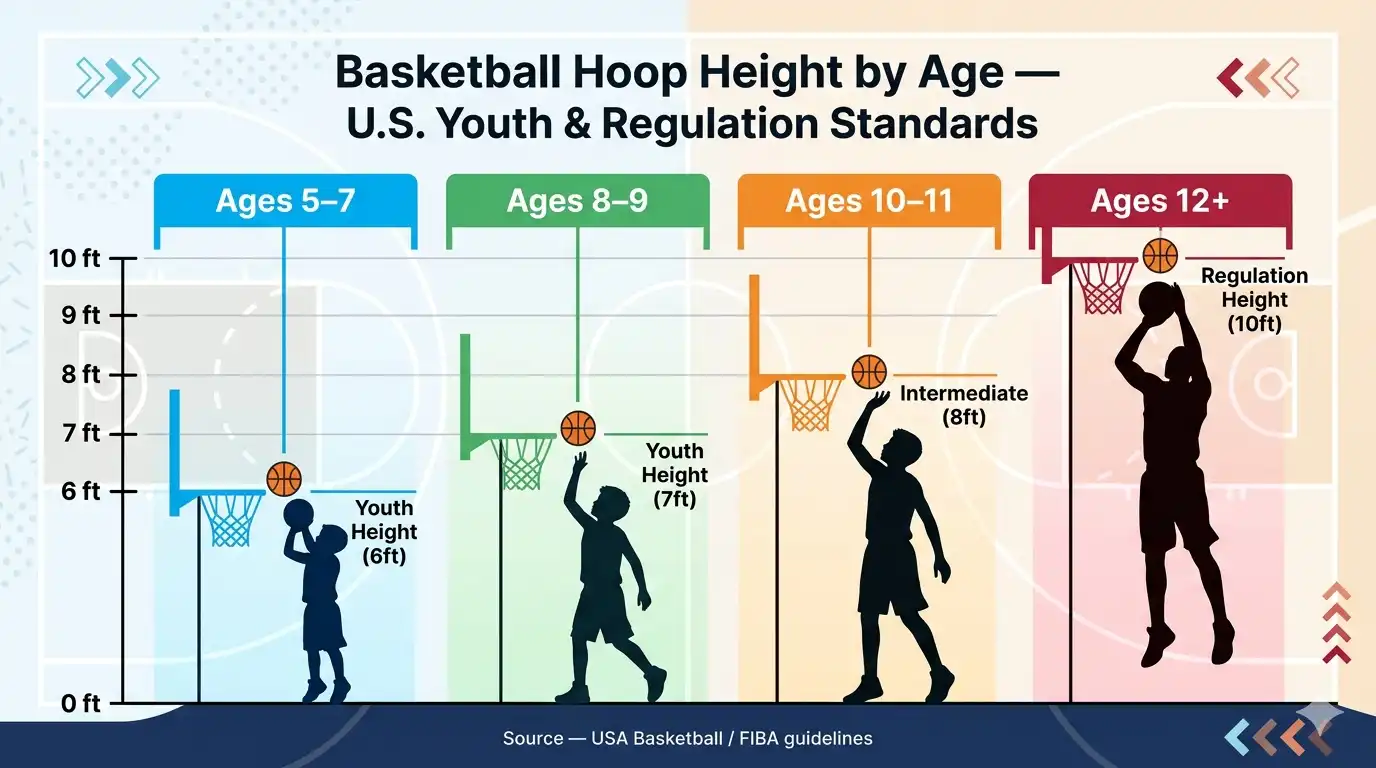
While 10 feet is the regulation height for players 12 and older, youth basketball organizations across the U.S. use progressively lower rim heights to support proper shooting mechanics and age-appropriate skill development. Forcing young players to shoot at a 10-foot hoop too early leads to compromised form — pushing the ball from the hip or chest rather than developing a proper release.
| Age Group | Recommended Rim Height | Ball Size | Level |
|---|---|---|---|
| Ages 5–7 | 6–7 feet (1.83–2.13 m) | Size 3 (mini) | Beginner |
| Ages 8–9 | 8 feet (2.44 m) | Size 4 (youth) | Beginner |
| Ages 10–11 | 9 feet (2.74 m) | Size 5 (intermediate) | Intermediate |
| Ages 12–14 | 10 feet (3.05 m) | Size 6 (women’s) or 7 | Regulation |
| Ages 15 & older | 10 feet (3.05 m) | Size 7 (men’s) | Official Regulation |
Adjustable basketball hoop systems are the best investment for family courts. Most quality adjustable hoops range from 7.5 feet up to the regulation 10 feet, allowing one system to grow with your child from early recreational play all the way through to full regulation height.
NBA vs. WNBA vs. FIBA vs. NCAA: Regulation Comparison
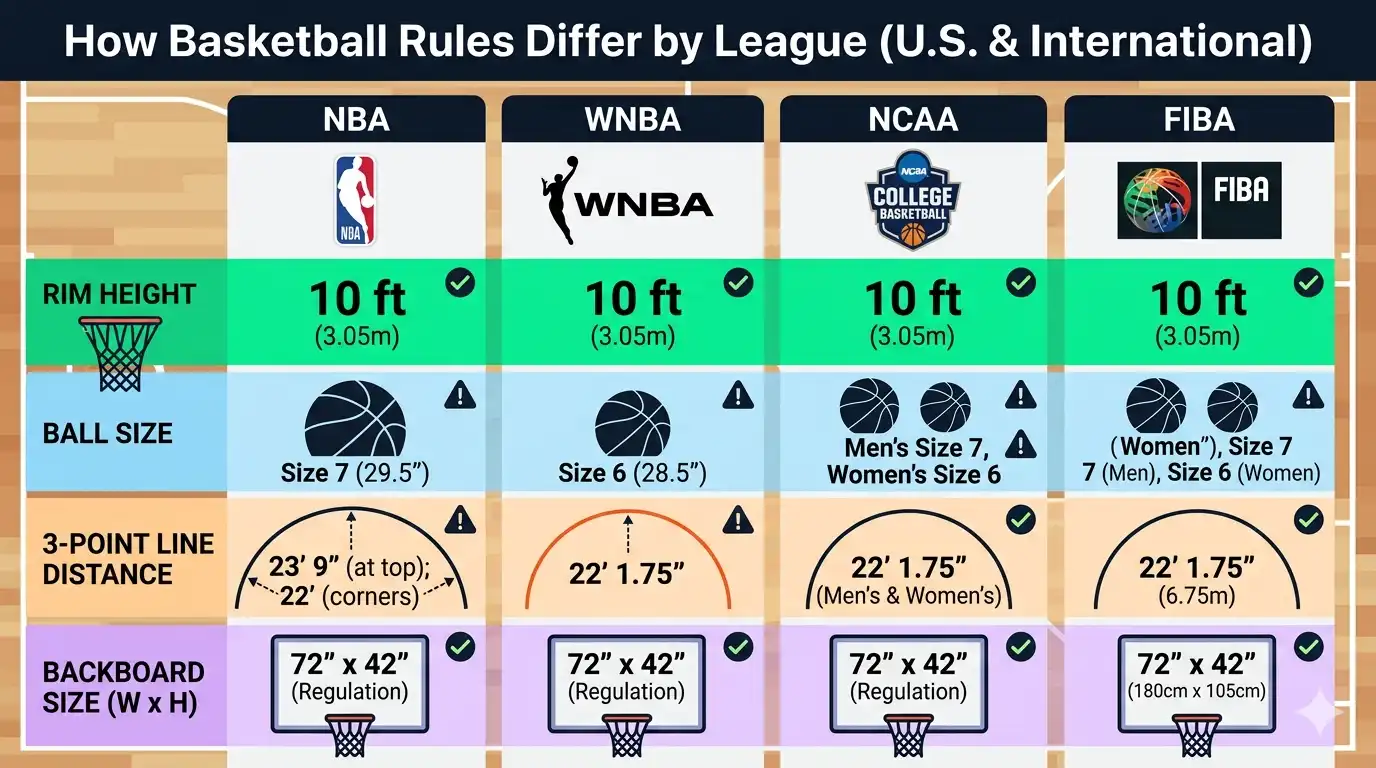
One of the most common questions from U.S. basketball fans is whether the rim height changes between leagues—for example, does the WNBA use a lower hoop? The answer is no. Every major professional and collegiate basketball organization uses the same 10-foot standard.
| Specification | NBA | WNBA | NCAA | FIBA |
|---|---|---|---|---|
| Rim height | 10 ft (3.05 m) | 10 ft (3.05 m) | 10 ft (3.05 m) | 10 ft (3.05 m) |
| Rim diameter | 18 in (46 cm) | 18 in (46 cm) | 18 in (46 cm) | 18 in (46 cm) |
| Backboard size | 72 × 42 in | 72 × 42 in | 72 × 42 in | 72 × 42 in |
| 3-point line distance | 23.75 ft | 22.15 ft | 22.15 ft | 22.15 ft |
| Ball size (circumference) | 29.5 in (size 7) | 28.5 in (size 6) | 29.5 in (men) / 28.5 in (women) | 29.5 in (men) / 28.5 in (women) |
| Lane width | 16 ft | 12 ft | 12 ft | 16 ft |
| Shot clock | 24 sec | 24 sec | 30 sec | 24 sec |
Complete Basketball Hoop Specifications
The regulation rim height is just one part of a standardized basketball equipment setup. Here are all the critical measurements you need to know—whether you’re building a home court or verifying a gym installation.
NBA regulations specify a white rectangle on the backboard that measures 24 inches wide by 18 inches tall, centered horizontally, with its bottom edge sitting level with the top of the rim. This target box helps players aim their bank shots and is standard across all regulation backboards.
How Rim Height Affects Shooting Mechanics & Player Development
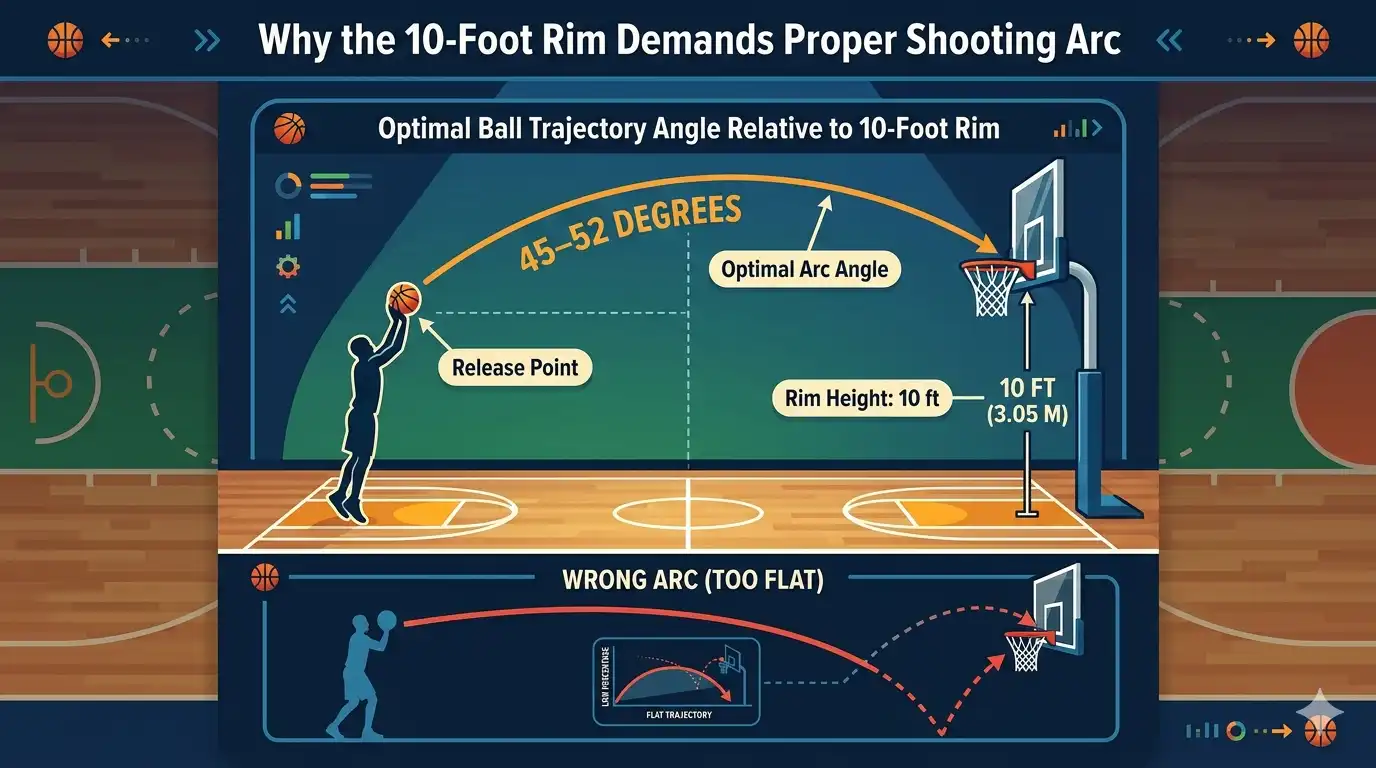
The 10-foot rim height is not arbitrary — it demands specific biomechanics that define successful shooting form. Players need a launch arc of roughly 45–52 degrees, leg-driven power generation, a clean elbow tuck, and a relaxed wrist snap on release. These mechanics transfer directly to consistent, high-percentage shooting throughout a career.
When young players attempt to shoot on a regulation hoop before they’re physically ready, they compensate by pushing the ball from the chest or hip—ingrained habits that are notoriously difficult to correct later. This is the primary reason USA Basketball, the National Federation of State High School Associations (NFHS), and youth leagues across the country advocate for age-appropriate rim heights.
The recommended progression—6–7 ft→ 8 ft→ 9 ft→ 10 ft— mirrors how youth sports organizations structure physical development in other sports. Each stage builds on the last, reinforcing proper mechanics before increasing the physical demand. Transitioning to 10 feet around age 12 typically coincides with the physical maturation needed to execute regulation shooting form without compensating.
How to Measure & Verify Basketball Hoop Height at Home
If you’re installing or checking an adjustable basketball system, accurate measurement is relevant for skill transfer. Here’s how to verify your rim is at the correct height without professional tools.
Method 1 — Tape measure (most accurate)
Position a step ladder safely underneath the hoop. Extend a measuring tape from the playing surface directly below the front of the rim straight up to the top edge of the rim. Ensure the tape is perfectly vertical—use a level or plumb line if needed. Measure from at least three points around the rim to confirm it’s level.
Method 2 — Ball reference check
A regulation NBA basketball has a diameter of approximately 9.5 inches. If you know your standing reach height, you can estimate rim height by calculating how many ball widths fit between your fingertips and the rim. This method is approximate — always confirm with a tape measure for permanent installations.
Common installation errors
Portable hoop systems in particular can drift below regulation height over time if the height lock mechanism wears or loosens. Re-inspect portable systems every season, especially if multiple users adjust the height regularly.
Frequently Asked Questions
What is the official height of an NBA basketball hoop?
The official NBA rim height is 10 feet (3.05 meters) from the floor to the top edge of the rim. This is identical to the standard used in the WNBA, NCAA, FIBA, and all U.S. high school competition. It has been unchanged since 1891.
Does the WNBA use a lower basketball hoop than the NBA?
No. The WNBA uses the same 10-foot (3.05 m) rim height as the NBA. While the WNBA uses a slightly smaller ball (size 6, 28.5 inches circumference vs. the NBA’s size 7, 29.5 inches), the hoop height is identical across all professional leagues, both men’s and women’s.
What basketball hoop height is right for a 10-year-old?
A 9-foot (2.74 m) rim height is recommended for players ages 10–11. This lets them practice proper shooting form—developing an arc, follow-through, and leg drive—without the physical strain of reaching a full 10-foot rim. An adjustable hoop system is ideal for home use so the height can be raised as the child grows.
Why is a basketball hoop 10 feet high?
The 10-foot height is a product of historical circumstance. When James Naismith invented basketball in 1891, he hung peach baskets on a gymnasium balcony railing that happened to be 10 feet off the floor. The height was effective in practice and has been in the rules for over 134 years.
Has the NBA ever considered changing the hoop height?
The idea has been floated several times over the decades—most famously, Wilt Chamberlain, who stood 7 feet 1 inch, reportedly suggested raising the rim to 12 feet to level the playing field. However, the NBA and other governing bodies have never formally moved to change the standard, citing competitive consistency and 134 years of historical precedent.
What is the diameter of a basketball hoop (Rim)?
The inner diameter of a regulation basketball rim is 18 inches (46 cm). This is standard across the NBA, WNBA, NCAA, FIBA, and all high school competition. An NBA basketball (size 7) has a diameter of about 9.4–9.5 inches, meaning two basketballs could theoretically fit side-by-side through a regulation rim—though barely.
When should a youth player transition to a 10-foot hoop?
Most youth basketball guidelines recommend transitioning to the regulation 10-foot hoop around age 12. The progression is: ages 5–7 use 6–7 ft; ages 8–9 use 8 ft; ages 10–11 use 9 ft; ages 12 and up use 10 ft. Individual physical development varies, so coaches should monitor shooting mechanics rather than switching purely based on age.
Final Takeaway
The 10-foot basketball hoop height is one of the most enduring constants in American sports history. Whether you’re a parent choosing your child’s first adjustable hoop, a coach calibrating your gym setup, or a fan curious about the rules, the measurement is universal — 10 feet from floor to rim, at every level from the local rec center to the NBA.
For younger players, the age-appropriate progression from 6 feet to 10 feet isn’t just a convenience — it’s the foundation of sound shooting mechanics that carry through an entire career. Start at the right height, develop proper form, and the step up to regulation feels natural.
