


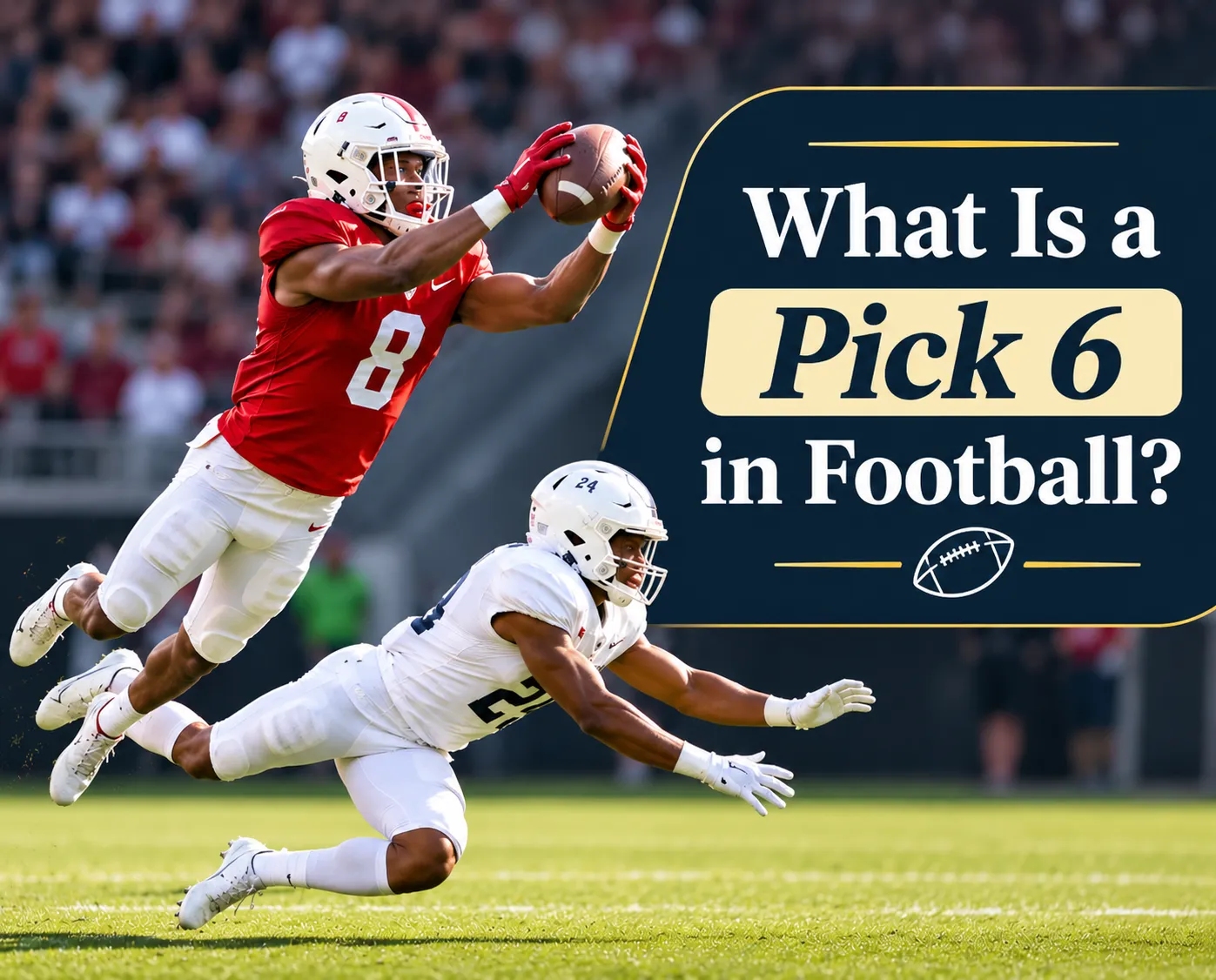
A Pick Six occurs when a defensive player intercepts a forward pass and returns it into the opponent’s end zone for a touchdown, scoring six points. The term combines “pick,” common football language for an interception, with “six,” the points awarded for a touchdown. Because the interception and touchdown occur on the exact same down, a Pick Six immediately changes possession and puts points on the scoreboard.
Consequently, this guide explains how a Pick Six happens, how it affects the score, and which NFL plays have made the term famous. For broader context on how downs, penalties, and scoring fit together, consult American Football Rules Explained: Field, History, Positions & Records.
What Is a Pick Six in Football?
A Pick Six is an interception that a defensive player returns for a touchdown on the same play. Specifically, the sequence develops through four stages from the snap:
- The quarterback throws the pass: The offense attempts a forward pass toward an eligible receiver.
- The defender intercepts the ball: A defensive player catches the forward pass before it hits the ground, completing the interception under NFL catch rules.
- The return begins: The defender advances the ball toward the opponent’s end zone while teammates set blocks against opposing tacklers.
- The runner scores the touchdown: If the runner crosses the opponent’s goal line with possession, the play produces a touchdown.
For example, suppose a quarterback throws toward a wide receiver running an out route. If a cornerback breaks on the ball, intercepts the pass, and sprints into the end zone, that defensive score represents a Pick Six. Crucially, the defender must carry the ball across the goal line; otherwise, an interception without a return touchdown remains a standard turnover.
Why Is It Called a Pick Six?
The phrase comes directly from two everyday football terms:
- Pick: A shortened form of “pick off,” meaning to intercept a pass thrown by the opponent.
- Six: The six points that an official awards for scoring a touchdown.
Therefore, the term describes the complete outcome of the play: a defender picks off a pass and scores six points by returning it for a touchdown. In football commentary, both “Pick 6” and “Pick Six” describe an interception returned for a touchdown. When fans ask what the phrase means, it refers specifically to that complete takeaway-and-scoring result.
How Does a Pick Six Work?
A Pick Six can turn an ordinary offensive play into a scoring opportunity for the defense in seconds.
The Interception and Transition
After the snap, a quarterback drops back and attempts a forward pass. Often, inaccurate throws, heavy pass-rush pressure, deflections, or alert defenders create interceptions. Once a defender secures the interception inbounds under league catch rules, that player’s team gains possession. As a result, the intercepting defender can legally advance the ball down the field.
Returning the Ball
Upon securing the catch, the intercepting player becomes an active runner. Meanwhile, teammates immediately shift roles from pass coverage into lead blockers to clear a running lane.
However, a return can end short of the end zone in multiple ways:
- An opponent tackles the ball carrier.
- The runner steps out of bounds.
- The runner fumbles the football.
If a runner fumbles during the return, the ball remains live under official rules governing loose balls and fumble recoveries.
Reaching the End Zone
Ultimately, the play becomes a Pick Six only when the defender carries the ball across the opponent’s goal line with possession.
If an opponent tackles the runner or forces the player out of bounds before the goal line, the interception still gives the team possession. Consequently, the team starts its next offensive drive at that dead-ball spot under standard placement rules. Similarly, if an accepted penalty wipes out the score, officials do not count the play as a Pick Six.
That rapid transition explains why a Pick Six carries so much impact: a single pass can instantly produce a defensive touchdown.
How Many Points Is a Pick Six Worth?
A Pick Six is worth six points because it constitutes an official touchdown.
Officials award the scoring team six points on the scoreboard. Immediately after the touchdown, the scoring team earns an untimed try to attempt one or two additional points.
| Scoring Play | Points | Explanation |
|---|---|---|
| Pick Six Touchdown | 6 | The defender returns an interception across the goal line. |
| Successful Extra-Point Kick | 1 | The kicker sends a placekick through the goalposts after the touchdown. |
| Successful Two-Point Try | 2 | The offense advances the ball into the end zone on a scrimmage play. |
The try functions as a separate play. Therefore, a team that scores a Pick Six can finish with six, seven, or eight total points from the touchdown and its try, depending on the outcome of the extra-point kick or two-point attempt.
For a broader explanation of scoring plays across different game situations, see our guides on How Does NFL Scoring Work? Every Way to Score Points and What Is a Touchdown Worth? The Real History Behind 6.
Pick Six vs. Interception: What Is the Difference?
An interception and a Pick Six describe two distinct outcomes on the field:
| Feature | Standard Interception | Pick Six |
|---|---|---|
| Definition | A defender catches an opponent’s forward pass. | A defender catches a pass and returns it into the end zone. |
| Points Scored | The turnover alone yields no points. | The resulting touchdown yields six points. |
| Touchdown Required? | No | Yes |
| Drive Result | The intercepting team takes possession where the return ends. | The intercepting team scores directly, followed by an extra-point or two-point try. |
| Statistical Record | The official scorer credits the defender with an interception and charges the passer with an interception thrown. | The official scorer credits the defender with an interception, return yards, and a defensive touchdown. |
In short, every Pick Six begins with an interception, but only a fraction of interceptions end in touchdowns. While a standard interception halts an opponent’s drive and secures possession, a Pick Six puts points directly on the scoreboard.
NFL Rules That Apply to a Pick Six
Under the official NFL Rulebook, specific provisions define the catch, legal advancement, scoring, and fouls:
- Rule 8, Section 1, Article 3 (Completed or Intercepted Pass): A defender intercepts a pass by catching an opponent’s throw before the ball touches the turf. Furthermore, the catch must satisfy the NFL’s requirements for control and completion before the defender advances the ball.
- Rule 3, Section 27 (Runner): A runner is any player in possession of a live ball. Thus, after completing an interception, the defender becomes a runner and may advance the ball until officials rule the play dead.
- Rule 11, Section 2, Article 1 (Touchdown Plays): A runner scores a touchdown (6 points) when carrying the ball across the plane of the opponent’s goal line.
- Rule 11, Section 3, Article 1 (Try): Following a touchdown, officials award the scoring team an untimed down to attempt a one-point kick or a two-point conversion from scrimmage.
However, a foul by the returning team can wipe out the touchdown or push back the starting spot of the next drive. Specifically, the final ruling depends on the infraction and the applicable penalty-enforcement rules.
Historic Pick Six Milestones and Famous Plays
Certain interception returns stand out as documented milestones and iconic championship moments in NFL history:
| Player | Game / Season | Return Distance or Achievement | Historical Context |
|---|---|---|---|
| Ed Reed | Baltimore Ravens vs. Eagles (2008) | 107-yard return | The NFL and Hall of Fame officially record this play as a 107-yard touchdown return. |
| James Harrison | Super Bowl XLIII (Steelers vs. Cardinals) | 100-yard return | Harrison returned an interception 100 yards for a touchdown as the first half expired. |
| Tracy Porter | Super Bowl XLIV (Saints vs. Colts) | 74-yard return | Porter intercepted a third-down pass late in the fourth quarter to help secure New Orleans’ victory. |
| Malcolm Smith | Super Bowl XLVIII (Seahawks vs. Broncos) | 69-yard return | Smith returned an intercepted pass 69 yards for a touchdown on his way to winning Super Bowl MVP honors. |
| DaRon Bland | Dallas Cowboys (2023 Season) | 5 interception-return touchdowns | Bland established the documented season achievement for defensive interception-return touchdowns in one year. |
Ed Reed’s 107-Yard Interception Return Against Philadelphia
On November 23, 2008, Baltimore Ravens safety Ed Reed intercepted Philadelphia Eagles quarterback Kevin Kolb in the end zone and returned the ball for a touchdown. Although some contemporary accounts reported the play as 108 yards, official NFL records and the Pro Football Hall of Fame list it as 107 yards. Previously, Reed had returned an interception 106 yards for a touchdown against Cleveland in 2004.
DaRon Bland’s Five Pick Sixes in the 2023 Season
Dallas Cowboys cornerback DaRon Bland recorded five interception-return touchdowns during the 2023 regular season. Consequently, this performance surpassed the previous single-season mark of four, which Eric Allen (1993), Ken Houston (1971), and Jim Kearney (1972) had shared.
Three Famous Super Bowl Pick Sixes
Championship games have produced several of the most memorable defensive returns in league history:
- James Harrison in Super Bowl XLIII: With 18 seconds remaining in the first half, the Arizona Cardinals drove to Pittsburgh’s 1-yard line. However, Steelers linebacker James Harrison dropped into pass coverage, intercepted Kurt Warner at the goal line, and returned the interception 100 yards for a touchdown as time expired. This return gave Pittsburgh a 17-7 halftime lead and paved the way for a 27-23 victory.
- Tracy Porter in Super Bowl XLIV: Leading 24-17 with 3:12 remaining in the fourth quarter, the New Orleans Saints defended against Indianapolis quarterback Peyton Manning. Crucially, cornerback Tracy Porter jumped a third-down pass route, intercepted the throw, and returned it 74 yards for the touchdown that sealed the franchise’s first championship.
- Malcolm Smith in Super Bowl XLVIII: In the second quarter of Super Bowl XLVIII, Seattle defensive end Cliff Avril pressured Peyton Manning and hit his arm during the throw. As a result, the pass floated into the air, allowing linebacker Malcolm Smith to intercept it and sprint 69 yards for a score. This play extended Seattle’s lead to 22-0 during a 43-8 victory, and Smith ultimately captured Super Bowl MVP honors.
Why Is a Pick Six a Game-Changing Play?
A Pick Six alters a game for three primary reasons:
- Direct points for the defense: The defense scores six points without requiring its offensive unit to run a drive.
- Immediate change of possession: The attacking team must immediately switch to defense, losing its scoring opportunity on that drive.
- Tactical adjustment: A defensive score late in a close contest often alters the opponent’s game plan, forcing a trailing team into predictable passing situations.
Ultimately, the game clock, score differential, and field position dictate how drastically a Pick Six changes the final outcome.
Frequently Asked Questions
What does Pick Six mean in football?
A Pick Six means a defensive player intercepts an opponent’s forward pass and returns it into the end zone for a touchdown, scoring six points.
How many points is a Pick Six worth?
A Pick Six awards six points. Furthermore, officials award the scoring team an untimed try to attempt a one-point extra-point kick or a two-point conversion.
Can a defensive player score a Pick Six on a two-point conversion attempt?
No. While a defender can return an interception or fumble recovery for a score during a two-point try, officials award the defense two points instead of six. Therefore, a defensive return on a try does not count as a Pick Six.
Is every interception a Pick Six?
No. The defender must return the interception into the end zone for a touchdown. If an opponent tackles the runner before the goal line, or if an accepted penalty wipes out the score, the play remains an ordinary interception.
Can a Pick Six happen in the NFL playoffs?
Yes. The rules governing interception-return touchdowns apply equally during regular-season games, playoff matchups, and the Super Bowl.
What is the difference between a Pick Six and a regular interception?
A regular interception changes possession and gives the intercepting team the ball at the dead-ball spot. In contrast, a Pick Six advances the ball across the goal line for a touchdown.