


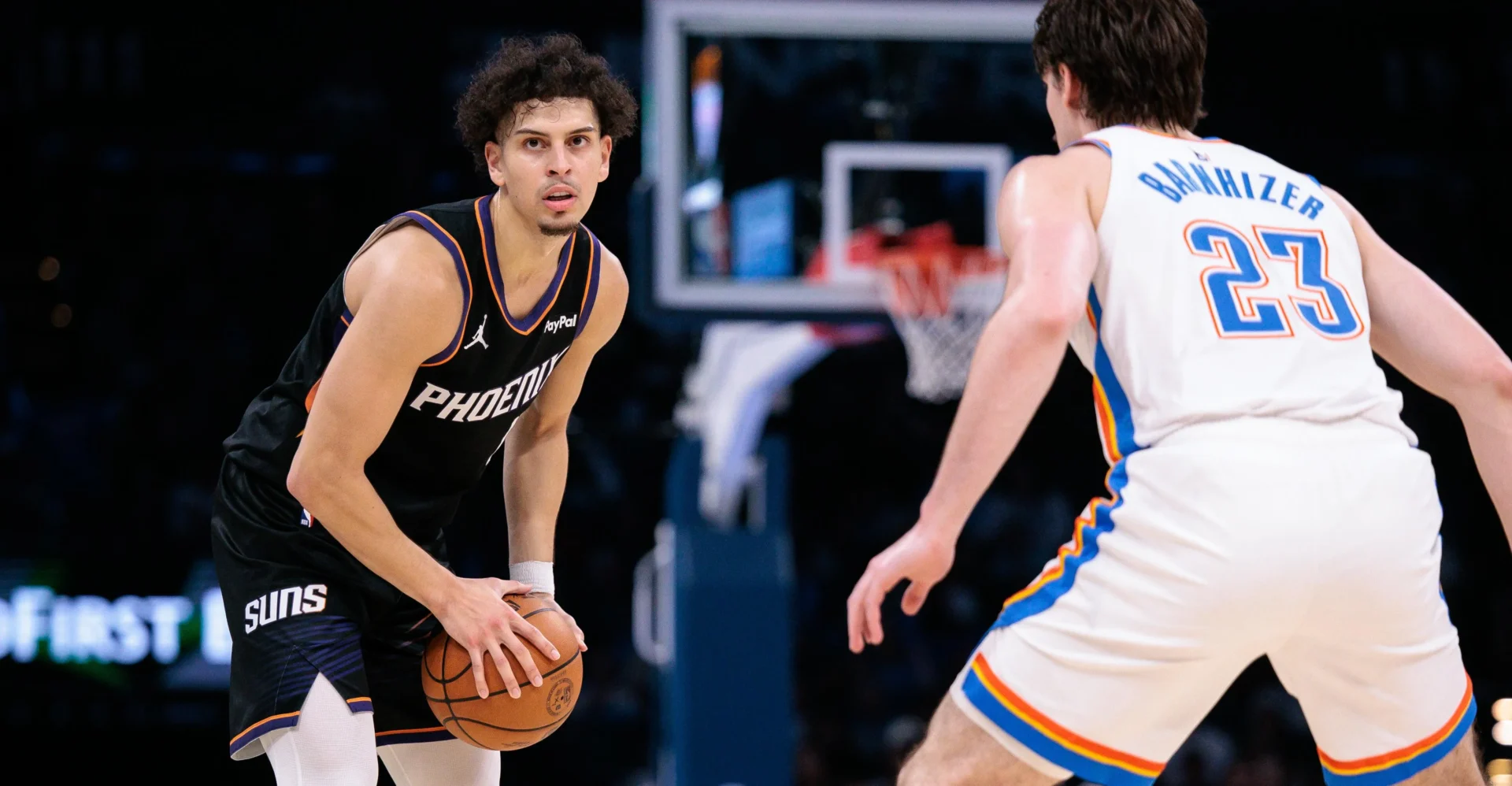
The Phoenix Suns’ two-way contracts rarely make headlines, but this year’s group deserves a closer look. Pat Spencer, Koby Brea, and CJ Huntley are not auditioning to be stars. Each one is built to solve a different problem if the Suns’ season stops going according to plan.
The Situation: How Phoenix Suns Two-Way Contracts Became a Team-Building Habit
Phoenix filled all three of its two-way slots again this offseason, continuing a pattern the front office has leaned on since the league expanded the allotment. The 2023 collective bargaining agreement raised the two-way limit from two roster spots to three per team, part of a broader push to formalize the G League as a developmental pipeline. It also lifted the active-game cap for two-way players from 45 games to 50, giving teams more runway to test young talent before a decision has to be made.
Point guard Pat Spencer signed with Phoenix in early July after three seasons with the Golden State Warriors, where his role grew every year. Power forward CJ Huntley, an undrafted rookie out of Appalachian State, returned on a fresh two-way deal after a bumpy first season that included a midseason waiver. Guard Koby Brea, the Suns’ 41st overall pick in the 2025 draft, re-signed on a two-way after appearing in 12 games as a rookie.
None of the three is close to aging out of eligibility. Two-way contracts require three or fewer years of NBA service time, and Spencer, Huntley and Brea all fit comfortably inside that window heading into 2026-27.
The Evidence: What Last Season’s Two-Way Players Actually Did
Point guard Jamaree Bouyea offers the clearest proof the system works. Basketball-Reference credits Bouyea with 46 games played for Phoenix in 2025-26, a career high, after he signed a two-way deal in November. He averaged 5.7 points and 1.8 assists in 14.0 minutes before the Suns converted him to a standard contract in March, and HoopsHype’s Michael Scotto reported Phoenix later exercised a $2.6 million non-guaranteed team option on him for 2026-27.
Huntley’s numbers with the Valley Suns back up the developmental bet, even though his path was not a straight line. Phoenix waived him in November to open a two-way spot for Bouyea, then re-signed him in March after he continued to produce in the G League. Basketball-Reference’s G League log shows Huntley averaging 15.3 points and 7.9 rebounds on 63.2% shooting across 41 games with Valley.
| Player | 2025-26 Home Team | Key 2025-26 Stat Line |
|---|---|---|
| Pat Spencer | Golden State Warriors | 66 games, 14 starts, 7.2 PPG, 3.5 APG |
| CJ Huntley | Valley Suns (G League) | 41 games, 15.3 PPG, 7.9 RPG, 63.2% FG |
| Koby Brea | Phoenix Suns | 12 games, 3.8 PPG, 43.3% 3PT (13-of-30) |
Spotrac lists Spencer’s new Phoenix deal at $678,882 with $91,000 guaranteed, a structure typical of the expanded two-way scale. Brea’s rookie sample size stayed tiny by design. His 43.3% clip from three on 30 attempts explains why the coaching staff kept him around even though NBA minutes were scarce.
Other franchises are leaning on the same math. The Oklahoma City Thunder added guard Payton Sandfort on a two-way deal earlier this year, the kind of low-cost flier that has become standard across the league since the 2023 CBA opened the third roster spot.
The Counter-Argument: Why the Bet Might Not Pay Off
Skeptics have a real case here. Phoenix’s backcourt is already crowded with Devin Booker, Jalen Green, Luke Kennard and Collin Gillespie ahead of Spencer and Brea on the depth chart. Power forward Miles Bridges now occupies the frontcourt spot Huntley would need to fill in an emergency, a swap that sportda.com’s own trade grades were not kind to, a fallout tracked in Miles Bridges Trade Grades: Suns Get D, Hornets Get A.
If health holds and Phoenix’s top six stay on the floor all season, two-way players see G League minutes by design, not NBA ones. That is the tradeoff built into the structure. Teams are buying cheap optionality, not guaranteed production, and there is no rule forcing a coach to play any of these three over an established rotation piece.
The Verdict: Insurance Only Matters When Something Breaks
None of that undercuts the logic behind the roster construction. Phoenix is not paying for production right now. It is paying for coverage across a range of scenarios, so the team does not have to scramble the way it briefly did during the 2025-26 season.
Point guard Collin Gillespie’s own path from an in-season two-way signing to a buzzer-beating rotation piece, a stretch that included Phoenix Suns Stun Wolves: Gillespie Buries Game-Winner in Miraculous 49-Second Comeback, is the outcome the front office is chasing again with all three names on this year’s list. The salary structure behind these deals matters as much as the players filling them, since two-way money does not count against the salary cap, a distinction covered in more depth in The Business of Basketball: Contracts, Analytics, Salaries & Sports Betting.
Watch how Phoenix uses its Valley Suns pipeline once training camp opens. A call-up before opening night would be the clearest sign yet that this year’s Phoenix Suns two-way contracts are working exactly as designed.