


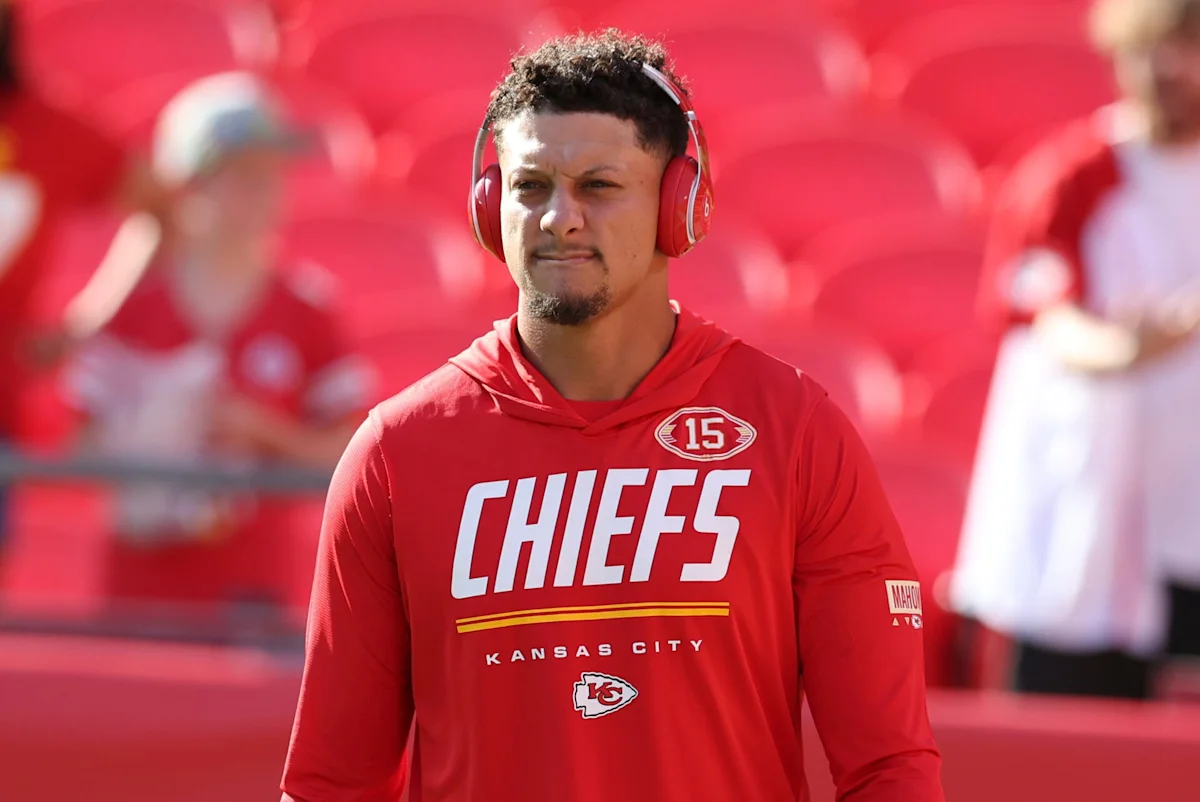
Quarterback Patrick Mahomes walked off the field with a 31-10 division victory in hand, yet his immediate postgame assessment sounded like that of a passer who had just dropped a home opener. Exactly 274 days after tearing both the anterior cruciate ligament (ACL) and lateral collateral ligament (LCL) in his left knee against the Los Angeles Chargers, the two-time MVP absorbed full-contact football on Monday Night Football against the Denver Broncos. While an opening-possession 15-yard touchdown scramble removed any lingering doubt about the structural integrity of his surgically repaired knee, the veteran franchise cornerstone focused solely on his own mechanical unevenness.
The box score proved functional rather than vintage, as Mahomes completed 15 of 27 passes for 184 yards, two touchdowns, and one interception on an early miscommunication with wide receiver Xavier Worthy. “I feel like I was moving around fast [and] I think I was a little quick with my reads,” Mahomes told reporters late Monday night after addressing his footwork. “There were some people where if I just got to the second or third read, they were open, especially earlier in the game. I tried to force a few things early and then I had a few overstrides, which is kind of part of it. I’ve got to get back to being balanced where I can make those throws.” That brutal self-honesty highlights the real gap facing players returning from complex reconstruction: passing medical milestones is one challenge, but recalibrating internal pocket clocks under live pass-rush fire remains entirely another.
Kansas City managed the emotional high of the evening by leaning on an overwhelming ground attack, taking pressure off their franchise leader while testing his mobility on designed play-action bootlegs. The victory instantly restored order in the AFC West, signaling to the rest of the conference that the league’s dominant baseline quarterback has officially resumed full operational duties.
Inside the Rapid Reconstruction That Powered His 274-Day Recovery
Medical logistics moved rapidly the moment Mahomes sustained the multi-ligament tear on December 14, 2025, during Kansas City’s playoff-eliminating Week 15 loss. Head trainer Rick Burkholder assembled an inner circle at the facility that included agent Chris Cabott, head coach Andy Reid, general manager Brett Veach, and owner Clark Hunt before flying the quarterback to Dallas for surgery the next day. Dallas Cowboys head team physician Dr. Dan Cooper operated within 24 hours of the initial incident, capitalizing on a crucial clinical factor: Burkholder confirmed Mahomes suffered zero damage to his popliteal artery, peroneal nerve, articular joint surfaces, or meniscus.
That clean pathology cleared a realistic nine-month pathway back to the active roster. Throughout the spring, Mahomes established an intense cross-country rehab partnership with veteran tight end Zach Ertz, who had torn his own ACL one week prior. The duo exchanged daily film of heavy single-leg deadlifts, depth drops, and lateral change-of-direction plyometrics to track recovery benchmarks. By late July, general manager Brett Veach green-lit full participation without restrictions on the exact morning wide receiver Rashee Rice returned from his own knee procedure.
Holding Mahomes out of all three preseason exhibitions preserved his knee for competitive contact, allowing him to step onto Arrowhead Stadium’s turf Monday without a brace limitation. The early dividend arrived quickly when rookie cornerback Mansoor Delane secured an interception on Denver’s opening drive, setting up Kansas City at the 15-yard line. When a split-zone concept broke down on third down, Mahomes climbed through interior rush lanes, plant-cut off the surgically repaired left leg, and dove past two closing defenders for the first touchdown of the season.
The moment showcased total confidence in his repaired ligaments, sending the home crowd into a frenzy:
Overcoming Prior Career Ailments Before the 2025 Ligament Rupture
This nine-month rehabilitation marked the first time Mahomes faced a long-term layoff, though navigating physical adversity has defined his professional tenure. In September 2019, he suffered a severe high-ankle sprain against the Jacksonville Jaguars, choosing to remain in the huddle while throwing for 378 yards and three scores. A month later against Denver, a dislocated right patella cost him just two starts before he engineered a postseason championship sprint.
Similar resolve surfaced throughout the 2020 playoffs, when he required post-Super Bowl surgery to repair a ruptured plantar plate, widely categorized as turf toe, after battling through turf-induced toe and foot trauma. That grit peaked again in January 2023, when an acute right high-ankle sprain suffered in the divisional round against Jacksonville failed to sideline him, culminating in another Vince Lombardi Trophy three weeks later against Philadelphia. December’s joint trauma against the Chargers, however, superseded every previous injury by forcing him to miss consecutive games for the first time as a full-time starter.
Reid’s Tactical Adjustments and the New Backfield Engine
Head coach Andy Reid implemented a distinct schematic adaptation on Monday to protect his returning passer, exacerbated by an in-game back injury sustained by offensive tackle Josh Simmons. Kansas City shifted away from empty-backfield spread sets, turning instead to heavy 12-personnel formations that highlighted the explosive arrival of running back Kenneth Walker III. Walker destroyed Denver’s front seven for 173 rushing yards on 23 carries, adding an explosive 60-yard scamper and two total touchdowns that dictated game script across the second half.
The offensive pivot visibly altered Mahomes’ typical distribution patterns. Tracking metrics from TruMedia confirmed that 40.7% of his attempts occurred at or behind the line of scrimmage, registering as the third-highest quick-release rate across Week 1. Furthermore, Mahomes released the football in under 2.5 seconds on 59.3% of his dropbacks, reflecting an accelerated processing rhythm designed to evade pocket collisions. Kansas City’s dominant two-way performance appears below, tracked using official game logs cross-referenced through Pro Football. Reference historical records:
| Player / Unit | Primary Metric | Game Impact Summary |
|---|---|---|
| Quarterback Patrick Mahomes | 15/27, 184 Pass Yds, 3 Total TDs | Rushed for 15-yard TD; averaged under 2.5 seconds to throw |
| Running back Kenneth Walker III | 23 Carries, 173 Rush Yds, 2 Total TDs | Logged 60-yard scoring run; added 2-yard receiving touchdown |
| Defensive Coordinator Steve Spagnuolo Unit | 9 Consecutive 3rd-Down Stops | Limited Denver to 10 points; forced Bo Nix interception |
Walker’s downhill explosion provided the exact offensive balance Kansas City lacked when Mahomes was isolated against heavy blitz looks late in 2025. Denver’s defense surrendered 17 unanswered points out of halftime, completely neutralized by the perimeter run game and disciplined underneath completions.
Calibrating Pocket Mechanics for the Long Road Forward
Mahomes knows that executing screens and relying on 170-yard rushing outbursts will not suffice against complex defensive shells later in the autumn. “I’ve got to be better,” Mahomes reiterated while dissecting missed intermediate crossers. “At the end of the day, I have to be better. There were times when those guys were open and I was a little bit quick with my reads and getting the ball out of my hand. I have to have the trust in the offensive line [and] I have to have the trust in myself that I can withstand taking the hits.”
Overstriding on baseline drive throws remains the standard technical hurdle for quarterbacks working through repaired plant legs, as the body instinctively compensates to relieve torque on the knee joint. When his front foot lands beyond its natural target line, the release point drops, causing routine perimeter throws to sail low into the dirt. Remedying that flaw requires live game repetitions against exterior edge rushers rather than scripted summer throwing sessions.
Kansas City now heads into a critical stretch where Mahomes will steadily expand downfield progressions and rebuild timing on second-reaction throws. Securing an emphatic AFC West victory proved that the Patrick Mahomes ACL tear return has officially crossed its physical hurdle, leaving only mechanical fine-tuning between the league’s top passer and his championship standard.