


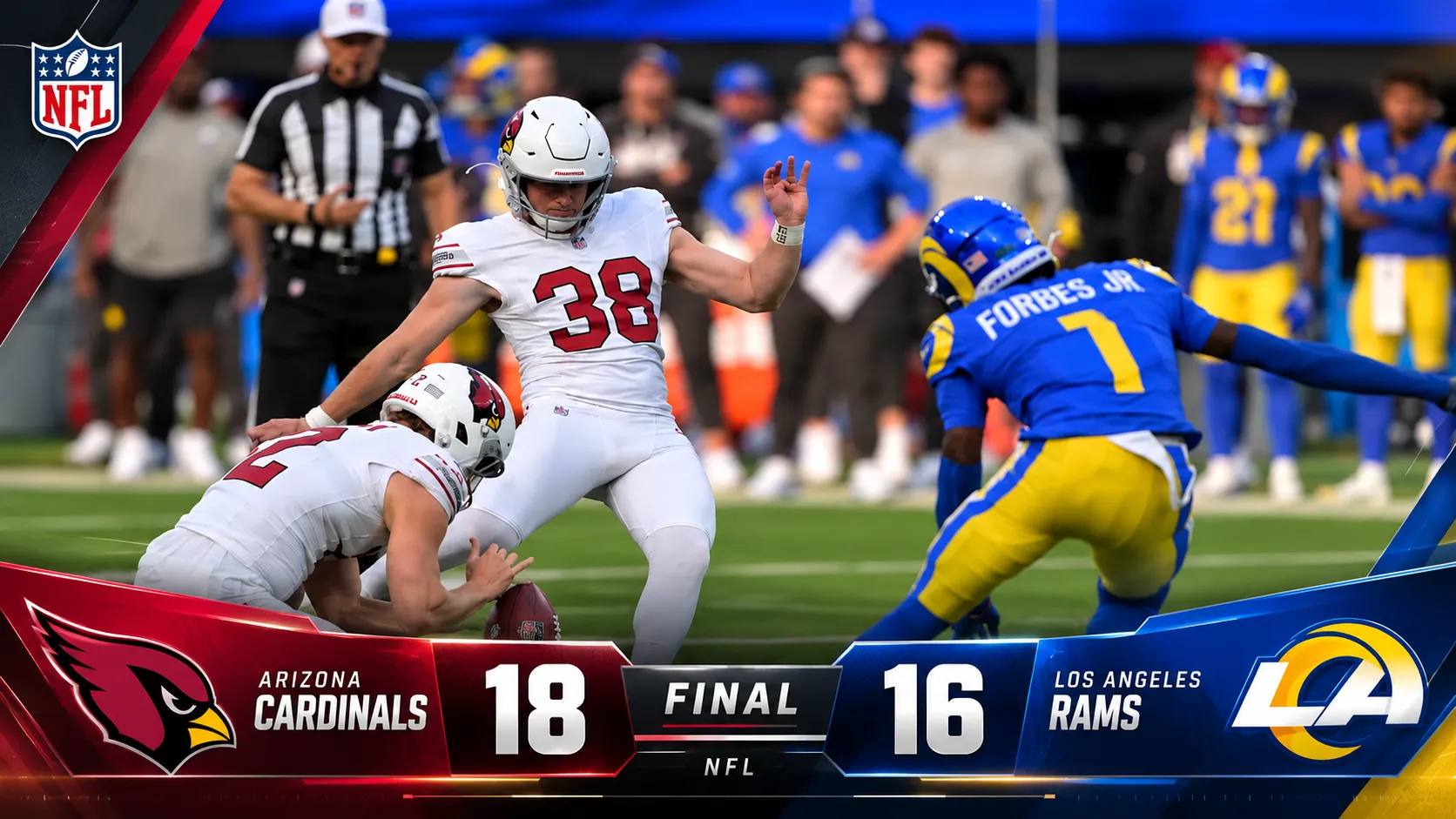
The Arizona Cardinals beat the Los Angeles Rams 18-16 on Sunday at SoFi Stadium, winning a divisional game without scoring a touchdown. Chad Ryland converted all six of his field-goal attempts, including a 43-yard kick as time expired, after the Rams had moved ahead with 47 seconds remaining.
Arizona’s winning drive was short but decisive. Jacoby Brissett completed a 21-yard pass to Ja’Corey Brooks, and a 15-yard unnecessary roughness penalty against Los Angeles extended the drive and moved the Cardinals closer to field-goal range. Ryland finished the possession with the kick that settled the game.
The result moved both NFC West teams to 2-4. Arizona outgained Los Angeles 338-286 and controlled possession for 34 minutes and 52 seconds, while the Rams were left to consider how a late lead slipped away after their new kicker, Blake Grupe, suffered a knee injury in the first quarter.
Arizona’s Defense Controls the Game
Arizona’s defensive performance supplied the foundation for the win. The Cardinals limited Los Angeles to 286 total yards, recorded three sacks and seven quarterback hits, and repeatedly forced the Rams to work through difficult down-and-distance situations.
Matthew Stafford completed 25 of 33 passes for 222 yards and two touchdowns. However, Los Angeles struggled to maintain offensive rhythm for much of the afternoon. Arizona’s pressure disrupted the pocket, while the Rams’ inability to capitalize on key possessions kept the Cardinals within reach even when their own offense stalled.
Safety Quentin Lake intercepted Brissett during Arizona’s opening possession, giving Los Angeles an early scoring opportunity. The Rams converted the takeaway into a 44-yard field goal by Grupe, but the Cardinals responded with a field goal of their own to make it 3-3.
Arizona’s defense became more effective as the game progressed. The Rams finished with 92 rushing yards and lost a crucial fumble when tight end Tyler Higbee surrendered possession in the fourth quarter. That turnover denied Los Angeles an opportunity to build on a promising offensive drive.
The Cardinals also stopped a fourth-down attempt at their own 27-yard line late in the third quarter. With Grupe unavailable, Los Angeles faced difficult decisions about whether to attempt longer field goals or keep its offense on the field. Arizona capitalized on that uncertainty and preserved its advantage.
Blake Grupe’s Injury Complicates Rams’ Decisions
Grupe’s injury changed the complexion of the contest almost immediately. The recently signed kicker made a 44-yard field goal on his first attempt as a Ram, but injured his knee while attempting to tackle returner Devin Duvernay on the ensuing kickoff. He did not return.
Los Angeles turned to punter Ethan Evans for emergency kicking duties. Evans converted the extra point after Stafford’s late touchdown pass to Colby Parkinson, giving the Rams a 16-15 lead with 47 seconds remaining.
The absence of a regular placekicker also affected Sean McVay’s decisions earlier in the game. Trailing 12-9 in the third quarter, Los Angeles attempted a fourth-and-1 conversion from Arizona’s 27-yard line rather than settle for a conventional field-goal attempt. The Cardinals stopped the run short, preserving their lead.
That decision proved costly in a game with limited scoring opportunities. Arizona’s defense repeatedly forced Los Angeles to earn every yard, while the Rams could not turn their possession advantages in key moments into a comfortable lead.
The injury alone did not decide the outcome, but it narrowed Los Angeles’ options. The Rams still managed to take the lead late in the fourth quarter, but they allowed Arizona to have one last possession.
Game Scoring: Ryland Converts All Six Attempts
The scoring progression shows how Arizona remained in control without finding the end zone. Ryland accounted for all 18 Cardinals points, while the Rams relied on a touchdown, a failed two-point conversion, and their own field goal.
| Quarter | Scoring play | Score after play |
|---|---|---|
| First | Blake Grupe, 44-yard field goal | Rams 3-0 |
| First | Chad Ryland, 34-yard field goal | 3-3 |
| Second | Chad Ryland, 30-yard field goal | Cardinals 6-3 |
| Second | Blake Corum, 15-yard touchdown reception; two-point attempt fails | Rams 9-6 |
| Second | Chad Ryland, 22-yard field goal | 9-9 |
| Third | Chad Ryland, 38-yard field goal | Cardinals 12-9 |
| Fourth | Chad Ryland, 27-yard field goal | Cardinals 15-9 |
| Fourth | Colby Parkinson, 6-yard touchdown reception; extra point good | Rams 16-15 |
| Fourth | Chad Ryland, 43-yard field goal as time expired | Cardinals 18-16 |
Arizona’s third-quarter scoring drive was particularly important. The Cardinals consumed 8 minutes and 35 seconds before Ryland converted from 38 yards, limiting Los Angeles’ opportunities to respond. Another extended possession produced his 27-yard field goal in the fourth quarter.
The Rams eventually broke through with Parkinson’s touchdown, but Arizona had the final possession. The winning drive demonstrated the value of staying within striking distance, particularly when the opponent’s special-teams situation had become uncertain.
Cardinals Find a Way to Win Despite Red-Zone Problems
Arizona’s offense never reached the end zone, a limitation that would ordinarily make winning difficult against a division rival. Instead, the Cardinals relied on field position, sustained drives, and Ryland’s accuracy to keep adding points.
Brissett completed 24 of 35 passes for 218 yards and threw one interception. Running back Bam Knight contributed 80 rushing yards on 15 carries, helping Arizona finish with 338 total yards. Tight end Trey McBride also provided a reliable receiving option as the Cardinals moved the ball between the 20-yard lines.
The offense’s inability to finish drives remains an area for improvement. Arizona repeatedly settled for field goals despite reaching scoring territory, placing additional pressure on its defense to prevent the Rams from creating separation.
Ryland’s perfect afternoon masked those shortcomings. His six successful attempts included kicks from 22, 27, 30, 34, 38 and 43 yards, with the final attempt carrying the greatest consequence.
For head coach Mike LaFleur, the immediate challenge is turning those productive drives into touchdowns. Arizona showed it can control possession and execute in close games, but relying on six field goals every week would leave little margin for error.
What the Result Means for Both NFC West Teams
The victory moved Arizona to 2-4 and gave the Cardinals another road win in the Los Angeles area this season. More importantly, it offered a potential turning point for a defense that had struggled badly recently.
Arizona’s ability to pressure Stafford, force a critical fumble, and stop a fourth-down conversion provided a blueprint for competing against a talented offense. The next step is maintaining that level of execution while improving red-zone efficiency.
For Los Angeles, the defeat left the Rams at 2-4 after a game they briefly appeared to have won. Stafford’s two touchdown passes gave the team a late opportunity, but the offense struggled for long stretches, and the loss of Grupe complicated its decisions in Arizona territory.
The Rams will need greater consistency on offense and a clear plan for their kicking situation. Their late scoring drive showed that they could move the ball when the game demanded it, but the inability to prevent Arizona’s final response proved decisive.
Arizona leaves SoFi Stadium with a win built on defensive pressure and flawless kicking. Ryland supplied the finish, but the Cardinals’ ability to stay composed through a low-scoring contest gave him the opportunity to decide it on the final play.