


The 2027 NFL draft class is taking shape as one of the deepest at the top of the board in years, and these 2027 NFL mock draft first-round predictions have a quarterback going first overall who didn’t even need to be here. Arch Manning had a clean path into the 2026 draft. He turned it down, and this projection still has him going No. 1 to the Dolphins a year later.
He won’t inherit an easy job. Miami’s roster is thin enough to suggest a full teardown already happened before this pick was ever made, and Manning would step in as the centerpiece of that rebuild. The silver lining: the Dolphins are projected to carry top-three cap space league-wide over the next two offseasons, giving the front office real room to build around a rookie quarterback immediately instead of asking him to carry the roster alone.
The rest of the board backs that story up with depth at nearly every premium position. Texas alone produces four top-10 selections, a Notre Dame cornerback profiles as a true shutdown corner in the making, and the Jets, by way of two earlier trades, control three first-round picks in this class. That last detail turns New York into one of the more compelling storylines in the entire draft.
The draft order here follows the reverse Super Bowl odds at DraftKings Sportsbook. The Jets hold three first-round selections: their own, the Cowboys’ pick acquired in the Quinnen Williams trade, and the Colts’ pick acquired in the Sauce Gardner trade. The Cowboys, in turn, control the Packers’ first-rounder from the Micah Parsons trade.
1. Miami Dolphins: Arch Manning, QB, Texas
Manning’s stretch run last season looked like the version of him scouts expected when he first arrived in Austin. If that quarterback shows up for a full season, this pick stops being a debate. Miami’s projected cap room over the next two years means the front office can surround him with talent rather than ask him to develop in isolation.
2. Arizona Cardinals: Jeremiah Smith, WR, Ohio State
Whoever ends up throwing to Smith in Arizona inherits a receiver capable of raising the floor of an entire passing game. He has produced more than 2,500 receiving yards across two college seasons, and that level of output at his size points to a genuine difference-maker rather than a product of scheme. Cardinals fans have been burned by big swings before, but Smith’s tools travel regardless of who’s throwing him the ball.
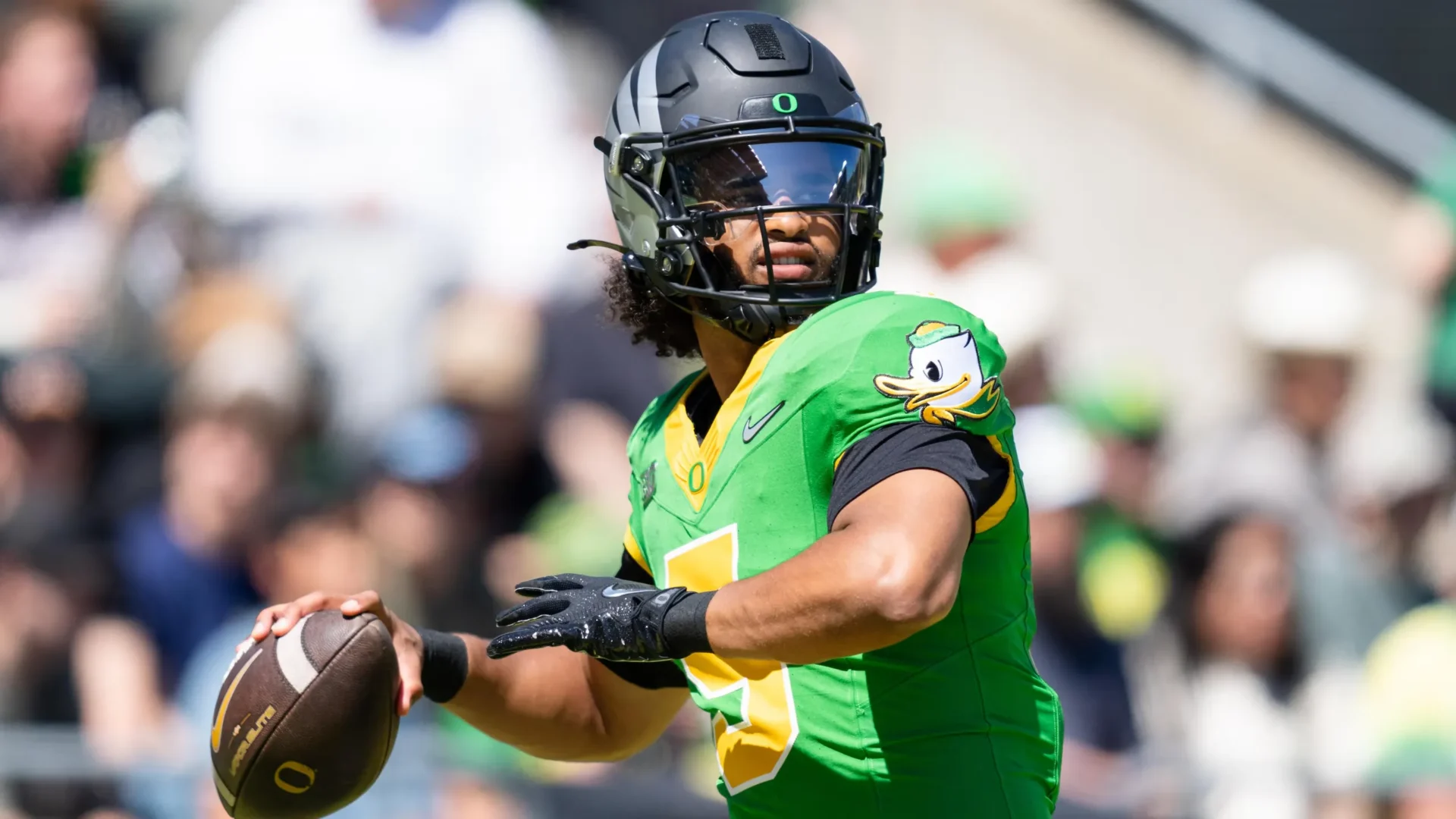
3. Cleveland Browns: Dante Moore, QB, Oregon
Moore already grades as one of the most accurate throwers in the country, and accuracy tends to translate fastest at the next level. He still has minor mechanical wrinkles to iron out, but his ball placement gives Cleveland a real foundation to build a passing offense around from day one.
4. Las Vegas Raiders: Leonard Moore, CB, Notre Dame
Fernando Mendoza could use more weapons in Las Vegas, but passing on a cornerback this good at No. 4 doesn’t hold up. Moore has played like the best corner prospect in the country since the day he arrived at Notre Dame, and his tape already projects as an island corner capable of erasing half the field.
5. New York Jets: Dylan Stewart, EDGE, South Carolina
Back-to-back elite edge rushers off the board isn’t a concern here. Premium pass-rushers rarely fall outside the top of the draft; four-man pressure remains the most valuable currency on defense, and Stewart sets the edge in the run game better than anything currently on the Jets roster. With two more first-round picks in reserve, New York can simply take the best player available.
6. Tennessee Titans: Trevor Goosby, OT, Texas
Goosby is managing a minor knee issue, but that shouldn’t scare off a team picking in the top 10 unless it develops into something more serious. He’s a prototype tackle physically, and his first year as a full-time starter showed the technique finally catching up to the frame. Tennessee gets Cam Ward’s blindside protected for the next decade.
7. New Orleans Saints: Colin Simmons, EDGE, Texas
Simmons brings a speed-rush element the Saints simply don’t have in their current edge group. The real question isn’t whether New Orleans takes him here; it’s whether he’s still on the board at all.
8. New York Giants: Charlie Becker, WR, Indiana
Becker’s game pairs naturally with a quarterback who pushes the ball downfield the way Jaxson Dart does. He wins vertically as well as anyone in this class and is just as dangerous at the catch point on contested throws. Slotting him into a group that already includes Malik Nabers and Malachi Fields gives the Giants one of the more complete receiving corps in the league.
9. Carolina Panthers: David Stone, DT, Oklahoma
Carolina has quietly rebuilt its defensive line from one of the league’s worst units into a formidable one, and Stone would push it into genuinely feared territory. Lining him up next to Derrick Brown and Lee Hunter turns the interior into a problem for opposing offensive lines on every down.
10. Washington Commanders: Cam Coleman, WR, Texas
That marks four Texas players in the top 10, which would be the first time any single program has managed that feat in 60 years. Coleman’s explosiveness is exactly what Washington needs, with its top two current receivers both entering their 30s.
11. New York Jets (from Cowboys): Ashton Hampton, CB, Clemson
New York’s secondary needed a pick exactly like this one. Hampton is a big-bodied corner who moves like a smaller one, giving the coaching staff flexibility to match him against bigger receivers while a quicker corner handles speed threats on the opposite side.
12. Atlanta Falcons: Jordan Seaton, OT, LSU
Seaton sliding to pick 12 says more about the depth of this class than it does about him. He’s an explosive athlete who can already pass protect at an NFL level, and drafts this loaded have a history of pushing talented tackles further down the board than they deserve to fall.
13. Tampa Bay Buccaneers: A’Mauri Washington, DT, Oregon
With Vita Vea turning 32 next year and his contract situation unresolved, identifying his eventual successor fits Tampa Bay’s timeline well. Washington moves explosively for a defensive tackle playing over 330 pounds, and he would slot right into a defensive line built around disruptive, physical players.
14. Pittsburgh Steelers: Jadan Baugh, RB, Florida
If Drew Allar is Pittsburgh’s long-term answer at quarterback, he’ll need a run game to lean on behind him. Baugh checks in near 230 pounds and plays like a back built for cold-weather football in December, exactly the profile Pittsburgh has always valued at the position.
15. Los Angeles Chargers: Will Heldt, DE, Clemson
Heldt was Clemson’s best defensive lineman a year ago without drawing much national attention. He’s an ascending, complete player, and Jim Harbaugh’s emphasis on winning the line of scrimmage makes him a fit even with other needs on the roster and Khalil Mack’s retirement approaching.
16. San Francisco 49ers: Trevor Lauck, OT, Iowa
Kyle Shanahan’s scheme has drifted away from a pure outside-zone identity, but athletic offensive linemen remain a priority regardless of scheme. Lauck showed exactly that kind of movement skill at Iowa last season, positioning him as a workable long-term transition plan behind Trent Williams.
17. Minnesota Vikings: Will Echoles, DT, Ole Miss
Minnesota doubling up at defensive tackle in back-to-back drafts isn’t as redundant as it appears. Echoles is a shorter, three-technique type, the opposite build from Caleb Banks, and his on-field readiness suggests he could contribute in Year 1.
18. Cincinnati Bengals: Lance Heard, OT, Kentucky
Heard’s path to Cincinnati has been circuitous, starting at LSU before stops at Tennessee and Kentucky, but the tape has steadily improved at each stop. He would fit a quietly physical offensive line, and Orlando Brown Jr.’s declining play combined with a rising cap number could make him expendable after this season.
19. New York Jets (from Colts): Kade Pieper, OT, Iowa
The offensive line has become a position New York consistently hits on in the first round, and Pieper continues that trend. His movement skills closely resemble Tyler Linderbaum’s at Iowa, giving the Jets rushing attack the flexibility scheme changes require.
20. Dallas Cowboys (from Packers): Kewan Lacy, RB, Ole Miss
Pairing Lacy with Javonte Williams gives Dallas a two-back setup reminiscent of David Montgomery and Jahmyr Gibbs in Detroit. Lacy has the tools to be a full-time starter, but he’s carrying significant wear for a college back, so a gradual workload increase would serve both player and team.
21. Chicago Bears: Justin Scott, DT, Miami
After trading Gervon Dexter, Chicago is left with one of the league’s oldest and least athletic defensive tackle rooms. Scott changes that instantly. He’s the kind of athlete built to disrupt plays in the backfield rather than simply occupy blockers.
22. New England Patriots: Jamari Johnson, TE, Oregon
Hunter Henry is entering his 30s, and New England could use fresh juice at tight end. Johnson’s wingspan and catch radius pair naturally with Drake Maye’s improvisational tendencies in the red zone.
23. Kansas City Chiefs: Sahir West, DE, UCLA
West fits the mold Steve Spagnuolo has always favored on the edge. At nearly 280 pounds, he can set the edge on early downs and still collapse the pocket from the interior in obvious passing situations, something last year’s rookie class didn’t fully address.
24. Jacksonville Jaguars: Sammy Brown, LB, Clemson
Jacksonville let Devin Lloyd walk this offseason and figures to do the same with Foye Oluokun next spring. That’s a talent and leadership gap arriving at once, and Brown has the instincts and physicality to fill both roles from day one.
25. Buffalo Bills: Greg Johnson, IOL, Minnesota
Buffalo let David Edwards leave in free agency, and while Alec Anderson has handled the job so far, he’s playing on an expiring deal. Johnson projects as a plug-and-play left guard who keeps one of the league’s top offensive lines intact.
26. Detroit Lions: Kelley Jones, CB, Mississippi State
Jones is a press-corner type who fits exactly what defensive coordinator Kelvin Sheppard wants on the outside. Detroit’s last first-round cornerback swing didn’t pan out, but Jones, at nearly 6-foot-4, is a completely different kind of prospect physically.
27. Philadelphia Eagles: Jordan Ross, EDGE, LSU
Ross looked like the five-star recruit he was once his career took off at Tennessee before transferring to LSU. Howie Roseman has never shied away from stockpiling defensive line talent, and Ross fits that pattern exactly.
28. Denver Broncos: Niki Prongos, OT, Stanford
Denver’s offensive line has ranked among the league’s best over the past several seasons, but that window is closing with Garett Bolles turning 35 next year and Mike McGlinchey turning 32. Prongos is a high-upside tackle who could spend a year developing behind both before taking over.
29. Houston Texans: Ahmad Hardy, RB, Missouri
Hardy’s status for this season is uncertain after he was shot at a concert this offseason, but his sophomore tape alone looked like a first-round running back. Houston has quietly built one of the league’s better run-blocking offensive lines and just needs the workhorse to run behind it.
30. Baltimore Ravens: Yhonzae Pierre, DE, Alabama
Pierre fits the exact archetype Baltimore has mined for years under its front-office development system: a rangy, twitchy edge rusher who isn’t a finished product yet but has every physical tool required to become one.
31. Cleveland Browns (from Rams): Luke Reynolds, TE, Virginia Tech
Adding a more traditional inline tight end lets Cleveland move Harold Fannin Jr. back into the flexible, movable role that suits him best. It also gives the offense two tight ends who can both split out wide and run receiver routes in the same personnel grouping.
32. Seattle Seahawks: Cayden Green, OT, Missouri
Given Seattle’s injury history at offensive tackle, this is a sharp insurance pick. Green might ultimately profile better at guard, where he could challenge for Anthony Bradford’s job immediately, but he’s shown he can kick out to tackle in a pinch if the depth chart forces it.
These 2027 NFL mock draft first-round predictions will keep shifting as the college season plays out, and Manning’s grip on the top spot looks far from settled.