


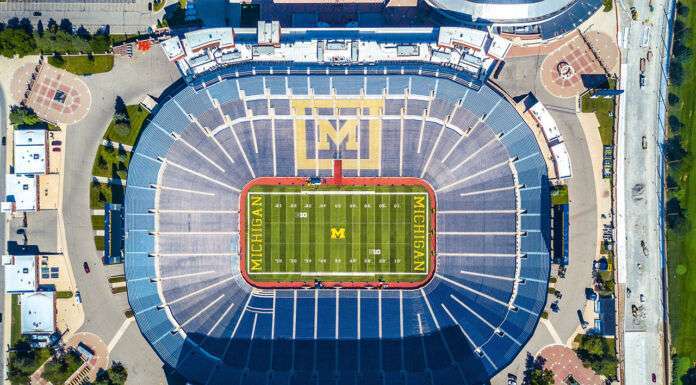
You’d expect NFL franchises to shrink their venues in an age when 4K broadcasts, RedZone, and immersive streaming have made the living room a credible alternative to Sunday at the stadium. The opposite is happening. Owners are pouring billions into bigger footprints, taller canopies, and louder bowls because the biggest NFL stadiums are no longer just buildings. They’re media studios, real estate plays, World Cup hosts, and the single most valuable physical asset on a club’s balance sheet.
This guide ranks every NFL stadium by capacity for the 2026 season, but more importantly, it explains why the rankings look the way they do: the economics, the architectural philosophies, and the upcoming new builds (Buffalo, Tennessee, Chicago, Cleveland, and Washington) that will reshape this list before the decade ends. Whether you’re a lifelong fan or just learning the rules of American football for beginners, understanding these venues is essential to understanding the modern NFL. If you’re looking for the deepest, most current breakdown of the largest stadiums in the NFL, this guide is the only piece you’ll need.
Quick Key Insights
- MetLife Stadium remains the largest NFL venue by listed capacity at 82,500 and will host the 2026 FIFA World Cup Final.
- AT&T Stadium has the highest peak capacity, expandable beyond 100,000 with standing room, the only NFL venue routinely drawing 90,000+ attendance.
- Soldier Field (61,500) is the smallest NFL stadium and is likely to be replaced by a domed venue as the Bears push for a new facility.
- Five stadiums currently seat 80,000 or more, while 17 sit below 70,000 a deliberate trade-off tied to the NFL’s demand-pricing model.
- The new Highmark Stadium in Buffalo (opening for the 2026 season) will actually shrink the Bills’ capacity to roughly 60,000 a major industry trend toward smaller, denser, premium-heavy bowls.
- Eleven U.S. NFL stadiums will host 2026 FIFA World Cup matches, accelerating $4+ billion in renovations league-wide.
Complete NFL Stadium Capacity Rankings (2026 Season)
Below is the full ranking of all 30 NFL stadiums by their officially listed seating capacity for the 2026 season. The league has 32 teams, but the Giants and Jets share MetLife Stadium, while the Rams and Chargers share SoFi Stadium.
| Rank | Stadium | Team(s) | Capacity | Roof | Opened |
|---|---|---|---|---|---|
| 1 | MetLife Stadium | Giants / Jets | 82,500 | Open-air | 2010 |
| 2 | Lambeau Field | Packers | 81,441 | Open-air | 1957 |
| 3 | AT&T Stadium | Cowboys | 80,000 (expandable to ~105,000) | Retractable | 2009 |
| 4 | Arrowhead Stadium | Chiefs | 76,416 | Open-air | 1972 |
| 5 | Empower Field at Mile High | Broncos | 76,125 | Open-air | 2001 |
| 6 | Bank of America Stadium | Panthers | 74,867 | Open-air | 1996 |
| 7 | Caesars Superdome | Saints | 73,208 | Fixed dome | 1975 |
| 8 | NRG Stadium | Texans | 72,220 | Retractable | 2002 |
| 9 | Highmark Stadium (current) | Bills | 71,608 | Open-air | 1973 |
| 10 | M&T Bank Stadium | Ravens | 71,008 | Open-air | 1998 |
| 11 | Mercedes-Benz Stadium | Falcons | 71,000 | Retractable | 2017 |
| 12 | SoFi Stadium | Rams / Chargers | 70,000 (expandable to 100,240) | Fixed translucent | 2020 |
| 13 | Lincoln Financial Field | Eagles | 69,596 | Open-air | 2003 |
| 14 | Nissan Stadium | Titans | 69,143 | Open-air | 1999 |
| 15 | EverBank Stadium | Jaguars | 69,132 | Open-air (partial cover) | 1995 |
| 16 | Lumen Field | Seahawks | 69,000 | Partial roof | 2002 |
| 17 | Levi’s Stadium | 49ers | 68,500 | Open-air | 2014 |
| 18 | Acrisure Stadium | Steelers | 68,400 | Open-air | 2001 |
| 19 | Huntington Bank Field | Browns | 67,895 | Open-air | 1999 |
| 20 | Northwest Stadium | Commanders | 67,617 | Open-air | 1997 |
| 21 | Lucas Oil Stadium | Colts | 67,000 | Retractable | 2008 |
| 22 | U.S. Bank Stadium | Vikings | 66,860 | Fixed translucent | 2016 |
| 23 | Raymond James Stadium | Buccaneers | 65,890 | Open-air | 1998 |
| 24 | Paycor Stadium | Bengals | 65,515 | Open-air | 2000 |
| 25 | Hard Rock Stadium | Dolphins | 65,326 | Open-air (canopy) | 1987 |
| 26 | Ford Field | Lions | 65,000 | Fixed dome | 2002 |
| 27 | Allegiant Stadium | Raiders | 65,000 | Fixed dome | 2020 |
| 28 | Gillette Stadium | Patriots | 64,628 | Open-air | 2002 |
| 29 | State Farm Stadium | Cardinals | 63,400 | Retractable | 2006 |
| 30 | Soldier Field | Bears | 61,500 | Open-air | 1924 (rebuilt 2003) |
Capacities reflect official listed seating for the 2026 NFL season; expandable figures denote standing-room and special-event configurations.
The Top 10 Biggest NFL Stadiums: In-Depth Breakdown
1. MetLife Stadium | 82,500 (East Rutherford, NJ)
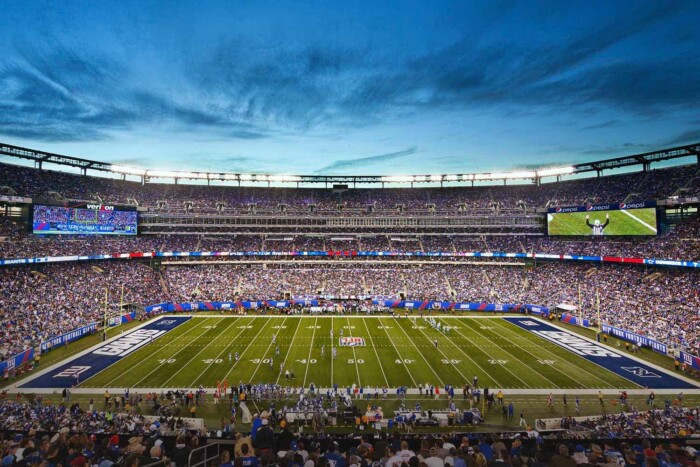
The shared home of the Giants and Jets is the largest NFL stadium by listed capacity and the most expensive American stadium ever built at the time of its completion ($1.6 billion). Its color-shifting LED facade flips between blue and green depending on the home team, and its 27,500 parking spaces make it the league’s most car-dependent venue.
The grass-vs.-turf controversy that followed Aaron Rodgers’ 2023 Achilles injury has driven a 2025–2026 surface upgrade ahead of MetLife hosting eight 2026 FIFA World Cup matches, including the final. Despite its scale, the stadium’s biggest weakness is connective: New Jersey Transit struggles to clear post-game crowds, and the bowl’s symmetrical design draws criticism for feeling generic compared to newer character venues.
2. Lambeau Field | 81,441 (Green Bay, WI)
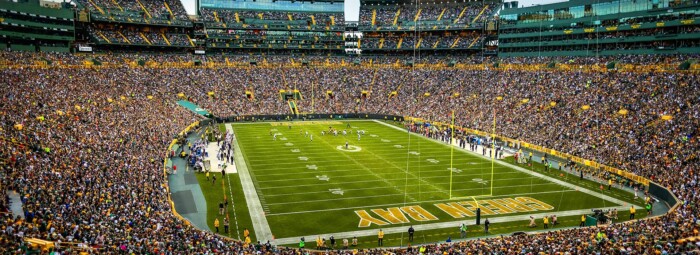
The oldest continuously operating NFL venue (Packers since 1957) is also the league’s most authentic. Lambeau has been renovated five times without losing its essential identity, a frozen, vertical bowl hugged tight to the field. The community-owned Packers model means there are no luxury skyboxes pricing locals out, and the season-ticket waiting list spans roughly 140,000 names with a wait that has historically exceeded 30 years.
The 2024–2025 concourse renovation added the Titletown District amenities without expanding seating, a deliberate choice to preserve scarcity. For sheer atmosphere, the consensus among players, coaches, and analysts is that Lambeau is the most iconic football stadium in the United States.
3. AT&T Stadium | 80,000 (expandable to ~105,000) (Arlington, TX)
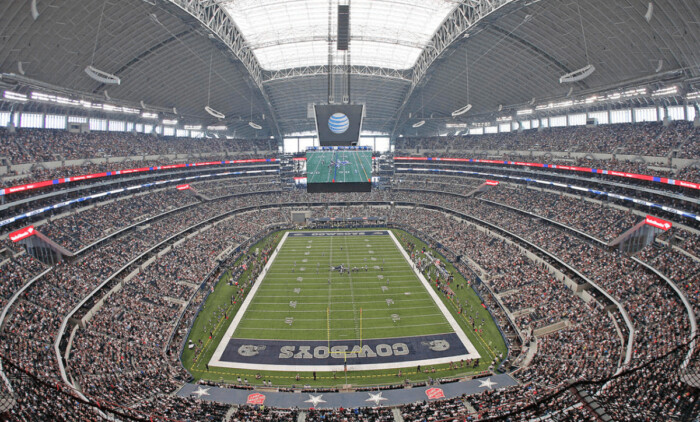
Jerry Jones’ “Death Star” technically ranks third by listed capacity but holds the highest peak attendance figures in NFL history: 105,121 fans for a 2009 Cowboys-Giants game. The retractable roof, the 600-ton center-hung video board, and the museum-grade contemporary art collection make it hard to tell whether this is a sports facility or an entertainment complex.
AT&T Stadium is undergoing a $350 million pre-World Cup renovation through 2026 and will host a league-high nine World Cup matches. The recurring critique: with so many premium suites and corporate sections, regular-season home crowds can feel quieter than the architecture warrants.
4. Arrowhead Stadium | 76,416 (Kansas City, MO)
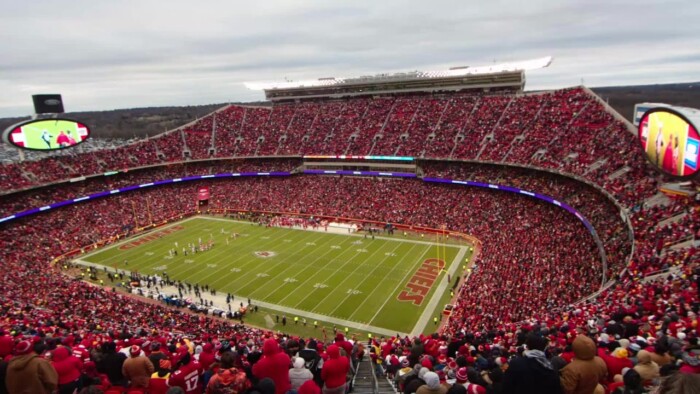
Arrowhead held the Guinness World Record for loudest outdoor stadium (142.2 decibels) and remains the loudest sustained environment in the NFL. The bowl was engineered with a steep tier and tight sightlines specifically to amplify crowd noise, and three Super Bowl wins in five years have only intensified the home-field edge. The stadium will host 2026 FIFA World Cup matches, and the Chiefs are simultaneously evaluating a long-term $800 million renovation versus a new domed venue across state lines in Kansas, a decision with major implications for the franchise’s footprint.
5. Empower Field at Mile High | 76,125 (Denver, CO)
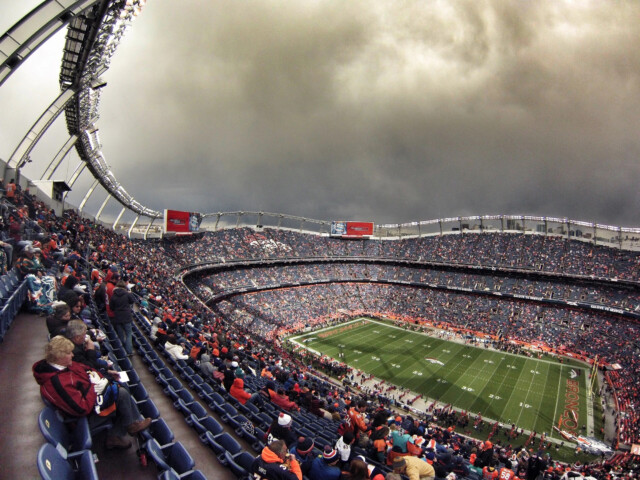
Denver’s altitude is more than marketing; visiting teams routinely report measurable late-game fatigue. The stadium replaced the original Mile High in 2001, but it preserved the steel “thunder” floor in the south stands, where fans literally stomp the metal seats to create the trademark rolling roar. Recent renovations have improved digital connectivity and concessions, though the open-air design means scheduling-driven weather games (snow, wind) remain part of the experience.
6. Bank of America Stadium | 74,867 (Charlotte, NC)
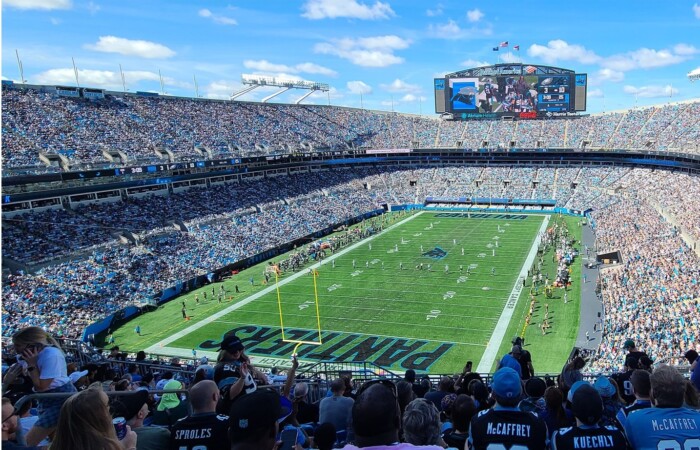
The Panthers’ downtown venue is mid-pack on amenities but elite on location, integrated directly into Charlotte’s uptown core. The $800 million renovation announced in 2023, which is partly publicly financed, will modernize concourses, add premium lounges, and upgrade the playing surface ahead of the 2026 World Cup, where the venue will host five matches.
7. Caesars Superdome | 73,208 (New Orleans, LA)
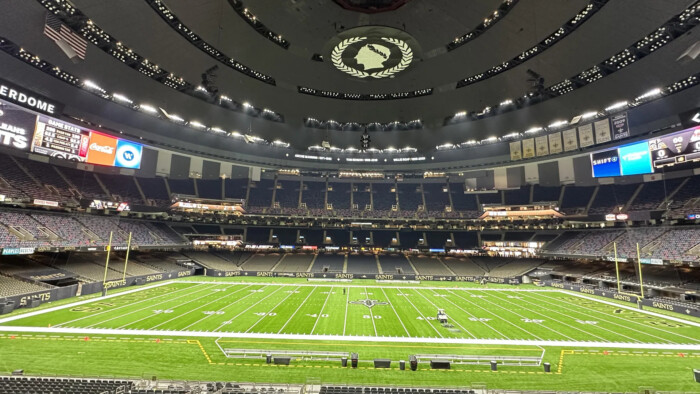
Built in 1975, the Superdome has survived Hurricane Katrina, multiple roof replacements, and a $560 million top-to-bottom modernization completed in 2024. It’s one of the few fully enclosed domed stadiums on this list and consistently ranks among the loudest indoor environments in pro sports. Its central French Quarter-adjacent location creates a uniquely walkable game day that no other large NFL venue can match.
8. NRG Stadium | 72,220 (Houston, TX)
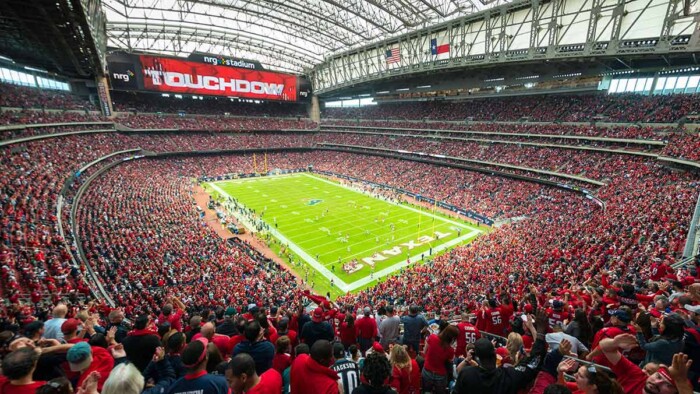
NRG was the first NFL stadium with a retractable roof when it opened in 2002 and remains a template for hybrid indoor/outdoor design. Its expandable capacity reaches 80,000 for special events. The stadium will host seven 2026 World Cup matches, prompting a $2 billion renovation discussion that includes possibly replacing the venue entirely later this decade.
9. Highmark Stadium | 71,608 (Orchard Park, NY)
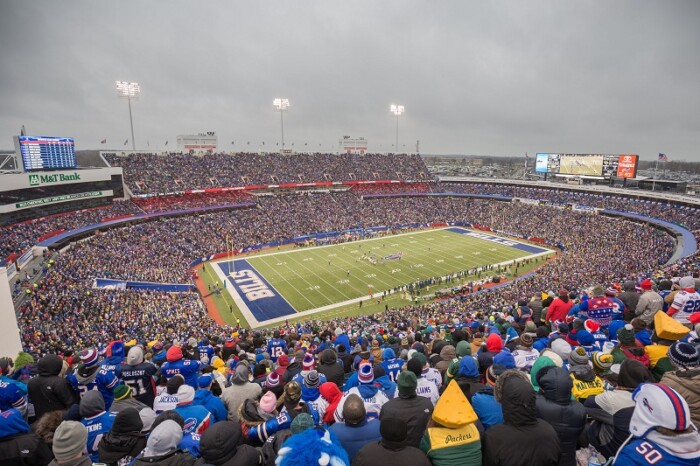
The Bills’ current home is a paradox: aging, austere, and consistently rated one of the loudest, most passionate environments in the league. The new Highmark Stadium across the parking lot opens for the 2026 season at roughly 60,000 capacity, actually smaller than the current venue, reflecting a modern philosophy of denser premium product over raw seat counts. The Bills Mafia tailgate culture is expected to migrate intact.
10. M&T Bank Stadium | 71,008 (Baltimore, MD)
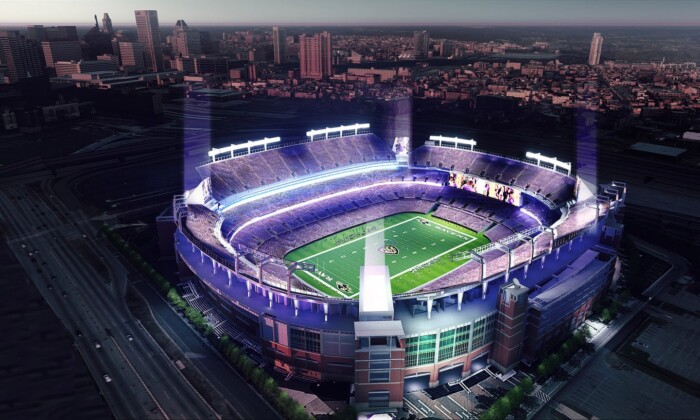
Baltimore’s downtown stadium completed a $120 million phased renovation in 2024, adding new club spaces and a video board upgrade. Its partnership with neighboring Camden Yards creates the most concentrated dual-stadium urban district in American sports.
Beyond Listed Capacity: How Real Attendance Tells a Different Story
Listed capacity is a polite fiction. Actual attendance, which includes standing-room sections, suite occupancy, and overflow, results in a completely different ranking. Based on average paid attendance over the last three completed seasons:
- AT&T Stadium: average attendance is 93,000+, regularly exceeding the listed capacity by 13,000+.
- MetLife Stadium: Average 80,000, near sellout for both tenants.
- Lambeau Field: Average 78,500, sold out continuously since 1960.
- Mercedes-Benz Stadium: Average 71,000+, near 100% paid capacity.
- SoFi Stadium: Average 73,000, regularly using its expandable configuration for premium events.
This gap matters because the NFL’s revenue model no longer relies on ticket volume; it relies on premium yield per fan. AT&T Stadium generates more matchday revenue than any venue in the league despite ranking third in listed capacity because Jones’ bowl is engineered around 320+ luxury suites and 15,000+ club seats with average pricing several multiples of the general admission seat next to them.
Information Gain #1: Why NFL Stadiums Are Getting Smaller, Not Bigger
Here’s the contrarian truth most stadium rankings miss: the next generation of NFL venues will have fewer seats than their predecessors. Compare the trajectory:
- Old Highmark Stadium: 71,608 → New Highmark Stadium (2026): ~60,000
- RFK Stadium (Washington’s former home): 56,692 → New Commanders facility (planned): ~65,000 with denser premium
- Old Soldier Field: ~66,000 (pre-2003) → 61,500 today, with replacement plans further reducing GA
- Tennessee’s new domed stadium replacing Nissan Stadium: ~60,000 seats
- Buffalo, Cleveland, and Chicago are all targeting capacities below their existing venues
The reason is economics, not demand. Every owner has run the same model: a 75,000-seat bowl produces less revenue and worse atmosphere than a 60,000-seat bowl with three times the suite count, double the club seating, and a sold-out scarcity narrative. Demand-based ticket pricing pioneered league-wide between 2018 and 2023 has destroyed the rationale for the 80,000-seat behemoth. When the marginal upper-deck seat sells for $90 in week 4 against a non-rival, the ROI from building it never materializes.
Expect MetLife and Lambeau to remain anomalies: MetLife because two teams share the cost and Lambeau because it’s untouchable cultural property. Everyone else is shrinking.
Information Gain #2: The Hidden Capacity Tier: How Standing Room Rewrites the Rankings
If the NFL ranked stadiums by maximum verified attendance rather than listed capacity, the order would change dramatically:
| Stadium | Listed Capacity | Verified Peak Attendance | Event |
|---|---|---|---|
| AT&T Stadium | 80,000 | 108,713 | 2010 NBA All-Star Game |
| AT&T Stadium | 80,000 | 105,121 | 2009 Cowboys vs. Giants (NFL record) |
| SoFi Stadium | 70,000 | ~100,240 | Super Bowl LVI configuration |
| MetLife Stadium | 82,500 | ~84,000 | 2014 Super Bowl XLVIII |
| NRG Stadium | 72,220 | ~80,000+ | George Strait concert (2019) |
This capability matters for FIFA World Cup 2026 staging: AT&T and SoFi are the only NFL venues that can credibly stage 90,000+ fan events without temporary structures. That capability is also why both stadiums have hosted WrestleManias, Final Fours, and major boxing cards that other NFL venues simply cannot accommodate.
The 2026 FIFA World Cup Effect: Renovation Wave Reshaping the Rankings
Eleven U.S. NFL stadiums will host the 2026 FIFA World Cup. To meet FIFA pitch dimensions, broadcast standards, and security requirements, those venues collectively committed to roughly $4 billion in renovations between 2023 and early 2026. The host stadiums and their match counts:
- AT&T Stadium (Dallas): 9 matches, including a semifinal
- MetLife Stadium (New York/New Jersey): 8 matches, including the Final
- SoFi Stadium (Los Angeles): 8 matches
- Mercedes-Benz Stadium (Atlanta): 8 matches, including a semifinal
- NRG Stadium (Houston): 7 matches
- Hard Rock Stadium (Miami): 7 matches
- Gillette Stadium (Boston): 7 matches
- Levi’s Stadium (San Francisco): 6 matches
- Lincoln Financial Field (Philadelphia): 6 matches
- Lumen Field (Seattle): 6 matches
- Arrowhead Stadium (Kansas City): 6 matches
The cascading effect: even non-host venues are renovating to remain competitive in stadium tour markets, premium hospitality benchmarks, and concert tour booking. Bank of America Stadium’s $800 million project, the Caesars Superdome’s $560 million revamp, and M&T Bank Stadium’s $120 million upgrade all trace back, in part, to the 2026 deadline.
Domed vs. Open-Air vs. Retractable: Why Roof Type Now Predicts Revenue
The NFL’s stadium architecture has split into three philosophies, each tied to a different revenue strategy:
- Open-air (15 stadiums): Lower construction cost, weather-as-narrative, peak atmosphere. Lambeau, Arrowhead, Highmark, and Lincoln Financial. Best for fan experience, worst for non-football event booking.
- Retractable roof (5 stadiums): Maximum flexibility at AT&T, NRG, Mercedes-Benz, Lucas Oil, and State Farm. Highest year-round utilization rates, with concerts, NCAA Final Fours, and college football championships filling non-NFL dates.
- Fixed dome / fixed translucent (5 stadiums): SoFi, Allegiant, U.S. Bank, Ford Field, and Caesars Superdome. Sacrifice the open-air feeling for guaranteed climate control, which is critical for Super Bowl rotation eligibility and high-end concert tour booking.
The retractable roof has emerged as the financial winner. NRG Stadium and Mercedes-Benz Stadium each report 200+ event days per year more than triple a typical open-air venue. That’s the model future builds will copy.
The Real Battle: Smallest NFL Stadiums and Why They’re Disappearing
The five smallest NFL stadiums all have something in common: replacement plans are either active or imminent.
- Soldier Field (61,500): Bears actively pursuing a domed lakefront or Arlington Heights replacement.
- State Farm Stadium (63,400): Cardinals signed a lease through 2032 but are already studying expansion.
- Allegiant Stadium (65,000): Newest, but Raiders may push for premium-focused expansion.
- Ford Field (65,000): Lions are exploring renovation, given that on-field success is driving sustained demand.
- Hard Rock Stadium (65,326): The renovation has already cost over $700 million, and the Dolphins are now focused on increasing hospitality density.
The NFL has a hard floor of 50,000 seats since 1971 for full-time franchises, but in practice, no team plays in anything below 60,000. Sub-60K is now incompatible with hosting Super Bowls, College Football Playoff games, or major World Cup-tier events, which are three revenue streams that owners refuse to surrender.
Practical Guide: Which Big NFL Stadium Should You Actually Visit?
Capacity rankings are useful, but here’s how to choose your bucket-list NFL stadium based on what you actually want from the trip:
- Best pure football atmosphere: Lambeau Field, Arrowhead Stadium, and Highmark Stadium (visit the current venue before the 2026 closure).
- Best architectural spectacles: SoFi Stadium, AT&T Stadium, Mercedes-Benz Stadium.
- Best urban game day: M&T Bank Stadium (Baltimore), Caesars Superdome (New Orleans), and Lumen Field (Seattle).
- Best weather-proof experience: SoFi Stadium, Allegiant Stadium, and Lucas Oil Stadium.
- Best historic significance: Lambeau Field, Soldier Field, and Arrowhead Stadium.
- Best for first-timers from out of the country: AT&T Stadium, the spectacle, will calibrate every other NFL trip you take.
If you’re new to the sport entirely, our guides on how American football works and the typical length of an NFL game are useful primers before you book a stadium trip.
Frequently Asked Questions
What is the biggest NFL stadium?
MetLife Stadium in East Rutherford, New Jersey, is the largest NFL stadium by listed seating capacity, at 82,500. It’s the shared home of the New York Giants and New York Jets. AT&T Stadium has a higher peak attendance (over 105,000 with standing room), but its official capacity is 80,000.
What are the top 5 biggest NFL stadiums by capacity in 2026?
The five largest NFL stadiums for the 2026 season are MetLife Stadium (82,500), Lambeau Field (81,441), AT&T Stadium (80,000 expandable to 105,000), Arrowhead Stadium (76,416), and Empower Field at Mile High (76,125).
What is the smallest NFL stadium?
Soldier Field, home of the Chicago Bears, is the smallest NFL stadium with a capacity of 61,500. It’s also the oldest stadium in continuous NFL use, having opened in 1924, though it was rebuilt in 2003. The Bears are actively pursuing a replacement venue.
Which NFL stadium has the highest single-game attendance ever?
AT&T Stadium holds the NFL regular-season attendance record at 105,121 for a 2009 Dallas Cowboys vs. New York Giants game. The same stadium also hosted the 2010 NBA All-Star Game with 108,713 attendees, the highest verified attendance for a basketball game in history.
Why is MetLife Stadium bigger than Lambeau Field if both are huge?
MetLife Stadium has roughly 1,000 more seats than Lambeau Field because it was designed in 2010 to serve two NFL franchises (Giants and Jets), requiring extra capacity to handle dual season-ticket bases. Lambeau, despite countless renovations, has preserved a tighter bowl that prioritizes atmosphere and sightlines over raw seat count.
How many NFL stadiums will host the 2026 FIFA World Cup?
Eleven U.S. NFL stadiums will host 2026 FIFA World Cup matches: AT&T Stadium, MetLife Stadium, SoFi Stadium, Mercedes-Benz Stadium, NRG Stadium, Hard Rock Stadium, Gillette Stadium, Levi’s Stadium, Lincoln Financial Field, Lumen Field, and Arrowhead Stadium. MetLife will host the Final.
Are NFL stadiums getting bigger or smaller?
NFL stadiums are trending smaller in raw seat count but larger in premium product. New builds like Highmark Stadium (Buffalo, 2026) and the planned Tennessee Titans dome will have fewer general-admission seats than their predecessors but significantly more suites, club seats, and hospitality areas. The economics favor density over volume.
Which NFL stadium has the loudest crowd?
Arrowhead Stadium in Kansas City has held the Guinness World Record for the loudest outdoor stadium at 142.2 decibels. Lumen Field (Seattle) and Caesars Superdome (New Orleans) are also consistently ranked among the loudest, with the Superdome’s enclosed roof amplifying crowd noise in a way open-air venues cannot replicate.
Conclusion: The End of the Capacity Arms Race
For four decades, NFL franchises competed to build bigger. That era is effectively over. MetLife Stadium and Lambeau Field will likely remain at the top of the capacity rankings for the foreseeable future, not because they represent the future of stadium design, but because they represent the last generation of it. The new builds in Buffalo, Tennessee, Chicago, and Washington will be smaller, denser, more weatherproof, and more lucrative, and they’ll change how this list looks by 2030.
The deeper insight: stadium size has become a poor proxy for stadium quality. A modern 60,000-seat venue with a retractable roof, packed premium inventory, and downtown integration will outperform an 80,000-seat suburban bowl on every metric that matters to ownership revenue per seat, year-round utilization, broadcast aesthetics, and fan satisfaction scores.
The biggest NFL stadiums are still cathedrals. But the most valuable ones increasingly aren’t the biggest. That’s the rebalancing now reshaping the league’s physical footprint, and it’s the story this ranking will tell more clearly with every passing season.
For more on the league’s structure and franchises that play in these venues, explore our deeper guides on all 32 NFL franchises, how the NFL playoffs are structured, and the founding history of the NFL.
