

When someone describes a plot of land as “about a football field,” most people picture something close to an acre. The reality is a bit different. A regulation American football field, including both end zones, covers roughly 1.32 acres, noticeably larger than a single acre of land.
Understanding the exact acreage of a football field is useful for real estate buyers, coaches, facility planners, and anyone trying to visualize large land measurements. It also clears up one of the most common misconceptions in casual land conversation.
This guide breaks down football field dimensions in feet, yards, meters, and acres. It covers the math behind the conversions, compares field sizes across levels of play, and shows how the “football field” has become a practical yardstick for measuring American land. For a broader breakdown of field layout and rules, see our complete guide to American football.
How Many Acres Is a Football Field?
A standard American football field used by the NFL, NCAA, and high schools measures 360 feet long by 160 feet wide when both end zones are included. That produces a total area of 57,600 square feet, which converts to approximately 1.32 acres.
If you exclude the end zones and only count the 100-yard playing field between the goal lines, the area shrinks to 300 feet by 160 feet. That works out to 48,000 square feet, or about 1.10 acres.
So a complete American football field is roughly 1.32 acres, and conversely, one acre equals about 0.76 of a full football field.
Standard American Football Field Dimensions
Across every major level of American football played in the United States, the core field dimensions are identical. The total length from one end line to the other is 120 yards, or 360 feet. This includes the 100-yard main playing area plus two 10-yard end zones on each side.
The width of every regulation field is 53⅓ yards, which equals 160 feet. Multiplying length by width results in the total playing surface of 57,600 square feet, or approximately 5,351 square meters.
In metric terms, the full field stretches about 109.7 meters long and 48.8 meters wide. Converted into hectares, the area is roughly 0.535 hectares a useful figure for international comparisons.
The Exact Math: From Square Feet to Acres
Converting a football field to acres is a straightforward calculation. Start with the total area of the field, then divide by the standard definition of an acre.
Step 1: Calculate Total Square Footage
Multiply length by width: 360 feet × 160 feet = 57,600 square feet. This figure represents the full field, including both end zones.
Step 2: Convert Square Feet to Acres
One acre is officially defined as 43,560 square feet. Dividing 57,600 by 43,560 yields approximately 1.32 acres.
Step 3: Verify Using Square Yards
Football is often measured in yards, so this method is useful as a cross-check. The field area in yards is 120 × 53.33, which equals roughly 6,400 square yards. Since one acre is 4,840 square yards, dividing gives the same result: about 1.32 acres.
Both methods confirm that a regulation American football field occupies around 1.32 acres of land.
NFL vs. College vs. High School: Same Acres, Different Details
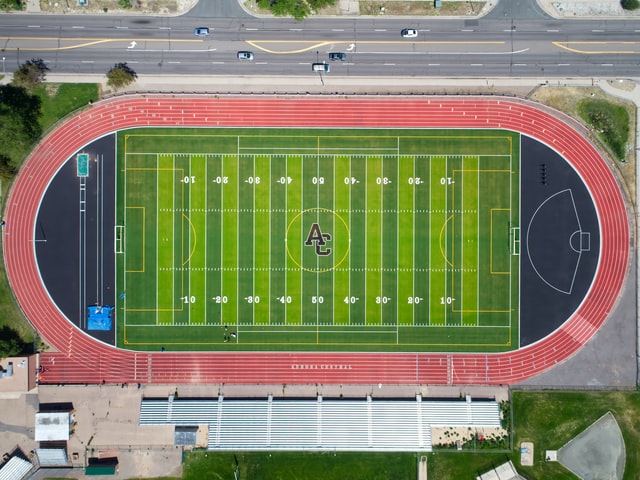
The three major levels of American football share identical outer dimensions. That means the total acreage of an NFL field, a college field, and a high school field is the same: approximately 1.32 acres.
Where they differ is in the internal markings and goalpost width. NFL hash marks are 18 feet 6 inches apart, keeping plays centered and rewarding precision passing. College hash marks sit 40 feet apart, while high school hash marks stretch 53 feet 4 inches apart.
Goalpost width also varies. The NFL and NCAA both use posts 18 feet 6 inches wide, while high school goalposts are 23 feet 4 inches wide to provide developing kickers a more forgiving target.
None of these differences change the total land footprint. All three levels still measure 360 feet by 160 feet, covering 57,600 square feet. For a more profound look at how rules differ between levels, see our comparison of college football vs. NFL rules.
Why People Think a Football Field Equals One Acre
The myth that a football field equals one acre is widespread but incorrect. The confusion comes from the fact that both figures represent “large” parcels of space, and both are commonly used in land descriptions.
The Acre’s Origin
The acre is a traditional unit of land that originated in medieval England. Historically, it described the amount of land a farmer could plow in one day using a team of oxen. In modern measurement, it is fixed at exactly 43,560 square feet regardless of shape.
The Actual Comparison
A full football field covers 57,600 square feet, while a single acre covers 43,560 square feet. That makes a football field about 32 percent larger than one acre. If someone tells you their property is “a football field of land,” they are describing roughly 1.32 acres — not 1.00 acre.
Football Field Size vs. Other Sports Fields
Putting football field acreage in context with other sports helps clarify how it fits on the scale of athletic venues.
An American football field is larger than a basketball court but smaller than many professional soccer pitches and baseball fields. A standard FIFA soccer field typically measures about 115 × 74 yards, covering close to 1.76 acres. A Major League Baseball field, including outfield and foul territory, often exceeds 2.5 acres depending on the stadium.
Canadian football fields are significantly larger than American ones. With longer end zones and a wider playing surface, a Canadian field covers roughly 2 acres. On the smaller end, an NBA basketball court measures just 94 by 50 feet — about 0.11 acres, or less than one-tenth the size of a football field.
How Football Field Acreage Is Used in Real Life
Because most Americans can visualize a football field, the measurement has become a practical communication tool in several industries.
Real estate and land sales: Agents often translate acreage into “football fields” for buyers. It’s easier for first-time land buyers to picture “about three football fields” than “about four acres.”
Sports facility planning: Designers of multi-field complexes start with the 1.32-acre playing surface, then add buffer zones, sideline space, spectator areas, and parking. A single field with modest surrounding space typically requires 1.5 to 1.6 acres of total land.
Agriculture and land management: Farmers and ranchers sometimes convert large parcels into football field equivalents. For example, 100 acres equals roughly 76 football fields — a mental image that helps convey scale.
Environmental communication: Scientists often describe deforestation or wildfire spread as “football fields per minute” or “football fields per day.” This framing makes abstract acreage numbers easier for the public to understand.
Quick Conversion: Acres to Football Fields
Using 1.32 acres per full field, you can estimate how many football fields fit into a given land area.
| Acres | Football Fields (approx.) | Square Feet |
|---|---|---|
| 1 | ~0.76 fields | 43,560 |
| 1.32 | 1 field | 57,600 |
| 5 | ~3.8 fields | 217,800 |
| 10 | ~7.6 fields | 435,600 |
| 20 | ~15.2 fields | 871,200 |
| 50 | ~37.9 fields | 2,178,000 |
| 100 | ~75.8 fields | 4,356,000 |
These rounded values work well for planning, rough visualizations, and everyday comparisons.
End Zones and Their Impact on Acreage
One of the most common errors in calculating football field acreage is forgetting the end zones. The 100-yard playing field between the goal lines is only part of the total surface.
Calculated alone, the main playing area measures 300 feet by 160 feet, or 48,000 square feet approximately 1.10 acres. Adding the two 10-yard end zones extends the length to 360 feet and brings the total to 57,600 square feet, or 1.32 acres.
The difference is 9,600 square feet, or about 0.22 acres. Whenever you talk about football field acreage, it’s important to specify whether you mean the full field, including end zones, or only the area between the goal lines.
Goalpost Dimensions for the Complete Picture
Goalposts don’t affect the ground area of a football field, but they are a defining part of the standard layout.
The crossbar sits 10 feet above the ground, and the uprights typically extend at least 30 to 35 feet total from the field surface. NFL and NCAA goalposts are 18 feet 6 inches wide, while high school posts are 23 feet 4 inches wide. Goalposts are positioned on the end lines at the back of each end zone. The NFL moved its goalposts from the goal line to the back of the end zone in 1974 to reduce interference with play.
How Many Football Fields Fit in Famous Places?
Scaling football field acreage up to major landmarks makes the measurement easier to grasp.
Central Park in New York City spans about 843 acres, which equals roughly 639 football fields. The Pentagon site covers about 29 acres, or 22 football fields. Vatican City, one of the smallest sovereign states in the world, occupies around 110 acres — about 83 football fields.
Walt Disney World Resort in Florida covers approximately 25,000 acres, or nearly 19,000 football fields. At the largest end, the Amazon Rainforest spans roughly 1.4 billion acres, which would equal well over one billion football fields. To see where some of the nation’s largest venues sit on this scale, refer to our rundown of the best football stadiums in the USA.
Frequently Asked Questions
How many acres is a standard American football field?
A standard American football field including both end zones is about 1.32 acres, with a total area of 57,600 square feet. Excluding the end zones, the 100-yard playing field alone is about 1.10 acres.
Is a football field bigger or smaller than an acre?
A football field is bigger than one acre. One acre equals 43,560 square feet, while a full field covers 57,600 square feet — making the field about 32 percent larger.
Are NFL, NCAA, and high school football fields the same size?
Yes. All three levels share the same overall dimensions of 120 yards long by 53⅓ yards wide, totaling about 1.32 acres. The main differences are hash mark spacing and goalpost width.
How many football fields are in one acre?
One acre equals approximately 0.76 of a full football field. In other words, it takes about 1.32 acres to cover one complete regulation field.
How many square feet is a football field?
A regulation football field including end zones is 57,600 square feet. The 100-yard playing field between the goal lines alone is 48,000 square feet.
What is a football field in meters and hectares?
In metric units, a full American football field is about 109.7 meters by 48.8 meters, with an area of roughly 5,351 square meters or 0.535 hectares.
How many football fields make up 5 acres?
Five acres contain approximately 3.8 football fields, since 5 divided by 1.32 equals about 3.79.
Final Takeaway
A full American football field, including both end zones, measures about 1.32 acres. The 100-yard playing area alone covers roughly 1.10 acres. The total field area is 57,600 square feet, which translates to about 5,351 square meters or 0.535 hectares.
NFL, college, and high school fields all share the same basic dimensions and acreage, differing only in hash mark spacing and goalpost width. And despite the popular assumption, one acre is not the same as one football field it’s about three-quarters of one.
For developers, real estate professionals, coaches, and curious fans, knowing that a football field equals 1.32 acres provides a clear and repeatable reference point. As stadium construction and land-use debates continue across the country, this measurement will remain a reliable shorthand for visualizing acreage in a way everyone can picture.
