


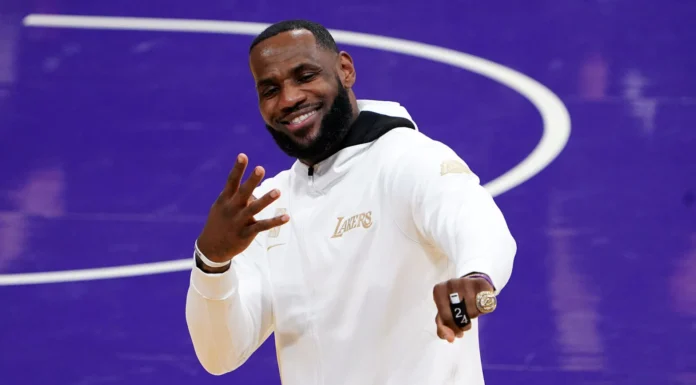
LeBron James possesses four NBA championship rings, earned through relentless leadership and clutch performances across three different franchises. These titles highlight his extraordinary playoff prowess, strategic adaptability, and ability to thrive in the intense pressure of NBA Finals basketball.
LeBron James stands as a colossus in NBA history with his four championship rings, each forged in the fire of high-stakes postseason battles. These victories are not mere accolades but vivid testaments to his multifaceted skill set—blending explosive scoring, tenacious rebounding, visionary passing, and defensive intensity—that has redefined what a superstar can achieve in modern basketball.
From powering superteams to orchestrating underdog miracles, James’ path to these rings reveals a career defined by resilience and evolution. His triumphs with the Miami Heat showcased peak athleticism, the Cleveland Cavaliers’ victory embodied hometown heroism, and the Los Angeles Lakers’ title demonstrated veteran mastery. This multi-franchise success underscores his unparalleled franchise-elevating impact, a rarity among basketball’s elite.
As debates rage in the GOAT conversation—greatest of all time—James’ rings serve as a cornerstone, amplified by his record 10 Finals appearances and four Finals MVPs. Let’s dive into the granular details of each championship, statistical milestones, and comparative insights that paint a fuller picture of his legacy.
LeBron James Rings Breakdown: Years, Teams, and Key Performances
LeBron’s championship journey began with the Miami Heat, where he joined forces with Dwyane Wade and Chris Bosh to form one of the league’s most formidable Big Three units. This era marked his transition from criticized prodigy to undisputed alpha.
2012 Miami Heat: First Ring and Finals MVP Breakthrough
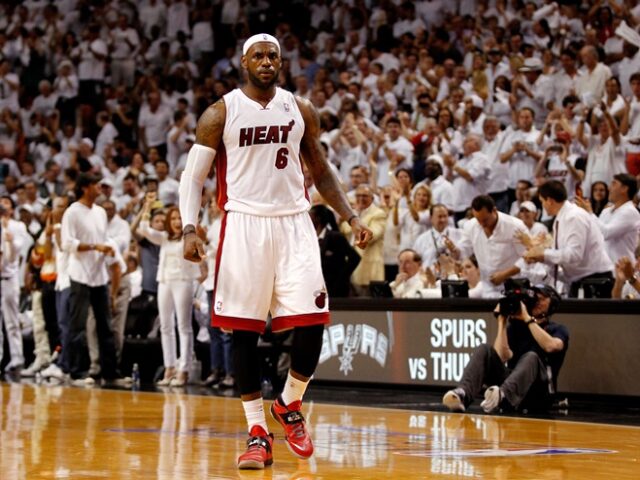
In 2012, James finally shed the weight of Finals failures by leading the Heat past the young Oklahoma City Thunder in five games. Averaging 28.6 points, 10.2 rebounds, and 7.4 assists per game, he dominated both ends, culminating in a Finals MVP nod. This series victory silenced years of scrutiny after “The Decision,” demonstrating his ability to perform under pressure. Key moments included his versatile defense on Kevin Durant and explosive scoring bursts that overwhelmed OKC’s backcourt.
2013 Miami Heat: Repeat Glory and Clutch Mastery
Building momentum, the Heat defended their crown in 2013 against the battle-tested San Antonio Spurs in a grueling seven-game war. James elevated to new heights, posting 25.3 points, 10.9 rebounds, and 7.0 assists, with his iconic Game 6 block and three-pointer in the final seconds forcing a decisive Game 7. Securing his second straight Finals MVP, this run highlighted his growth as a clutch performer, blending mid-range mastery with improved three-point shooting under championship pressure.
2016 Cleveland Cavaliers: Historic Comeback and Hometown Redemption
Returning to Cleveland with a promise to win a title, James achieved an extraordinary feat in 2016. Trailing the record-setting 73-win Golden State Warriors 3-1 in the Finals, the Cavs staged the only 3-1 comeback in NBA Finals history—a truly historical feat.
James’ 29.7 points, 11.3 rebounds, 8.9 assists, and 2.6 steals per game included 41-point explosions in Games 5 and 7, plus the legendary chase-down block on Andre Iguodala. This third Finals MVP cemented his legacy as a miracle worker, fulfilling a vow to Northeast Ohio fans.
2020 Los Angeles Lakers: Bubble Mastery and Fourth Ring
After joining the storied Lakers, James took just two seasons to lift their 17th banner in 2020, amidst the COVID-19 bubble. Against a gritty Miami Heat squad, he averaged 29.8 points, 11.8 rebounds, and 8.5 assists, earning his unprecedented fourth Finals MVP with three different teams.
Teamed with Anthony Davis, his playmaking unlocked a dominant playoff run, adapting to an empty-arena format while honoring Kobe Bryant’s memory. This victory bridged eras, blending old-school grit with contemporary spacing.
These four rings, spaced across 12 years and three cities, illustrate James’ sustained excellence amid roster flux, injuries, and superteam dynamics.
LeBron James Finals Appearances: Record 10 Trips and Winning Percentage
Beyond rings, James’ 10 NBA Finals trips—tied for third all-time—speak to his gravitational pull on contention. Only Bill Russell (12) and Sam Jones (11) surpass him, yet James achieved this without a dynasty’s safety net. His 40% winning percentage (4-6 record) contrasts with perfect marks like Michael Jordan’s 6-0 or Russell’s near-flawless runs, but context matters.
James faced juggernauts like the Spurs dynasty, the Curry-era Warriors, and the stacked Heatles squads, often dragging mismatched rosters deep into June. This endurance fuels arguments for his superior longevity in playoff basketball.
Championship Rings Comparison: LeBron vs NBA Legends Table
| Player | Rings | Teams | Finals MVPs | Finals Appearances |
|---|---|---|---|---|
| Bill Russell | 11 | Boston Celtics | N/A | 12 |
| Sam Jones | 10 | Boston Celtics | N/A | 11 |
| Michael Jordan | 6 | Chicago Bulls | 6 | 6 |
| Kareem Abdul-Jabbar | 6 | Bucks, Lakers | 2 | 10 |
| Magic Johnson | 5 | Lakers | 3 | 9 |
| Kobe Bryant | 5 | Lakers | 2 | 7 |
| Tim Duncan | 5 | Spurs | 3 | 5 |
| LeBron James | 4 | Heat, Cavs, Lakers | 4 | 10 |
This expanded table reveals LeBron’s unique balance: matching Kareem’s appearances while tying Jordan in MVPs per ring, a nod to his on-court command.
LeBron’s 2016 Comeback vs. Rare NBA Playoff Turnarounds
James’ statistical footprint elevates his rings from impressive to iconic. Career playoff averages of 28.7 points, 9.0 rebounds, and 7.2 assists on efficient shooting lead all-time among high-volume players.
His 2016 heroics stand alone: the sole Finals 3-1 comeback ever—the greatest single-series turnaround in NBA history. Across NBA playoffs, only 13 such reversals have occurred since 1950, none in the championship round before or since.
Unique Data Table: Epic NBA Playoff Comebacks Comparison
| Series | Year | Round | Deficit Overcome | Leader/Key Stat | Outcome |
|---|---|---|---|---|---|
| Cavs vs. Warriors (LeBron) | 2016 | NBA Finals | 3-1 | LeBron: 41 pts G5/G7, 3-1 comeback | Cavs win 4-3 |
| Warriors vs. Thunder | 2016 | W. Conf Finals | 3-1 | Curry/Durant: 36-pt G7 comeback | Warriors 4-3 |
| Nuggets vs. Clippers | 2020 | W. Conf Semis | 3-1 | Jokic/Murray: 50+ pt games each | Nuggets 4-3 |
| Suns vs. Lakers (2003) | 2003 | First Round | 3-1 | Nash: 20+ pts, fast-paced surge | Suns win 4-3 |
| Heat vs. Knicks (1995) | 1995 | Conf Semis | 3-1 | Mourning: Defensive stops, rebounds | Heat win 4-3 |
LeBron’s feat towers over these rarities due to Finals stakes, opponent pedigree (73-9 Warriors), and individual load—averaging a triple-double while locking down stars.
LeBron Playoff Stats Deep Dive
James owns the most playoff points (8,162), steals (410), and half of the top 10 scoring Finals games. His Player Efficiency Rating (PER) in Finals play (28.6) rivals Jordan’s, but with quadruple the minutes logged, showcasing durability.
LeBron James Playoff Dominance: Beyond Rings to All-Time Stats
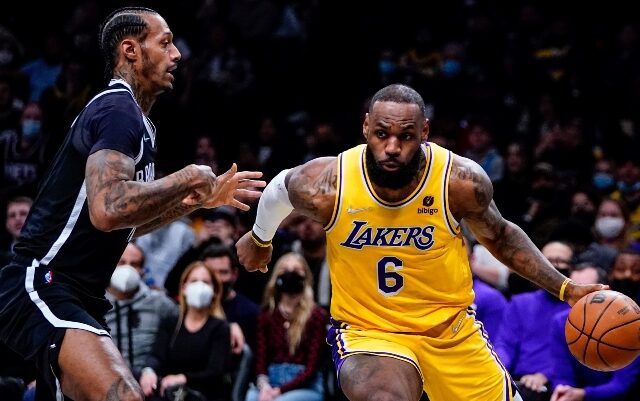
LeBron’s 51.0 playoff win share eclipses Jordan’s 39.8 at similar career stages, factoring in era-adjusted pace and three-point volume. He leads in playoff triple-doubles (28) and VORP (Value Over Replacement Player), metrics blending his all-around game.
At age 41, still active with the Lakers, James defies Father Time, posting All-Star caliber numbers amid a positionless revolution he pioneered. His evolution—from slash-and-kick forward to stretch-forward—mirrors basketball’s shift.
LeBron Rings vs. Contemporaries: Adaptability Edge
Peers like Duncan (5 rings, one team) or Kobe (5, Lakers loyalist) thrived in stability; LeBron’s multi-franchise success—rivaled only by role players—highlights transformative impact. This rarity cements his legacy in NBA championship narratives.
LeBron James vs. GOAT Rivals
In GOAT debates, rings spark passion. Russell’s 11 rode dynastic dominance; Jordan’s 6 were flawless. LeBron’s 4 championships, however, were achieved amidst free agency chaos, salary caps, and global talent dilution—resulting in a 40% win rate despite six losses to all-time greats.
Advanced stats bolster him: highest career playoff Box Plus-Minus (+9.4), most 40+ point Finals games. Finals losses often featured herculean efforts, like 2015’s 35.8 PPG vs. Warriors or 2018’s near-repeat sans Love/Irving.
LeBron James Legacy: Rings, MVPs, and GOAT Debate Fuel
LeBron James’ four rings, paired with Finals MVPs and 10 appearances, position him firmly among basketball immortals—one of the greatest to ever play. His statistical depth—from comebacks to triple-doubles—transcends raw counts, inspiring future NBA stars.
From Akron to a global ambassador, James inspires with a work ethic that matches his gifts. As the best ageless wonder, his influence on playoff strategy, positionless ball, and superstar accountability endures, etching him among historical legends.
Frequently Asked Question
How many times has LeBron James been an All-Star?
LeBron James was selected 19 times while playing 18 All-Star games. LeBron holds the record for most All-Star Game selections among active players of the NBA. He is also the record holder for playing consecutive games with 18 All-Stars.
Who has more rings than Michael Jordan?
The NBA has never seen a player like Michael Jordan. He has six championship rings, which puts him ahead of Bill Russell (11 rings), Kareem Abdul-Jabbar (6 rings), and Kobe Bryant (5 rings).
Does LeBron James have 6 rings?
James has won 4 NBA championships, 4 MVP awards, 4 MVP awards in the NBA Finals, 3 MVP awards in the All-Star game, and 2 gold medals at the Olympics. James has the second-most points of all time, the most points in the playoffs, and the seventh-most assists in NBA history.
Who is better than Michael Jordan?
The statistics on LeBron James show that he is a much better overall basketball player. While Jordan had a higher point total, LeBron is a more efficient scorer thanks to his improved shooting from the field. LeBron not only has amazing scoring skills but also outperforms Jordan as a passer and rebounder.
Who has more rings, LeBron or Jordan?
Michael Jordan is the NBA’s GOAT. Jordan leads all categories except All-Star, All-NBA, and Hall of Fame. He’s won more NBA Finals. Jordan has won two more NBA Finals rings than LeBron James. He’s also been named All-Defense and MVP. James hasn’t won Defensive Player of the Year. LeBron’s pursuit of his fourth ring brings him closer to his goal of six or more.
, the teams, years, Finals MVPs, and statistical comparison to NBA legends like Jordan and Russell in his enduring playoff career)