

Flag football is a fast-growing, non-contact version of American football where defenders pull flags from a ball carrier’s belt instead of tackling them to the ground. The sport blends strategy, athleticism, and excitement with a safer, more accessible format. With its confirmed debut at the 2028 Los Angeles Olympics and approximately 20 million players worldwide, this sport has rapidly evolved from a casual pastime into a globally recognized competitive game.
Whether you are a parent exploring youth sports, a player looking to compete, or a fan curious about the game, this guide covers everything you need to know — from rules and positions to equipment, penalties, and the sport’s exciting future.
Origins and Evolution of Flag Football
A Brief History
Flag football traces its roots to the early 20th century. Military personnel developed it as a recreational alternative to tackle football. The goal was to preserve the game’s competitive spirit while reducing injury risk. Players initially competed informally on military bases. Over time, the sport spread to schools, parks, and community leagues across the United States.
From Pastime to Organized Sport
Over the decades, national and international organizations formalized the game. The International Federation of American Football (IFAF) governs the sport globally and led its campaign for Olympic inclusion. In the United States, USA Football serves as the sport’s National Governing Body, responsible for selecting and leading Team USA in international competition. Meanwhile, NFL FLAG has grown into the largest youth flag football organization in the country, with more than 500,000 athletes competing across all 50 states.
The Growth Explosion
The growth numbers tell a compelling story. Youth participation in the U.S. now reaches approximately 4.1 million players, a 50% increase since 2020. High school programs have expanded rapidly, with the sport now available in 39 states. The number of young women on high school teams alone rose nearly 60% between 2024 and 2025.
How Flag Football Differs From Tackle Football
Understanding what sets flag football apart helps clarify why it appeals to such a wide audience. Here are the core differences:
| Feature | Flag Football | Tackle Football |
|---|---|---|
| Contact | No contact; flag pull ends the play | Full-contact tackling allowed |
| Players per side | 5 to 7 (varies by league) | 11 |
| Field size | Typically 70 x 25 yards or 80 x 40 yards | 100 x 53.3 yards |
| Blocking | No blocking or screening allowed | Blocking is a core tactic |
| Equipment | Flags, football, cleats, mouthguard | Full pads, helmet, shoulder pads |
| Fumbles | No fumbles — dead ball when dropped | Live ball on fumbles |
| Kickoffs | No kickoffs in most formats | Kickoffs start each half and follow scores |
The center snaps the ball and immediately becomes an eligible receiver, since there are no linemen or blocking in flag football. This creates a wide-open, pass-heavy game that rewards speed, route-running, and quick decision-making.
Flag Football Rules: A Complete Breakdown
The Objective
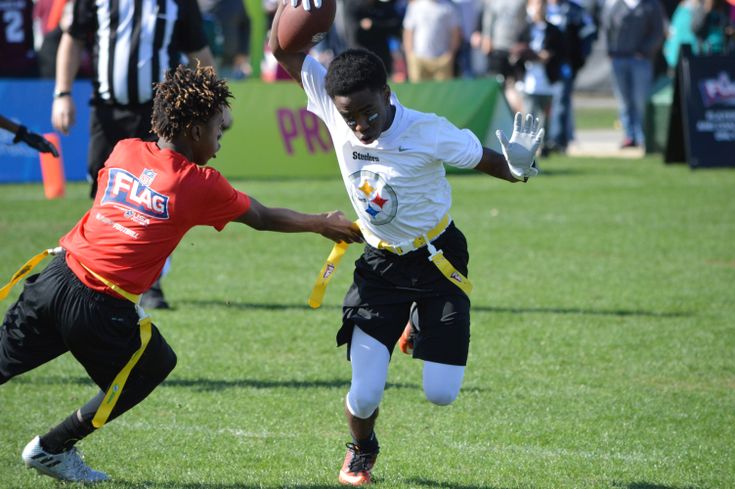
The goal is to score points by advancing the ball into the opposing team’s end zone. Teams move the ball through running plays and passing plays, similar to traditional football. However, a play ends when a defender pulls a flag from the ball carrier’s belt, not through a physical tackle.
Down and Distance System
Flag football uses a unique down-and-distance system that differs from tackle football:
- Each team gets four downs (plays) to advance the ball past midfield.
- Once a team crosses midfield, it earns a first down and receives a new set of downs to score a touchdown.
- Failure to gain a first down or score results in a turnover on downs.
This midfield-based system keeps the game moving and creates natural momentum shifts.
Scoring System
Flag football scoring closely mirrors traditional football:
- Touchdown: 6 points for carrying or catching the ball in the end zone.
- Extra point (1 point): Attempted from the 5-yard line after a touchdown.
- Two-point conversion: Attempted from the 10-yard line after a touchdown.
- Safety: 2 points, earned when a ball carrier loses their flag in their end zone.
- Interception return: A defensive interception returned for a touchdown scores 6 points. An interception during an extra point attempt scores 2 points.
No-Run Zones
No-run zones prevent power plays in tight spaces. These zones sit five yards before each end zone and five yards on each side of midfield (under IFAF rules). When the ball starts in a no-run zone, the offense must use a pass play. Running the ball is not allowed.
Quarterback Rules
Specific rules govern the quarterback’s actions:
- The QB has seven seconds to release the ball after the snap. If the pass is not thrown in time, the play is dead.
- The QB cannot run directly across the line of scrimmage with the ball. However, the QB may hand off behind the line and then become eligible to catch a forward pass.
Blitzing Rules
Defenders who rush the quarterback must follow strict guidelines:
- Blitzers must line up at least seven yards behind the line of scrimmage.
- They must self-identify by raising one hand before the snap.
- A maximum of two designated rushers may blitz on any play.
- Once the ball is handed off or pitched behind the line, all defenders become eligible to rush.
Dead Ball Rules
Officials rule the ball dead in these situations:
- A defender pulls the ball carrier’s flag.
- The ball hits the ground (no fumbles in flag football).
- The ball carrier steps out of bounds.
- The ball carrier’s body apart from hands or feet touches the ground.
- A pass is incomplete.
- The ball carrier’s flag falls off on its own.
Clock and Game Format
Games typically consist of two halves lasting 15 to 25 minutes each, depending on the league. A running clock is used for most of the game. The clock stops during the final two minutes of each half for incomplete passes, out-of-bounds plays, turnovers, and touchdowns. Each team receives timeouts per half. If the game is tied at the end of regulation, overtime determines the winner.
Flag Football Positions Explained
Flag football positions differ from tackle football because there are no offensive or defensive linemen. Every player on the field is actively involved in passing, receiving, or defending.
Offensive Positions
- Quarterback (QB): Commands the offense, calls plays, and throws passes. The QB cannot run past the line of scrimmage unless the ball has been handed off first and returned.
- Center (C): Snaps the ball to the quarterback. Unlike tackle football, the center immediately becomes an eligible receiver after the snap.
- Wide Receivers (WR): Line up on the outside and run routes to get open for passes. Speed and precise route-running are essential.
- Running Back (RB): Receives handoffs from the QB and runs the ball. Also runs routes as a receiver out of the backfield.
Defensive Positions
- Rushers: Line up at the rush line (seven yards back) and try to reach the quarterback before the pass is thrown. They must identify themselves before each snap.
- Defensive Backs (DB): Cover wide receivers using man-to-man or zone coverage. Quick reflexes and anticipation are critical.
- Safety: Acts as the last line of defense. The safety covers deep throws and players who break free from other defenders.
Flag Football Penalties
Officials call penalties to maintain fair play and safety. Here are the most common violations:
Offensive Penalties
| Penalty | Description | Consequence |
|---|---|---|
| Flag guarding | Ball carrier shields their flags from a defender (stiff arm, covering flags, lowering elbows) | 10-yard penalty and loss of down |
| False start | Offensive player moves before the ball is snapped | 5-yard penalty and loss of down |
| Delay of game | Offense fails to snap the ball before the play clock expires | 5-yard penalty and loss of down |
| Illegal forward pass | A second forward pass is thrown or a pass is thrown beyond the line of scrimmage | 5-yard penalty and loss of down |
| Offensive pass interference | Receiver pushes off or initiates contact to create separation | 10-yard penalty and loss of down |
| Impeding the rusher | Offensive player blocks or gets in the path of a self-identified blitzer | Penalty from the line of scrimmage |
Defensive Penalties
| Penalty | Description | Consequence |
|---|---|---|
| Defensive pass interference | Defender contacts or restricts a receiver before the ball arrives | Automatic first down |
| Illegal contact | Unnecessary or prohibited contact with an offensive player | Automatic first down |
| Illegal rushing | Rushing from inside the seven-yard line or without self-identifying | Automatic first down |
| Offsides | Defender crosses the line of scrimmage before the snap | Automatic first down |
All offensive penalties result in a loss of down and yardage. All defensive penalties result in an automatic first down.
Flag Football Equipment
This sport requires minimal gear compared to tackle football. Here is a breakdown of essential and optional equipment:
Required Equipment
- Flag belt and flags: Each player wears a belt with two detachable vinyl flags, one on each hip. Flags are typically attached by velcro or a PopSocket mechanism.
- Football: Similar to a regulation football, though often slightly smaller for easier handling. Ball size varies by age group.
- Mouthguard: Required in most organized leagues as the only piece of protective equipment.
- Cleats: Rubber-soled cleats for traction. Metal cleats are prohibited.
- Shorts without pockets: Players must wear shorts or pants without pockets to prevent flags from catching and to reduce finger injury risk. Shirts must be tucked in.
Optional Equipment
- Football gloves: Improve grip on the ball, especially in wet conditions.
- Athletic tape or wristbands: For comfort and wrist support.
Flag Football Format Variations
The game comes in several formats, each with slightly different rules and team sizes. The three most common are the following:
5 on 5
The most popular format is especially prevalent at the youth level. NFL FLAG uses 5v5 with a 70 x 30-yard field. This format emphasizes passing, speed, and individual matchups.
7 on 7
A widely used format at the high school and adult recreational level. USA Football’s 7s format uses a 70 x 25-yard field. The extra players allow for more complex offensive and defensive schemes.
9 on 9
Used in some competitive adult leagues and larger-format play. This version may allow limited blocking and resembles tackle football more closely in structure, though contact remains restricted.
Rules vary between organizations, so players should always consult the specific rulebook for their league.
Offensive and Defensive Strategies
Offensive Strategies
Successful flag football offenses rely on speed, timing, and deception:
- Quick passes: Short, rapid throws to exploit gaps in zone coverage before defenders can react.
- Crossing routes: Receivers run across the field to create confusion in man-to-man coverage and open passing lanes.
- Play-action: The QB fakes a handoff to freeze the defense, then throws to an open receiver downfield.
- Misdirection runs: Running backs take handoffs against the flow of the defense to exploit the weak side.
- Stack formations: Receivers line up behind each other and break in different directions at the snap, making it difficult for defenders to match up.
Defensive Strategies
Defenses focus on anticipation, positioning, and flag-pulling technique:
- Zone defense: Defenders cover assigned areas of the field rather than specific players. Effective against spread offenses.
- Man-to-man coverage: Each defender is responsible for a specific offensive player. Best used against teams with a dominant QB.
- Blitz packages: Sending identified rushers to pressure the QB and force quick, less accurate throws.
- Flag-pulling technique: Defenders square up the ball carrier, align their heads and knees, and grab the flag at its base where it attaches to the belt for the cleanest pull.
Women’s and Girls’ Flag Football
One of the most significant developments in the sport is the explosive growth of the women’s game.
High School Expansion
Currently, 17 state associations have sanctioned girls’ flag football, including Florida, California, New York, Georgia, and Ohio. Six more states are voting on sanctioning in 2026, and 15 additional states are running independent or pilot programs. Louisiana will begin sanctioning the sport in 2027.
Collegiate Growth
In January 2026, the NCAA officially added women’s flag football to its Emerging Sports for Women program. This designation means schools offering the sport immediately count toward the 40-program threshold required for NCAA championship status. As many as 60 varsity programs are expected by spring 2026, with three NCAA conferences already sponsoring the sport.
The NAIA has also added flag football as an invitational sport, and over 200 club and varsity teams are competing in the 2025-26 season.
A Clear Pathway
The combination of high school sanctioning, NCAA recognition, professional leagues, and Olympic inclusion has created a complete athletic pathway for women in flag football — from youth leagues all the way to the world stage.
Flag Football at the 2028 Olympics
The sport’s biggest milestone is its confirmed debut at the 2028 Los Angeles Olympics. The International Olympic Committee officially approved the addition in October 2023, following a two-year evaluation process led by IFAF with support from the NFL.
What to Expect
- Both men’s and women’s tournaments will feature six teams each.
- Games will take place at BMO Stadium in Los Angeles, home of MLS club LAFC.
- NFL players have been cleared to compete following a league decision in May 2025.
- Team USA is considered a heavy favorite on the men’s side, with Great Britain, Japan, and Canada expected to contend.
Road to LA 2028
USA Football has already announced initial 2026 national team rosters for both men and women. These athletes are preparing for the 2026 IFAF Flag Football World Championship in Düsseldorf, Germany, a key stepping stone toward Olympic qualification.
The Future of Professional Flag Football
The professional landscape is expanding rapidly alongside the Olympic push.
NFL-Backed Professional League
In March 2026, the NFL announced a partnership with TMRW Sports to launch a professional flag football league for men and women. NFL clubs authorized 32 Equity to invest up to $32 million in the league’s development. Investors include Serena Williams, Billie Jean King, and current and former NFL stars. The launch timeline is expected to align with the 2028 Olympics.
International Flag League
Separately, iFlag (formerly USA Flag) announced the International Flag League, a professional 5v5 league for men and women set to begin in summer 2027. The league plans to feature 16 teams across U.S. and international markets.
American Flag Football League (AFFL)
The AFFL, founded in 2016, introduced the world to professional 7-on-7 flag football. It operates youth, women’s, and men’s competitions and has been instrumental in elevating the sport’s profile, though its professional league launch has faced delays.
The Appeal of Flag Football
Accessibility and Inclusivity
This sport welcomes players of all ages, genders, and skill levels. The non-contact format removes the physical size barrier that often limits participation in tackle football. Co-ed leagues, youth programs, and adult recreational leagues make the sport one of the most inclusive options in team athletics.
Health and Safety Benefits
Removing tackling from the equation significantly cuts the risk of concussions and other injuries tied to full-contact football. Parents, schools, and recreational organizations increasingly choose this format to keep athletes active and safe.
Social and Community Benefits
Beyond fitness, the game builds teamwork, communication, and sportsmanship. Community leagues foster lasting friendships and create a sense of belonging whether players compete seriously or just for fun.
Flag Football Glossary
Understanding key terms helps new players and fans follow the action:
| Term | Definition |
|---|---|
| Dead ball | The period when the ball is not in play — after a flag pull, incomplete pass, or out-of-bounds play |
| Flag guarding | Illegal act of a ball carrier shielding their flags from a defender |
| Line of scrimmage | An imaginary line across the field through the point of the football where each play begins |
| No-run zone | Designated area where running plays are prohibited and teams must pass |
| Rush line | The line seven yards behind the line of scrimmage where blitzers must start |
| Lateral | A backward or sideways toss of the ball (prohibited in most youth leagues) |
| Shovel pass | A short, legal forward pass — overhand or underhand — to a nearby receiver |
| Live ball | The period when the ball is in play and action is ongoing |
| Down | One play or attempt to advance the ball |
| Spot foul | A penalty enforced from the exact yard line where the violation occurred |
Frequently Asked Questions
What is flag football?
Flag football is a non-contact version of American football where players wear belts with detachable flags. Instead of tackling, defenders end a play by pulling a flag from the ball carrier’s belt. The game emphasizes speed, agility, and strategic play.
What is the main difference between flag football and tackle football?
The primary difference is contact. In flag football, there is no tackling, blocking, or physical screening. A play ends when a defender removes a flag, not by bringing the ball carrier to the ground.
Can anyone play flag football?
Yes. Flag football is designed to be inclusive and accessible. Youth leagues welcome children as young as five. Adult leagues, co-ed leagues, and senior leagues exist across the country, making it a sport for every age and ability.
What equipment do I need to play flag football?
At minimum, you need a flag belt with flags, a football, rubber-soled cleats (no metal), and a mouthguard. Shorts without pockets are required in most leagues. Football gloves are optional but helpful.
Is flag football safe for children?
Yes. The non-contact format greatly reduces the risk of concussions and serious injuries. Pediatric and sports medicine organizations widely recommend flag football as a safer entry point into the sport.
Is flag football in the Olympics?
Yes. Flag football will make its Olympic debut at the 2028 Los Angeles Games, featuring both men’s and women’s six-team tournaments at BMO Stadium. NFL players are eligible to represent Team USA.
Are there professional flag football leagues?
Yes. The NFL has partnered with TMRW Sports to launch a professional league for men and women, backed by a $32 million investment. The International Flag League is also launching a 5v5 professional league in 2027.
How many players are on a flag football team?
It depends on the format. The most common format is 5v5 (NFL FLAG), but players also participate in 7v7 (USA Football, high school) and 9v9 (competitive adult) formats.
Can the quarterback run in flag football?
In most leagues, the QB cannot run past the line of scrimmage with the ball. However, the QB may hand off behind the line of scrimmage and then become eligible to receive a forward pass.
What is flag guarding in flag football?
Flag guarding is when the ball carrier intentionally shields their flags from a defender—such as by using a stiff arm, covering flags with their hand, or lowering their elbow. It is illegal and results in a 10-yard penalty and loss of down.
Conclusion
What started as a military recreation has evolved into a dynamic, globally recognized sport. The combination of speed, strategy, and accessibility makes it appealing to millions of players worldwide. With its confirmed Olympic debut in 2028, rapid expansion at the collegiate and professional levels, and a growing pathway for women and girls, flag football stands at the most exciting point in its history. Whether played in a backyard, a local league, or on the Olympic stage, it continues to unite athletes through the pure joy of competition.
For a complete overview of American football rules, history, positions, and records, visit our American Football Ultimate Guide.
