


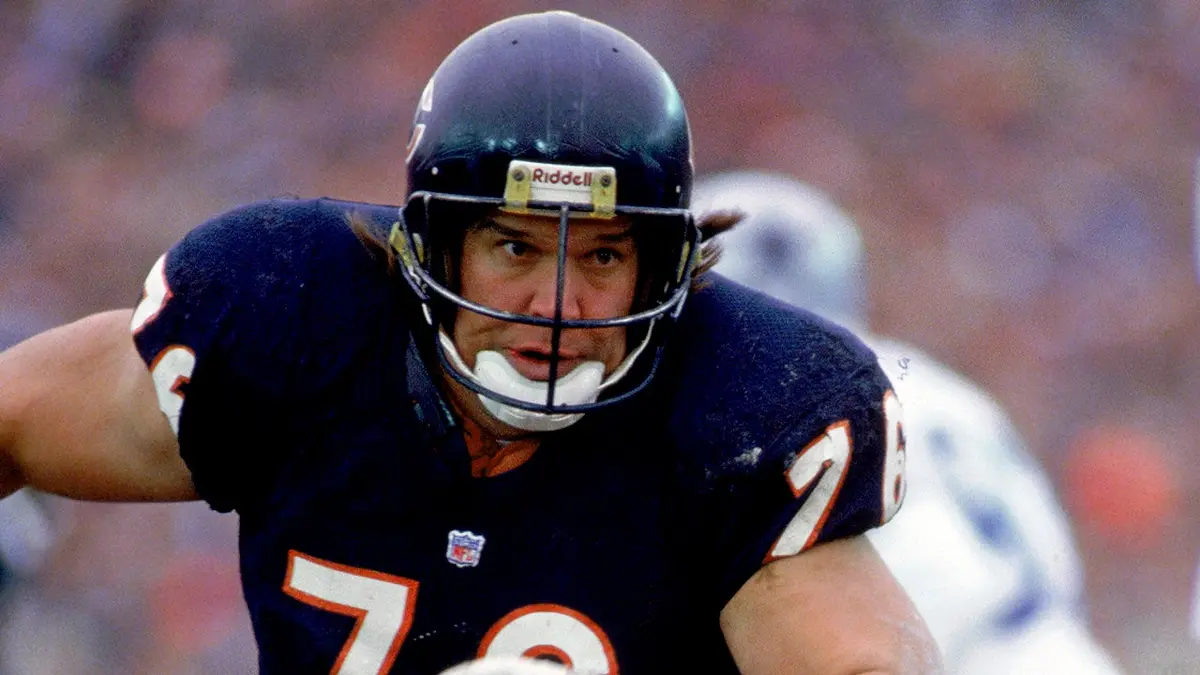
Steve McMichael never blamed the game that made him famous. New research, however, now suggests that over two decades of violent collisions left a devastating mark on his brain.
Boston University researchers posthumously diagnosed the Chicago Bears legend with chronic traumatic encephalopathy, or CTE. The Concussion & CTE Foundation confirmed McMichael reached stage 3 of the four-stage disease. Doctors can only confirm CTE after a patient dies.
McMichael’s Legacy on the Field
McMichael spent 13 of his 15 NFL seasons anchoring one of the most fearsome defensive lines in league history. He earned the nicknames “Mongo” and “Ming the Merciless” for his relentless style of play. Chicago recorded 92½ sacks with the Bears — second only to Richard Dent on the franchise’s all-time list. He also played a franchise-record 191 consecutive games from 1981 to 1993.
A two-time All-Pro, McMichael powered the dominant 1985 Chicago Bears defense that delivered a Super Bowl championship. That team remains one of the most iconic in NFL history. McMichael also had brief stints with the New England Patriots and Green Bay Packers before pursuing a career in professional wrestling.
The ALS-CTE Connection
McMichael publicly revealed his ALS diagnosis in 2021. He died in April 2025 at age 67, after a five-year battle with the disease. ALS destroys nerve cells in the brain and spinal cord. It gradually strips away a patient’s muscle control. McMichael lost the ability to speak in his final years.
Before his death, he pledged his brain to science. He wanted to advance research into the link between ALS and repetitive brain trauma. That decision is now producing meaningful results.
Dr. Ann McKee directs the Boston University CTE Center. She has spoken clearly about what the data shows. “There is strong evidence linking repetitive brain trauma and ALS,” McKee said. She also noted that roughly 6 percent of individuals in their brain bank with CTE also developed ALS. A 2021 Harvard and Boston University study found NFL players are more than four times as likely to develop ALS as men in the general population.
McMichael is not alone in this tragic overlap. Former NFL players Pete Duranko, Wally Hilgenberg, Eric Scoggins, running back Steve Smith, and Kevin Turner all died of ALS and later received CTE diagnoses as well.
A Family’s Mission
Misty McMichael, Steve’s wife of 25 years, released a statement through the foundation. She pointed to a pattern she believes demands urgent attention. Too many players develop ALS while alive and receive a CTE diagnosis only after death. She donated her husband’s brain specifically to push that research forward.
“I donated Steve’s brain to inspire new research into the link between them,” she said.
Steve McMichael, who died at the age of 67, had CTE, a study of his brain has revealed. pic.twitter.com/R3tcSyOBTu
— Bears History (@ChiBearsHistory) April 7, 2026
Chris Nowinski, co-founder and CEO of the Concussion & CTE Foundation, praised McMichael’s final contribution. He described the defensive tackle as someone whose last act gave something meaningful back to the sports community — a legacy far beyond sacks and Super Bowl rings.
From our field observation, McMichael’s case carries added significance because of the disease stage researchers confirmed. Stage 3 CTE reflects advanced progression, meaning cognitive and behavioral symptoms likely developed even if they stayed hidden from public view. McMichael reportedly showed few signs of dementia for much of his life. Still, his loss of verbal communication in his final years may reflect what stage 3 CTE can do to a patient.
A Broader Conversation Reopened
CTE is a degenerative brain disease that researchers have found in contact sport athletes, combat veterans, and others who experience repeated head trauma. It can trigger violent mood swings, depression, and impulsive behavior. Because doctors cannot diagnose it in living patients, many families only learn the truth after choosing to donate brain tissue for study.
McMichael’s former Bears teammate Dave Duerson also received a CTE diagnosis. Duerson died by suicide in 2011 after reportedly asking researchers to study his brain. Both men now receive recognition at the Concussion & CTE Foundation’s Race to End CTE event, scheduled for April 23 in Chicago.
Neither the Chicago Bears nor the NFL issued a public comment on the McMichael diagnosis at the time of reporting.
The Pro Football Hall of Fame inducted McMichael in 2024. His illness prevented him from attending the ceremony in Canton, Ohio. His wife accepted the honor on his behalf. That moment, in retrospect, carries even greater weight today.
