


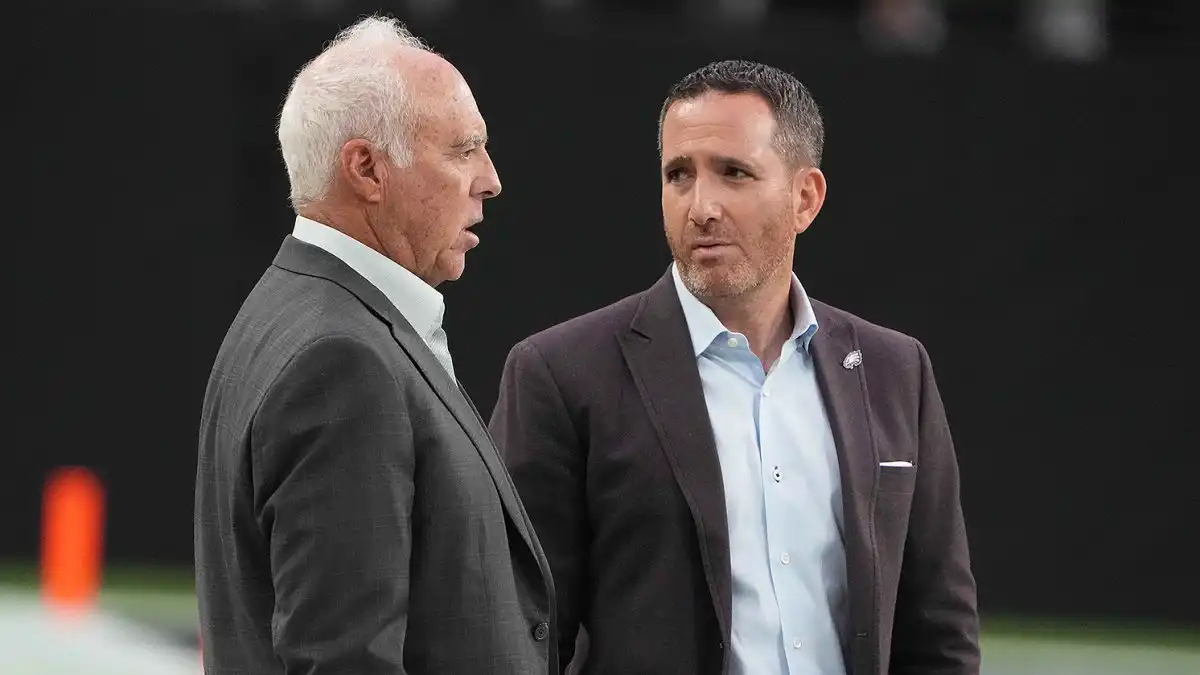
Philadelphia Eagles general manager Howie Roseman stayed calm and controlled at the 2026 NFL owners’ meetings in Phoenix. His answers were polished, not emotional. Reporters started with A.J. Brown and then moved to cap space, safety depth, and the QB3 question. Roseman did not waver. He kept returning to one idea. The Eagles’ vision matters more than any single storyline.
According to our field observation, the real question is not whether A.J. Brown will be traded soon. It is uncertain whether the front office will keep cap space open. Philadelphia wants high-upside signings. It also must manage the optics of a superstar’s uncertain future.
A.J. Brown is a member of the Eagles
At the owners’ meetings, almost every session returned to A.J. Brown. He is the Eagles’ All‑Pro receiver. He again topped 1,000 receiving yards in 2025. He played a key role in the team’s playoff run.
Roseman repeated a short script. He said, “A.J. Brown is a member of the Eagles.” Some fans see stability. Brown appears to be staying. The team keeps its top wideout. Others see a soft signal. The future is not as clear as the statement sounds.
The salary cap impact changes after June 1. That makes a potential trade easier or harder. Roseman insists that roster construction be built on a long‑term plan. One player’s situation does not rewrite the whole blueprint.
Smart, low‑risk additions reshape the secondary
The Eagles lost Jaelan Phillips to a $30 million‑per‑year deal in Carolina. He was a rising edge rusher who fit the defense well. Philadelphia now must rebuild the pass rush and secondary without blowing the cap.
The team turned to Riq Woolen, a former Pro Bowl cornerback. Woolen stands 6‑foot‑4 and weighs 210 pounds. He has blazing speed and recorded 12 interceptions in four seasons in Seattle.
Roseman called Woolen a “supremely talented player.” He added that Woolen must be more consistent in coverage. That explains why he hit the market. The Eagles agreed to a one‑year, $12 million deal. That fits the classic buy‑low, prove‑it move. If Woolen settles into the scheme, he can evolve into a starter‑level option at a low cost.
Tight end depth restored with Goedert and role players
For the second straight offseason, Dallas Goedert’s future seemed uncertain. This time, the Eagles brought him back. He signed a one‑year, $7 million contract.
Roseman wants the tight end room to feel balanced and complete. The team re‑signed Grant Calcaterra. It also added Johnny Mundt and Stone Smartt.
Mundt’s value is in his blocking. He can anchor at the line of scrimmage. He also fits the new offense under coordinator Sean Mannion. The Eagles now mix in-line blockers with move-line pieces at tight end. That improves both short‑zone and red‑zone schemes.
Safety room light but still molding
The Eagles let Reed Blankenship sign a three‑year, $24.75 million deal with the Houston Texans. That move surprised many fans. Blankenship was a starter, a captain, and a key part of two Super Bowl runs.
Roseman explained that the cap picture is tight. The Eagles must protect young, high‑priority players. That forces hard choices at older spots.
As a result, the safety room looks lighter heading into 2026. The franchise bets on second‑round pick Drew Mukuba. It also counts on Marcus Epps and Michael Carter II. Carter can play as a nickel corner or as a safety hybrid.
Roseman said the Eagles will keep adding at safety. That hints at another mid‑round pick or a low‑cost veteran later in the value‑style offseason.
Receiver room built around speed and fit
Outside the A.J. Brown story, the Eagles reshaped the receiver room. They signed Hollywood Brown and Elijah Moore. Both deals are one‑year contracts. Both players bring clear roles.
Roseman wants receivers with different sizes and skills. Hollywood Brown is a true vertical threat. He can separate at the top of his routes. Moore is more of a slot‑style creator. He has not yet matched his draft hype.
Still, the Eagles see upside. Roseman pushed back on the idea that Moore was signed because of his college bond with A.J. Brown. He said the move is about football fit. The team wants weapons that fit Jalen Hurts’ deep‑ball style and quick‑decision skill set.
QB3 and space flexibility
The Eagles’ decision to add Andy Dalton as the QB3 raised questions. Some thought it meant a potential McKee trade. Roseman dismissed that idea. He said the move is independent of McKee.
Philadelphia likes to keep three quarterbacks. One injury can change the whole picture. The front office wants to avoid being one injury away from disaster.
Dalton’s 2026 salary with the Eagles is only $1.5 million. That’s very low for a veteran who can start in a pinch. The trade involved a restructure. The previous team covered part of the bonus.
Because of those moves, the Eagles hold cap-space flexibility. Roseman stressed that the team is not saving room for one big move. It wants to stay agile. If a trade for A.J. Brown appears or another big‑name offer shows up, the Eagles can act quickly.
From our field observation, Roseman’s 2026 owners‑meetings session reflects the Eagles’ current identity. The franchise wants to be smart and steady. It mixes high‑upside, low‑cost signings with roster‑vision discipline. It also keeps cap space wide enough to chase the right moves later.
